
War Robots Players: Think Before You Spend a Single Dollar
If you play War Robots, there is something you need to consider before spending any money on the game.
Not just before making another large purchase.
Not just before upgrading an expensive Titan.
Not just before buying the newest robot or weapon.
Before spending ANY money.
The warning is simple: equipment you purchase or upgrade today can become practically useless within a matter of weeks.
And this is not some newly discovered problem.
This is the business model War Robots players have been dealing with for years.
Players are encouraged to obtain powerful equipment, invest resources into upgrading it, and build competitive hangars around it.
Then the competitive environment changes.
New equipment arrives. Balance adjustments alter existing equipment. Previously powerful setups become less effective.
And players are encouraged to start spending all over again.
The cycle continues, with the cost falling on the people who play the game.
This Is Not New — It Is the Business Model
War Robots has operated for years with a monetization structure built around acquiring, developing, and upgrading equipment.
The game continually introduces new robots, weapons, Titans, and other systems that can change what players need to remain competitive.
Players who want to keep up are presented with opportunities to purchase resources, equipment, and upgrades.
But there is a fundamental problem with spending money in an environment where the developer controls the competitive value of everything being purchased.
The company can change the value of your investment without changing what you originally paid for it.
A robot that dominates battles today can become substantially weaker following balance changes.
A weapon that players invest heavily in upgrading can lose its competitive advantage.
A powerful combination can become outdated when newer equipment enters the game.
The equipment may still exist in your account, but that does not mean it retains the performance that made you want to purchase it.
This recurring relationship between equipment releases, upgrades, balance changes, and replacement spending is central to the criticism of War Robots' monetization model.
Players are not simply purchasing equipment. They are purchasing equipment whose competitive usefulness remains under the developer's control.
And that distinction matters.
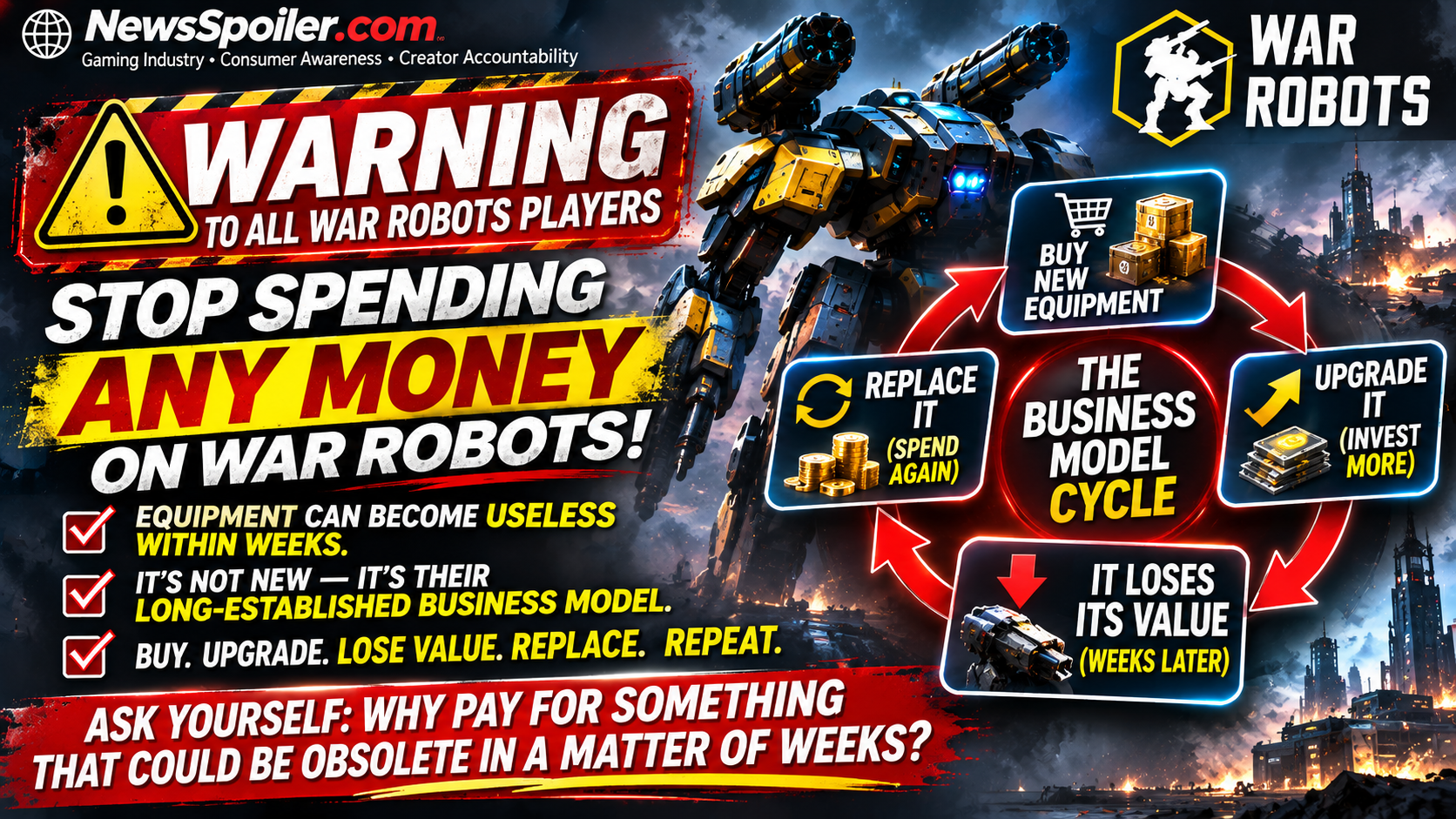
The Cycle: Buy It, Upgrade It, Replace It
Consider how the process works.
A new robot or weapon enters the game.
It attracts attention because of its capabilities.
Players see it performing well in battles, often through videos, livestreams, and demonstrations.
Some players purchase it immediately.
Others spend money acquiring the resources necessary to upgrade it.
Once upgraded, the equipment becomes part of their competitive hangar.
Then the environment changes.
A balance adjustment reduces its effectiveness, or a newer release offers advantages that the previous equipment cannot easily match.
Players who invested in the older equipment now face the prospect of replacing it.
And replacing equipment frequently means acquiring and upgrading something else.
Buy. Upgrade. Lose competitive value. Replace. Repeat.
This is the spending cycle that players should recognize before opening their wallets.
It does not require every piece of equipment to become completely unusable.
It only requires previously purchased equipment to become sufficiently less competitive that players feel pressure to obtain something newer.
That pressure creates opportunities for repeated spending.
The player bears the financial cost of keeping up with changes the developer controls.
Your Equipment Can Lose Its Value in Weeks
One of the biggest problems with spending money on War Robots is the uncertainty surrounding how long equipment will remain competitively effective.
A player can purchase equipment based on its current performance, only to encounter changes that substantially reduce its usefulness.
This can happen through direct adjustments to equipment statistics.
It can also happen indirectly when new equipment changes the competitive environment.
A robot does not necessarily need to receive a direct nerf to become less useful.
It can simply become outclassed.
The same applies to weapons, Titans, drones, and other upgrade systems.
An item can remain fully functional while becoming a poor competitive investment.
For players spending real money, that distinction offers little comfort.
They paid for equipment because of what it could do.
When that equipment can no longer deliver comparable results, the value of the purchase has changed.
And when this happens within weeks of purchasing or upgrading something, players have every reason to question whether the expense was worthwhile.
Stop Treating Temporary Power Like a Permanent Investment
A major part of the problem is how players evaluate purchases.
When a new weapon performs exceptionally well, it is easy to focus on what that weapon can accomplish today.
When a robot appears dominant, players may assume it is worth developing immediately.
But purchasing equipment based entirely on its current strength ignores the larger reality of the game.
You do not control how long that equipment will remain powerful.
Pixonic does.
The developer controls balance adjustments, equipment statistics, new releases, and many of the systems that determine competitive performance.
That means players can spend substantial amounts developing equipment without having any guarantee that its competitive value will last.
A discounted purchase is not necessarily a good deal.
A limited-time offer is not necessarily an opportunity.
And a powerful new release is not necessarily worth buying.
If the equipment loses its usefulness shortly after you purchase it, the discount did not protect your money.
The Upgrade System Makes the Problem Worse
Purchasing equipment is only part of the financial equation.
War Robots also encourages players to upgrade their equipment.
Depending on the system involved, upgrades can require considerable resources, time, and potentially real-money spending.
A player may obtain a robot relatively cheaply but still face substantial costs to make it competitive.
Weapons require development.
Titans and their equipment require resources.
Other supporting systems can add further expenses.
By the time a player finishes building a competitive setup, the total investment may be much greater than the original purchase.
And that entire setup remains vulnerable to changes in the game's competitive environment.
The more a player invests in a particular setup, the greater the potential loss of competitive value when that setup becomes outdated.
This is why the warning applies to all spending.
Not just expensive purchases.
Not just newly released equipment.
Any money spent on equipment or upgrades is money committed to a system where the developer controls the item's future effectiveness.
Content Creators and Mentors Need to Stop Selling the Illusion
War Robots content creators and mentors also have a responsibility to the players who follow their advice.
When a creator demonstrates a powerful robot or weapon, viewers may be encouraged to purchase or upgrade that equipment.
Some creators receive early access, promotional opportunities, or other benefits through their relationships with the game.
That makes transparency especially important.
Players need to understand the difference between watching someone demonstrate powerful equipment and receiving sound purchasing advice.
A creator showing a fully upgraded robot dominating battles is not necessarily showing viewers what they can realistically expect from their own investment.
The demonstration may not reflect the resources required to build that setup.
It may not reflect how the equipment performs at lower upgrade levels.
And it cannot guarantee that the equipment will retain its competitive value after future changes.
A mentor who encourages players to spend money without discussing the risks of equipment becoming outdated is not giving them the complete picture.
Real mentorship should help players make informed decisions.
It should explain the costs, limitations, and potential consequences of investing in equipment.
It should not simply encourage players to chase the next powerful release.
And it should never treat a player's money as an unlimited resource.
Players Should Question the Entire Spending Model
The issue is larger than any single robot, weapon, or balance adjustment.
It concerns the relationship between monetization and competitive progression.
When new equipment repeatedly changes the competitive environment, players who want to remain competitive may feel pressure to continue investing.
That creates a recurring spending opportunity for the company.
The concern is whether the system provides lasting value to players or continually encourages them to replace purchases that have lost their effectiveness.
A business model that repeatedly benefits from equipment turnover deserves scrutiny from the customers paying for that turnover.
Players should ask whether the money they spend produces lasting enjoyment or simply buys a temporary competitive advantage.
They should also consider whether their ability to compete is increasingly tied to keeping up with the latest releases.
If maintaining a competitive hangar requires continually replacing previously purchased equipment, then spending money becomes an ongoing expense rather than a one-time investment.
And that is precisely why players should question whether spending anything is worthwhile.
The Difference Between Enjoying a Game and Financing Its Upgrade Cycle
There is nothing wrong with enjoying War Robots.
Players can enjoy the battles, the robots, the strategy, and the community without agreeing with every aspect of the game's monetization.
But enjoying a game does not require spending money on it.
Players should distinguish between entertainment and the pressure to remain competitive through purchases.
A game can be enjoyable without every new weapon.
A player can participate without purchasing every new robot.
And refusing to spend money does not mean abandoning the community.
You can enjoy War Robots without financially supporting a spending cycle you believe provides poor value.
That is a decision every player has the right to make.
The important point is that players should make that decision with a clear understanding of the risks.
What Pixonic Should Be Answering
Pixonic controls the systems that determine how equipment performs.
That gives the developer substantial influence over the competitive value of purchases.
Players deserve meaningful answers about how that control is exercised.
How long should players reasonably expect expensive equipment to remain competitively useful?
Why should players invest in upgrades when subsequent changes can substantially reduce their effectiveness?
How does Pixonic balance the need for new content against the value of equipment players have already purchased?
And what protections, if any, exist for players who spend money shortly before major changes affect their equipment?
These questions are especially important in a game where acquiring and upgrading equipment can involve substantial financial commitments.
Players should not be expected to continually finance equipment replacement without questioning whether the system is delivering reasonable value.
The Warning Is About ANY Money — Not Just More Money
This distinction is important.
The warning is not simply directed at players who have already spent hundreds or thousands of dollars.
It applies equally to someone considering their very first purchase.
A player spending five dollars is still spending real money.
A player purchasing a discounted upgrade is still investing in equipment whose competitive value can change.
A new player buying a starter package is entering the same system as someone who has been playing for years.
The amount of money does not change how the business model works.
Whether the purchase costs a few dollars or considerably more, the player is paying for something whose future competitive effectiveness is not guaranteed.
That is why the warning is not to spend less.
It is to seriously question spending any money at all.
Final Warning: War Robots Players, Keep Your Money
War Robots players have experienced years of new equipment releases, upgrades, balance adjustments, and changes in competitive performance.
This is not a sudden development.
It is a long-established pattern within the game's monetization and progression systems.
The concern is that players can invest money in equipment only to discover that its competitive value has deteriorated within weeks.
And when that happens, the player faces another decision about whether to spend money replacing it.
The cycle benefits from repeated purchases. The player pays for every round.
Before buying another robot, upgrading another weapon, purchasing another Titan, or spending money on resources, consider whether the purchase is genuinely worth the risk.
Do not assume that today's powerful equipment will remain powerful.
Do not assume that an expensive upgrade guarantees lasting competitive value.
Do not assume that a limited-time offer represents a worthwhile investment.
And do not assume that someone promoting equipment is necessarily protecting your financial interests.
WAR ROBOTS PLAYERS: THINK BEFORE YOU SPEND A SINGLE DOLLAR.
This is not a new problem. This is the business model players have been dealing with for years.
You do not have to finance the next round of equipment releases.
You do not have to pay to replace something that has lost its competitive value.
And you do not have to keep spending money simply because the game continues introducing new equipment.
Your money belongs to you.
Your time belongs to you.
And neither should be treated as disposable.
The next time War Robots presents you with something to purchase or upgrade, ask yourself one final question:
WHY SHOULD I PAY FOR SOMETHING THAT COULD BECOME USELESS IN A MATTER OF WEEKS?