
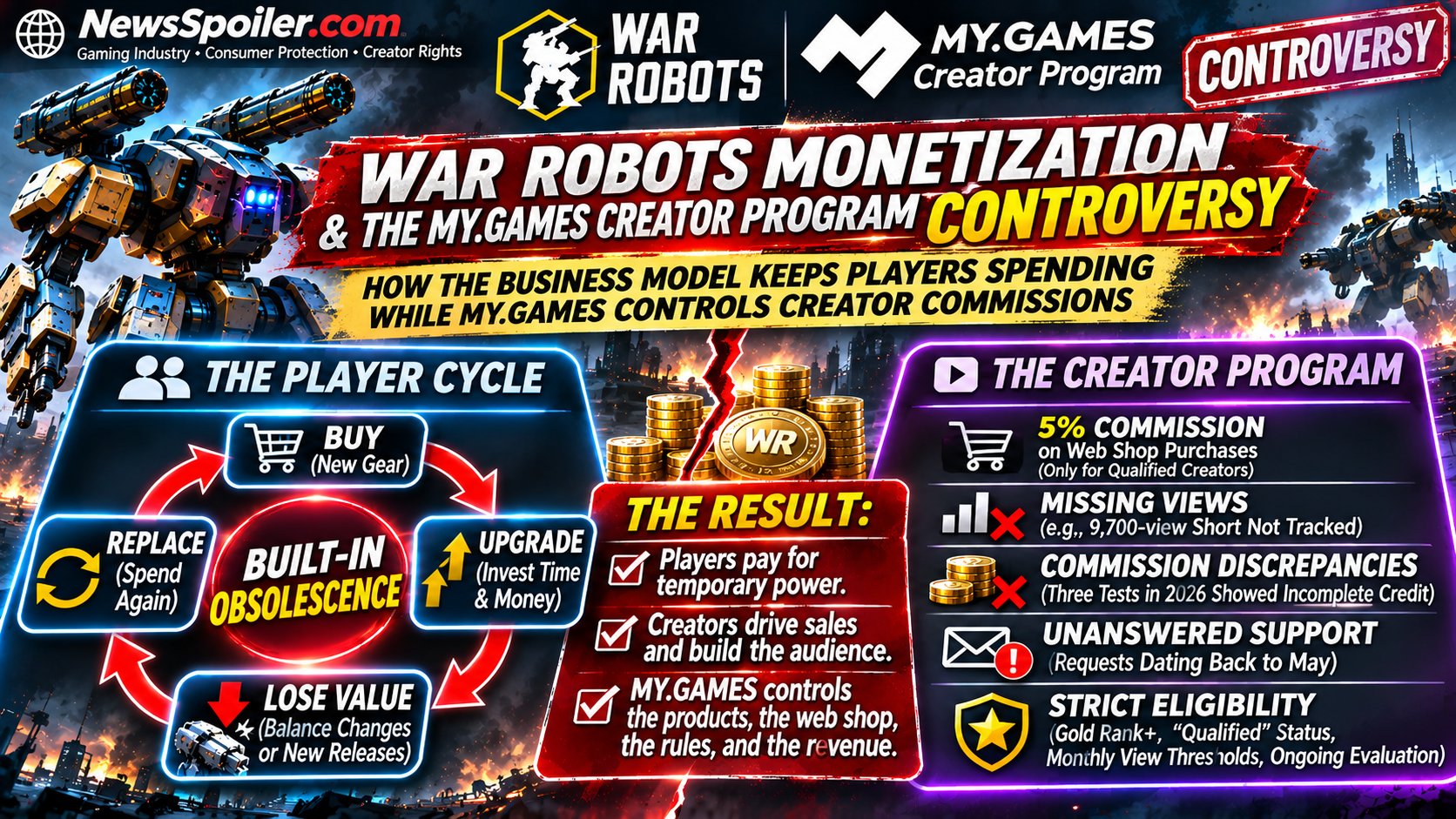
Two Sides of the Same Business Model
There are two groups that deserve a closer look at how War Robots makes money.
The first is the players.
They purchase robots, weapons, Titans, drones, pilots, modules, and upgrades, often investing substantial time and money into building competitive hangars.
The second is the creators.
They produce videos, livestream gameplay, organize events, build communities, promote new equipment, and encourage audiences to remain involved with the game.
Both groups contribute to the financial success of War Robots.
But both also operate inside systems controlled by Pixonic and MY.GAMES.
For players, the developer controls the competitive effectiveness of the equipment they purchase.
For creators, the publisher controls the official web shop, commission tracking, eligibility requirements, and access to revenue-sharing opportunities.
The result is a monetization ecosystem where the company controls the products, the storefront, the rules, and the distribution of rewards.
And that raises a fundamental question:
Are the people creating the value receiving a fair return, or are they being encouraged to continually invest in a system where the company maintains nearly all the control?
PART ONE: THE PLAYER SPENDING CYCLE
Buy It. Upgrade It. Watch It Lose Value. Replace It.
War Robots players have been dealing with this pattern for years.
A new robot or weapon enters the game.
It performs exceptionally well.
Players see demonstrations, promotional content, and gameplay videos showing what the equipment can accomplish.
Some purchase it immediately.
Others invest resources into obtaining and upgrading it.
But the competitive value of that equipment is not permanent.
Balance adjustments can reduce its effectiveness.
New releases can introduce stronger alternatives.
Changes to game mechanics can make previously effective combinations less competitive.
And players who invested in the older equipment may feel pressured to purchase and upgrade replacements.
Buy. Upgrade. Lose competitive value. Replace. Repeat.
This is not a newly discovered problem.
It is a recurring feature of the War Robots progression and monetization model.
The Developer Controls the Value of Your Purchase
Unlike purchasing a physical product whose basic capabilities remain under your control, purchasing equipment in War Robots means paying for something that operates entirely within a developer-controlled environment.
Pixonic determines equipment statistics.
Pixonic determines balance adjustments.
Pixonic determines when new equipment enters the game.
And Pixonic determines the gameplay systems that influence whether existing equipment remains competitive.
A player can spend money on equipment today and find that its effectiveness has changed substantially weeks or months later.
The equipment may still exist in the player's account.
But ownership does not guarantee continued competitive usefulness.
The player pays for the equipment. The developer controls how valuable that equipment remains in battle.
That is the central concern.
No Amount of Spending Is Protected
The problem does not begin only when someone spends hundreds of dollars.
A player spending five dollars enters the same system.
A player purchasing a discounted bundle faces the same uncertainty.
A player upgrading a single weapon is still investing resources into equipment whose future effectiveness is outside their control.
And a player building an entire premium hangar faces an even larger potential loss of competitive value.
There is no spending tier that guarantees protection against future balance changes or equipment becoming outdated.
That is why players should question spending any money on War Robots.
Not simply whether they should spend less.
Not whether they should wait for a better discount.
Whether they should spend anything at all.
PART TWO: THE WEB SHOP AND THE MONEY BEHIND IT
Why MY.GAMES Wants Players Purchasing Directly
The official War Robots Web Shop is another important part of the monetization structure.
Traditionally, purchases made through mobile app stores can involve platform commissions charged by Apple or Google.
Those commissions can reach 30%, although actual rates vary depending on the transaction and applicable programs.
Direct web purchases allow publishers to avoid some of those app-store fees.
That creates a financial incentive for MY.GAMES to encourage players to purchase through its own storefront.
Players may receive discounts, cashback, or other incentives for using the web shop.
But the company also benefits.
Moving a purchase from an app store to a company-controlled web shop can increase the portion of the transaction retained by the publisher.
The important question is how that additional revenue is distributed.
And that brings us to the creator program.
The 5% Creator Commission
According to the creator-program structure described in the materials reviewed for this article, qualifying MY.GAMES creators can receive a 5% commission when players use their creator codes for eligible purchases through the official web shop.
That commission is intended to recognize the promotional contribution of participating creators.
Creators introduce players to the game.
They showcase equipment.
They explain features.
They produce content that keeps audiences engaged.
And their recommendations can influence purchasing decisions.
A creator code provides a mechanism for attributing eligible purchases to that promotional work.
But the creator does not control the storefront.
The creator does not independently process the transaction.
And the creator does not control the system that determines whether a commission is recorded.
MY.GAMES controls the transaction infrastructure and the rules governing commission eligibility.
That places considerable responsibility on the company to maintain accurate reporting and transparent accounting.
PART THREE: WHAT HAPPENS WHEN A CREATOR LOSES QUALIFICATION?
The Company Controls Access to the Revenue Share
The supplied account of the MY.GAMES Creator Program describes eligibility requirements involving creator rank, Qualified status, monthly performance thresholds, and compliance with program rules.
It specifically identifies Gold rank or higher and Qualified status as conditions associated with receiving the 5% revenue share.
Under such a structure, creators can lose access to commissions if they fail to maintain the required standing.
That creates a significant dependency.
A creator may spend years developing an audience around War Robots.
They may produce hundreds of videos.
They may introduce substantial numbers of players to the game.
Yet their ability to earn commissions remains dependent on continued qualification under rules administered by MY.GAMES.
The creator builds the audience. The company controls whether the creator remains eligible to receive a commission.
This raises questions about the balance of power between creators and the publisher.
Who Keeps the 5% When a Creator Is Excluded?
Consider what happens when a creator loses Qualified status or access to a creator code.
Players can still purchase equipment through the official web shop.
MY.GAMES can still process those purchases.
The game can still benefit from the audience and community engagement that creators have helped build.
But the excluded creator may no longer receive commissions on those purchases.
If a previously commissionable purchase occurs without a qualifying creator attribution, the 5% creator payment may no longer be owed.
The financial consequence depends on the program's actual terms, transaction processing, and attribution rules.
Nevertheless, the economic question is important.
When a creator loses access to revenue sharing, does the publisher retain the amount that otherwise would have been paid to that creator?
Is that amount redistributed?
Is it used to fund other creator benefits?
Or does it simply remain part of the publisher's revenue?
MY.GAMES should explain what happens to the creator commission when no eligible creator receives it.
Players using the official web shop deserve to understand how their purchases support the creators they follow.
Creators deserve to understand how their commissions are calculated and when they can be lost.
PART FOUR: THE CREATOR REPORTING DISCREPANCIES
A 9,700-View War Robots Short Missing From the Dashboard
SpiderTaz has reported a significant discrepancy involving the MY.GAMES Creator Program's video tracking.
A War Robots Short with approximately 9,700 views was reportedly absent from the creator dashboard.
Meanwhile, an unrelated livestream about WRUnity.org Web Education appeared among the recognized content.
The educational livestream focused on independent creator mentorship, website ownership, and digital entrepreneurship.
It was not a War Robots gameplay broadcast.
That creates an obvious question about how the tracking system determines which content qualifies.
Why would an unrelated educational livestream be recognized while a War Robots Short with thousands of views was missing?
The answer should be available through the program's content recognition rules, reporting periods, and eligibility records.
If the Short was excluded for a legitimate reason, the reason should be identified.
If the system misclassified the videos, the records should be corrected.
The creator should not have to guess.
Three Commission Tests During 2026
SpiderTaz has also reported conducting three separate commission tests during 2026.
According to his account, each test produced discrepancies in which only some of the expected commissions were credited.
These were tests intended to examine the program's commission tracking.
Three separate tests reportedly produced incomplete commission crediting.
That raises questions about whether qualifying transactions are consistently attributed and whether commissions are calculated correctly.
A reliable system should be able to reconcile identifiable purchases against the applicable commission rate and resulting credit.
If a transaction does not qualify, the creator should receive an explanation.
If a commission is pending, its status should be visible.
If a transaction was missed, the accounting should be corrected.
The purpose of commission tracking is to ensure creators receive the amounts they are entitled to under the program.
A system that cannot be independently reconciled leaves creators dependent on figures they cannot adequately verify.
Support Requests Dating Back to May
SpiderTaz states that support requests concerning commission discrepancies were submitted beginning in May 2026.
As of November 15, 2026, he reports receiving no substantive response addressing those concerns.
That represents approximately six months of unanswered requests involving creator compensation.
Six months is far too long to leave financial accounting questions unresolved.
The issue is not simply whether a creator is satisfied with the program.
It is whether the company can provide a documented explanation of the transactions, commission calculations, and eligibility decisions involved.
A creator reporting potential underpayment should have access to a meaningful investigation process.
And a company operating a commission-based program should be able to account for the money.
PART FIVE: THE CREATOR'S CONFLICT OF INTEREST
Promote the Equipment or Warn the Players?
War Robots creators occupy a difficult position.
Their audiences often want to know which equipment performs best.
That creates demand for demonstrations of powerful robots, weapons, and Titans.
But demonstrating the strongest equipment can also encourage viewers to purchase it.
If the equipment subsequently loses competitive value, the viewer bears the financial consequences.
The creator may have received promotional benefits, early access, or commissions associated with the recommendation.
This does not mean every creator is misleading their audience.
But it does create a potential conflict between promoting purchases and protecting viewers from poor spending decisions.
A creator's financial incentive to generate purchases should never replace their responsibility to provide accurate information.
A genuine mentor should explain upgrade costs, balance risks, and the possibility of equipment becoming outdated.
They should help players understand the full financial consequences of building a competitive hangar.
And they should not present temporary competitive strength as a guarantee of lasting value.
What Happens When Creators Criticize the System?
The materials reviewed for this article also describe disputes involving prominent War Robots creators, including Manni Gaming and AD Gaming, over criticism of monetization, game balance, and creator-program decisions.
These disputes raise broader questions about how publishers handle creators who publicly challenge their business practices.
A creator program should have clear rules.
But those rules should also be applied consistently and transparently.
Creators should understand what conduct can result in loss of program benefits.
They should have access to a meaningful review process.
And criticism of a game's monetization should not automatically be treated as misconduct.
A creator program should reward legitimate contributions without requiring creators to surrender their independent judgment.
When financial opportunities depend on remaining in good standing with the company being reviewed, creators may face pressure to avoid difficult subjects.
That is why independence matters.
PART SIX: THE PLAYER AND CREATOR ARE BOTH DEPENDENT ON THE SAME COMPANY
The most important connection between these issues is the concentration of control.
Pixonic determines the competitive value of equipment.
MY.GAMES operates the purchasing infrastructure.
The creator program determines who qualifies for commissions.
The reporting system determines which views and transactions are recognized.
And the company administers the processes through which creators seek explanations or corrections.
Players depend on the company for the value of their purchases. Creators depend on the company for the recognition and compensation of their promotional work.
Both groups are exposed to decisions they cannot independently control.
For players, those decisions can change the usefulness of equipment they purchased.
For creators, those decisions can change access to commissions and other program benefits.
The financial incentives are not identical, but the underlying dependency is similar.
The company establishes the rules.
The company can change the rules.
And the people participating in the system must respond to those changes.
PART SEVEN: WHAT PLAYERS SHOULD DO
War Robots players should consider the entire monetization structure before spending money.
Do not evaluate a purchase solely by how powerful the equipment appears today.
Consider the cost of upgrading it.
Consider how frequently the competitive environment changes.
Consider whether you would still be satisfied with the purchase if the equipment became substantially less effective within weeks.
And consider whether repeatedly replacing equipment is a spending pattern you want to support.
You do not have to spend money to remain part of the War Robots community.
Players can continue participating, discussing strategy, creating content, and enjoying the game without purchasing every new release.
The warning is not simply to avoid expensive equipment.
It is to question the value of spending any money in a system where competitive usefulness can change so quickly.
Your money is yours. The decision to spend it should be based on your interests, not pressure created by the next equipment release.
PART EIGHT: WHAT CREATORS SHOULD DEMAND
Creators participating in the MY.GAMES Creator Program should expect transparent and verifiable reporting.
That includes clear documentation of eligibility requirements, video tracking rules, transaction attribution, commission rates, payment schedules, and dispute procedures.
Creators should be able to identify which transactions generated commissions.
They should be able to reconcile credited amounts against qualifying purchases.
They should receive explanations when content is excluded.
And they should receive timely responses when they report discrepancies.
No creator should have to rely on blind trust when their compensation is involved.
The company operating the program should be capable of producing a clear accounting.
PART NINE: QUESTIONS MY.GAMES AND PIXONIC SHOULD ANSWER
The combined concerns surrounding War Robots monetization and creator compensation raise several important questions.
- Why should players continue investing in equipment whose competitive effectiveness can decline rapidly after purchase?
- How does Pixonic account for the value of player investments when balancing existing equipment against new releases?
- How much additional transaction revenue does MY.GAMES retain by directing purchases through its official web shop rather than mobile app stores?
- What happens to the 5% creator commission when a purchase is not attributed to an eligible creator?
- What exact requirements determine whether creators qualify for revenue sharing?
- How are creator video views and qualifying transactions identified and tracked?
- Why was SpiderTaz's 9,700-view War Robots Short reportedly absent from the dashboard while unrelated educational content was included?
- Why did three reported commission tests produce discrepancies?
- Why have support requests dating back to May reportedly remained unanswered?
- What independent verification or audit process is available when creators dispute commission calculations?
These questions concern financial transparency, consumer value, and the treatment of people who contribute to the game's success.
They deserve direct answers.
Final Word: The Players Pay, the Creators Promote, and MY.GAMES Controls the System
War Robots has developed a monetization environment built around repeated equipment acquisition and upgrades.
Players invest money in equipment whose competitive value can change as the game evolves.
Creators promote that equipment, attract audiences, and help sustain community engagement.
MY.GAMES operates the official purchasing infrastructure and controls the conditions under which qualifying creators receive a share of eligible purchases.
The publisher's control over both sides of the relationship is what makes these concerns significant.
The players finance the equipment cycle.
The creators help generate interest and purchasing activity.
And MY.GAMES controls the rules governing both the purchases and the commissions.
When players question the lasting value of their purchases, they deserve meaningful answers.
When creators report missing views or incomplete commissions, they deserve accurate accounting.
And when support requests involving compensation remain unanswered for months, the company should be expected to address them.
This is not simply about one robot, one weapon, one creator, or one missing video.
It is about whether the people who provide the money, labor, audiences, and community engagement are receiving fair treatment within the business model.
War Robots players should think carefully before spending a single dollar.
Creators should think carefully before making their businesses dependent on a commission system they cannot independently verify.
And MY.GAMES and Pixonic should recognize that trust cannot be maintained through promotional promises alone.
It requires transparency, consistent rules, accurate reporting, and accountability.
Players deserve lasting value.
Creators deserve accurate compensation.
And both deserve to know where the money goes.
NewsSpoiler.com — Independent Gaming News, Consumer Awareness, and Creator Accountability