
Another Reporting Discrepancy Raises Serious Questions
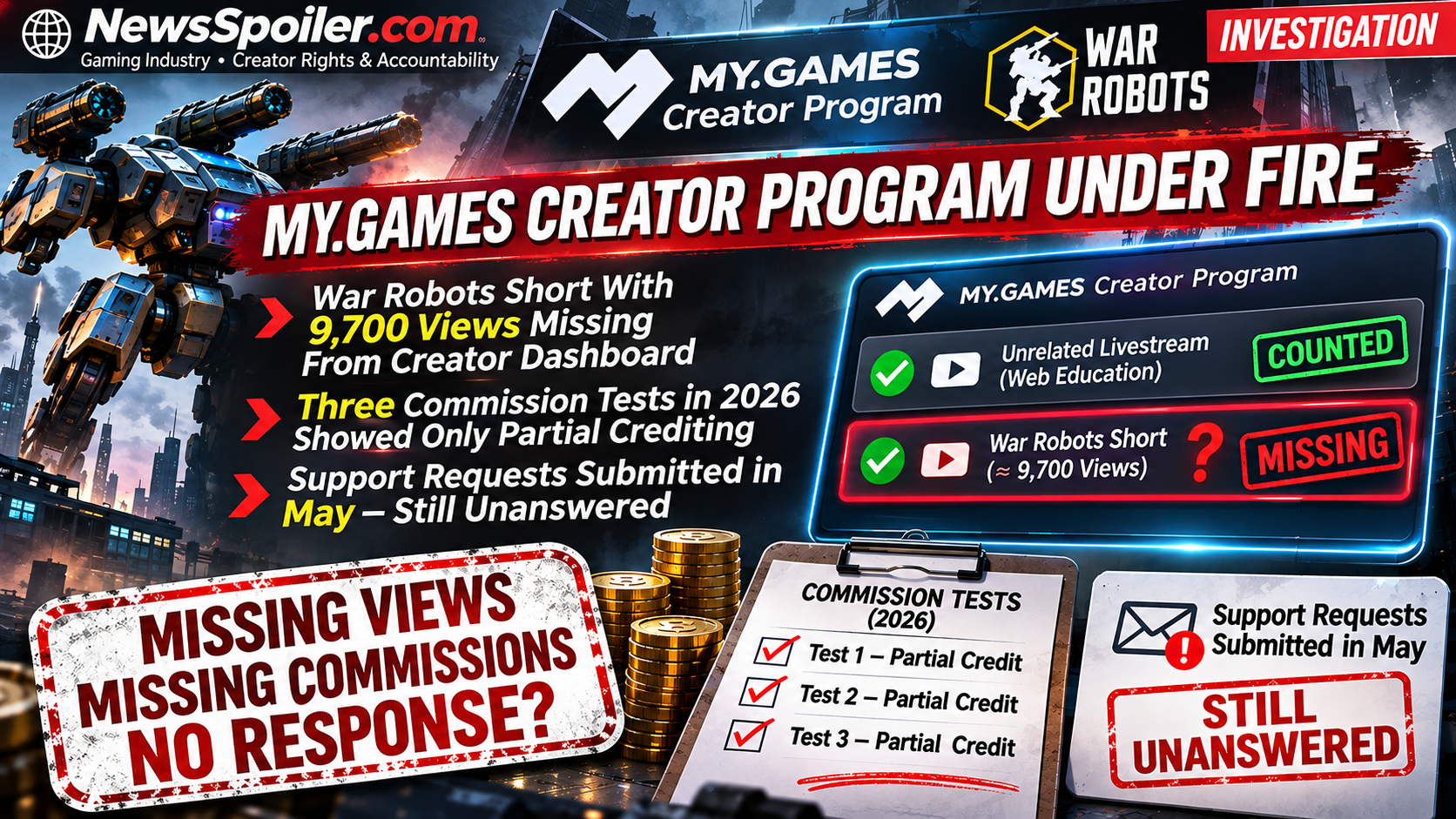
How does a creator program designed to recognize and reward War Robots content overlook a War Robots Short with 9,700 views while including a livestream that has absolutely nothing to do with the game?
That is the latest question facing MY.GAMES and Pixonic following another discrepancy identified by SpiderTaz in the MY.GAMES Creator Program dashboard.
According to screenshots supplied by SpiderTaz, the current reporting period displays just five videos totaling 745 views.
Yet a War Robots Short with approximately 9,700 views is missing from the reported content.
Meanwhile, the dashboard includes a livestream titled "Creator Talk Presents WRUnity.org Web Education LIVE."
That livestream focuses on independent creator education, website ownership, digital entrepreneurship, and the importance of mentorship that benefits creators rather than primarily serving corporate interests.
It is not War Robots gameplay.
It is not a Pixonic promotional video.
It is not even a discussion about MY.GAMES products.
Yet the system recognizes that unrelated livestream while failing to display a War Robots Short that has generated 9,700 views.
This is not simply a disagreement over numbers.
It raises fundamental questions about how the creator program identifies content, measures performance, and determines which creator contributions qualify for recognition.
And when combined with previously reported commission discrepancies and unanswered support requests, the situation becomes considerably more serious.
The Numbers Do Not Add Up Without an Explanation
The dashboard information supplied by SpiderTaz shows:
- Current reporting period: 5 videos and 745 views.
- Previous reporting period: 17 videos and 772 views.
- Channel subscriber growth: Approximately 19,100 to 22,100 subscribers.
- Missing War Robots Short: Approximately 9,700 views.
- Included unrelated content: WRUnity.org Web Education livestream.
The missing Short alone has approximately 13 times the views shown for all five videos in the current reporting period combined.
That represents a difference of 8,955 views between the Short's reported total and the dashboard's combined current-period figure.
These numbers require context. The Short's 9,700 views may include activity outside the dashboard's reporting window, and specific eligibility rules may apply.
However, the inclusion of unrelated content creates an additional question that cannot be answered simply by pointing to reporting periods.
Why is the system recognizing a livestream unrelated to War Robots while apparently overlooking a video specifically about War Robots?
If the Short does not qualify, MY.GAMES should explain why.
If the livestream qualifies under broader program rules, those rules should be identified.
If the system has incorrectly classified either video, the error should be investigated and corrected.
Creators should not be expected to guess how the reporting system works.
Three Commission Tests in 2026 — And Only Some Commissions Were Credited
The missing video is not the first reporting problem SpiderTaz says he has encountered.
According to SpiderTaz, three separate commission tests conducted during 2026 produced discrepancies in which only some of the expected commissions were credited.
These tests were conducted to examine whether the MY.GAMES Creator Program was properly tracking qualifying activity and accounting for commissions.
SpiderTaz reports that each test produced results that did not match the commissions he expected to receive.
Three separate tests. Three reported discrepancies. And still no satisfactory accounting.
This raises an issue that goes beyond missing video statistics.
When a creator program offers commission-based compensation, creators must be able to trust that qualifying transactions are accurately attributed, calculated, and credited.
A creator should be able to determine what activity generated a commission, which rate applied, when the commission was credited, and whether the amount was paid.
If some qualifying transactions are missing from the accounting, the financial consequences could be significant.
The three reported tests have not been independently audited for this article, and the precise amounts involved have not been established here. The discrepancies therefore do not, by themselves, prove that commissions were improperly withheld.
Nevertheless, repeated reports of incomplete crediting warrant a transaction-level investigation.
If a company cannot clearly account for commissions associated with identifiable transactions, how can creators independently verify that they are receiving everything they have earned?
That question deserves a documented answer.
Support Requests Submitted in May — Still Waiting for Answers in November
Perhaps even more concerning than the reported commission discrepancies is the lack of communication SpiderTaz says he has experienced.
According to SpiderTaz, support requests concerning commission reporting were submitted beginning in May 2026.
As of November 15, 2026, he reports that those requests remain unanswered.
That represents approximately six months without a substantive response to concerns involving creator compensation.
Six months is an extraordinary amount of time for a creator to wait for an explanation about potentially missing commissions.
Creators invest their own time, resources, equipment, and labor into promoting games and building audiences.
When a creator identifies a potential financial discrepancy, a responsible program should provide a meaningful process for investigating it.
That process should include reviewing the relevant transactions, explaining any exclusions, identifying applicable commission rules, and correcting confirmed errors.
Silence does not resolve an accounting discrepancy.
It does not establish that the calculations were accurate.
And it does nothing to build confidence in the program.
A creator should not have to spend half a year requesting an explanation about money they believe they earned.
MY.GAMES should be able to determine the status of the requests submitted since May, identify whether they were investigated, and provide a substantive response.
Missing Views and Missing Commissions: Two Different Problems, One Accountability Question
The latest video tracking discrepancy and the previously reported commission problems concern different parts of the creator program.
One involves content recognition and performance statistics.
The other involves financial attribution and commission accounting.
They should not automatically be assumed to share the same technical cause.
However, both raise a common question:
Can creators independently verify that MY.GAMES is accurately recognizing their contributions and calculating the benefits they are entitled to receive?
The missing 9,700-view Short raises questions about how content is identified and counted.
The three commission tests raise questions about how qualifying transactions are recognized and credited.
The unanswered support requests raise questions about how reported problems are handled.
Together, these concerns justify a comprehensive review of SpiderTaz's creator account.
That review should include the affected video records, reporting windows, eligibility rules, commission transactions, applicable rates, credited amounts, and support correspondence.
If the records establish that the program operated correctly, MY.GAMES should explain the calculations and eligibility decisions.
If errors are identified, they should be corrected.
What should not happen is for documented concerns to remain unresolved indefinitely.
The Irony: A Livestream About Independent Mentorship Gets Counted
One of the most remarkable details in this situation is the subject of the unrelated livestream appearing in the MY.GAMES dashboard.
SpiderTaz recently hosted "Creator Talk Presents WRUnity.org Web Education LIVE," a discussion focused on the importance of independent creator education and genuine mentorship.
The broadcast challenged the idea that mentorship should primarily benefit a company, its investors, or the individuals administering a creator program.
Instead, the discussion promoted teaching creators how to establish their own websites, build their own brands, develop independent revenue opportunities, and understand the systems influencing their businesses.
The message was straightforward:
Real mentorship should help creators become independent, not make them permanently dependent on the people or companies mentoring them.
And now that very livestream appears in the MY.GAMES Creator Program dashboard.
Meanwhile, a War Robots Short with 9,700 views does not.
The irony is difficult to miss.
A livestream discussing why creators should understand and question corporate-controlled systems is being recognized by one such system, while content directly related to the company's game is apparently absent.
The inclusion does not establish intentional conduct or explain the omission.
But it highlights the need for transparent content classification rules.
If the system cannot clearly distinguish relevant War Robots content from unrelated educational programming, creators deserve to know how its reporting decisions are being made.
How Reliable Are MY.GAMES Creator Program Metrics?
Creator programs depend on reliable performance measurements.
Creators produce videos, promote games, interact with audiences, organize community events, and contribute to the visibility of the products they cover.
Those contributions represent real labor.
In return, participating creators expect transparent rules and accurate reporting.
When thousands of views are missing from a dashboard, questions naturally arise about the reliability of its measurements.
When separate commission tests reportedly identify incomplete crediting, questions arise about financial accounting.
And when requests for clarification allegedly remain unanswered for months, confidence in the program's accountability can deteriorate.
The critical questions include:
- How does MY.GAMES identify eligible War Robots videos?
- Why is the 9,700-view Short absent from SpiderTaz's dashboard?
- Why was an unrelated educational livestream included?
- Are video views calculated using consistent and clearly disclosed reporting periods?
- Were all qualifying transactions in the three commission tests correctly attributed?
- Were the applicable commission rates calculated correctly?
- Have any commissions been delayed, excluded, or left uncredited?
- Could reporting errors have affected rewards, creator standing, or compensation?
- Why have the support requests submitted since May reportedly received no substantive response?
- Will MY.GAMES provide a complete accounting and correct any confirmed discrepancies?
These are basic questions about transparency and financial accountability.
They should not require public controversy to obtain answers.
A Creator Program Should Not Require Creators to Investigate Their Own Earnings
A properly administered creator program should provide participants with enough information to verify their own performance and compensation.
That includes clear eligibility requirements, identifiable transaction records, understandable commission calculations, and a reliable dispute process.
If a video is excluded, creators should be able to see why.
If a transaction does not qualify for commission, the program should identify the applicable rule.
If a commission is pending, the system should communicate that status.
If a technical error occurs, there should be a documented correction process.
Creators should not have to conduct repeated tests simply to determine whether their commissions are being properly credited.
Nor should they have to repeatedly contact support for months without receiving a meaningful explanation.
The responsibility for maintaining accurate reporting belongs to the organization operating the program.
Creators can reasonably be expected to comply with published program rules.
In return, the company should be expected to apply those rules consistently and maintain verifiable records.
That is not an unreasonable demand.
It is a basic expectation of a professional business relationship.
Are Other War Robots Creators Experiencing Similar Discrepancies?
The concerns raised by SpiderTaz also present an important question for other participants in the MY.GAMES Creator Program.
Have you checked whether your eligible videos, views, and commissions are being accurately reported?
Creators should compare their YouTube analytics against the content listed in their creator dashboards.
They should review the relevant reporting periods, examine eligibility requirements, and identify videos that appear to be missing.
Creators receiving commissions should also compare their qualifying transactions against the amounts credited to their accounts.
Not every difference represents an error.
Reporting windows, eligibility requirements, transaction processing periods, and commission rules can legitimately affect the figures displayed.
But unexplained differences should be investigated.
If other creators identify similar discrepancies, those findings could help determine whether the problems are isolated or more widespread.
The purpose of an audit is not to assume wrongdoing. It is to establish what actually happened.
And that is precisely what creators should be entitled to request when the numbers do not reconcile.
MY.GAMES and Pixonic Have an Opportunity to Resolve These Concerns
The issues raised in this article are specific enough to investigate.
The missing Short can be identified through its YouTube URL and analytics.
The unrelated livestream can be compared against the program's content eligibility rules.
The three commission tests can be examined through their underlying transaction records.
And the support requests submitted since May can be reviewed through the company's support history.
A meaningful response should address each issue separately.
MY.GAMES should explain why the 9,700-view Short is missing, why the unrelated livestream was included, and whether the video reporting requires correction.
It should also conduct a transaction-level review of the three commission tests, reconcile the amounts credited against the applicable program terms, and identify any outstanding commissions.
Finally, the company should address the reported lack of response to support requests dating back to May.
A complete accounting would provide far more value than another generic assurance that the system is working as intended.
If the program's records support its calculations, those records should be explained.
If the investigation identifies errors, corrections should follow.
The goal should be accuracy, transparency, and accountability.
WRUnity.org: Teaching Creators to Understand the Systems They Depend On
The situation also illustrates the importance of the creator education philosophy promoted through WRUnity.org.
SpiderTaz's Web Education initiative emphasizes helping creators understand websites, digital ownership, independent branding, platform development, monetization, and the business relationships that influence their work.
Rather than teaching creators to depend entirely on a single corporate program, the initiative promotes practical knowledge that can help them establish independent opportunities.
That includes understanding how creator programs measure performance, how commissions are calculated, and how to identify reporting discrepancies.
A creator who understands the business behind their content is better equipped to protect their own interests.
This is one reason independent creator education matters.
Creators should not have to blindly accept a company's calculations simply because they appear in an official dashboard.
They should have enough information to verify those calculations and ask informed questions when discrepancies appear.
And genuine mentorship should help them develop that understanding.
The success of a mentor should be measured by how well the creator is equipped to succeed independently, not by how dependent the creator remains on the mentor or the company behind them.
Final Word: 9,700 Views, Three Commission Tests, and Six Months Without Answers
The concerns surrounding SpiderTaz's MY.GAMES Creator Program account now extend beyond a single missing video.
A War Robots Short with approximately 9,700 views is absent from the creator dashboard.
An unrelated WRUnity.org Web Education livestream appears among the tracked content.
The dashboard reports only 745 views across five videos for the current period.
SpiderTaz reports conducting three separate commission tests during 2026, each producing discrepancies in which only some of the expected commissions were credited.
And support requests submitted beginning in May 2026 reportedly remain unanswered approximately six months later.
These allegations have not yet been independently reconciled against MY.GAMES' internal records. They do not establish deliberate manipulation, intentional withholding, or financial fraud.
But they do establish a clear set of concerns requiring investigation.
Creators deserve accurate reporting.
Creators deserve transparent commission accounting.
Creators deserve meaningful responses when they identify potential errors.
And creators should not be expected to accept months of silence when they are requesting answers about compensation.
MY.GAMES and Pixonic have the opportunity to address these concerns through a documented audit, a clear explanation of the applicable rules, and corrections to any confirmed inaccuracies.
Until that happens, the unanswered questions remain.
One missing 9,700-view Short.
Three reported commission discrepancies.
Support requests dating back to May.
Approximately six months without answers.
The question is no longer simply whether SpiderTaz is producing content or generating audience engagement.
The evidence of that work exists.
The question is whether MY.GAMES can accurately account for the content, performance, and commissions associated with its participating creators.
And after months of reported unanswered requests, SpiderTaz is still asking the question that should have been addressed long ago:
MY.GAMES, WHERE IS THE ACCOUNTING?