
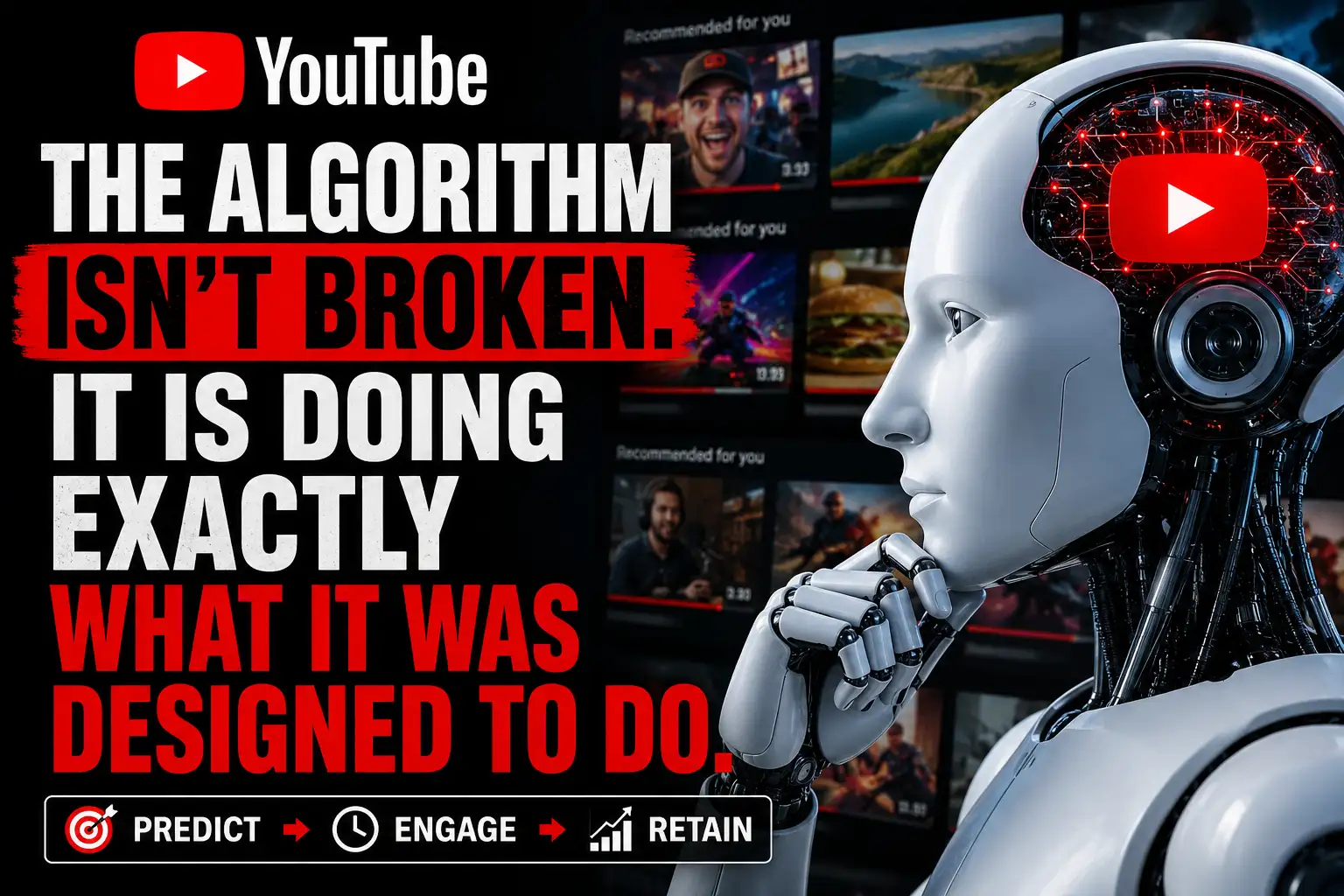
The YouTube Algorithm Isn't Broken. It Is Doing Exactly What It Was Designed To Do.
For years, creators have declared war on "the algorithm."
Every time a video fails, comments appear across the internet:
"The algorithm killed my channel."
"YouTube doesn't support small creators."
"The system is rigged."
But what if everyone is asking the wrong question?
What if the algorithm isn't broken at all?
What if it is actually one of the most successful artificial intelligence systems ever built?
That is the uncomfortable truth many creators do not want to hear.
The YouTube algorithm is not a judge sitting in a room deciding whether your content deserves success. It is not watching your videos and determining whether your editing is better than someone else's.
It does not care how long you worked.
It does not care how much money you invested.
It does not care whether you have been creating for ten years or ten days.
It has one job:
Predict what billions of people are most likely to watch and enjoy, then keep those viewers engaged.
That is it.
Everything else is a misunderstanding.
YouTube Is a Prediction Machine, Not a Talent Competition
The biggest mistake creators make is believing YouTube rewards effort.
It does not.
It rewards predicted viewer satisfaction.
Every second, YouTube's systems analyze enormous amounts of data:
Who clicked.
Who ignored the thumbnail.
How long they watched.
Whether they kept watching.
Whether they clicked another video afterward.
Whether they liked, commented, shared, or subscribed.
Whether they returned to YouTube later.
The algorithm is constantly asking:
"Based on everything we know about this person, what video has the highest probability of keeping them happy?"
Not:
"Who worked the hardest on this video?"
Not:
"Which creator deserves a chance?"
That distinction changes everything.
The Myth of Subscriber Count
Many creators believe gaining subscribers means their future videos are guaranteed views.
That is not how modern YouTube works.
Your subscribers are not your audience.
They are a list of people who have expressed interest in your content at some point in time.
When you publish a new video, YouTube does not automatically send it to all of them.
Instead, YouTube runs a series of tests.
It shows your content to small groups of viewers who are statistically likely to be interested. The system observes how they react.
Do they click?
Do they watch?
Do they leave?
Do they continue watching more content afterward?
Positive signals cause distribution to expand.
Negative signals cause the system to look elsewhere.
A creator with 10,000 subscribers can be outperformed by someone with 100 subscribers if the smaller creator's video generates stronger viewer satisfaction signals.
The Creator's Biggest Enemy: Chasing the Algorithm
Ironically, the creators who obsess over the algorithm often misunderstand it the most.
They search endlessly for hacks:
"Post at this exact time."
"Use this exact thumbnail style."
"Never make videos longer than 10 minutes."
"Use this secret keyword."
Those tricks may produce temporary improvements, but they are not the foundation of long-term success.
The algorithm changes.
Human psychology does not.
Great creators understand something simple:
The algorithm follows the audience.
The creator's job is not to please the algorithm.
The creator's job is to create something people cannot stop watching.
The Rise of AI and the New Creator Battlefield
Today, artificial intelligence is changing content creation faster than any previous shift in internet history.
AI can create thumbnails.
AI can generate voices.
AI can edit videos.
This means the barrier to creating content has collapsed.
Millions of new creators can now produce professional-looking content faster than ever before.
But this creates a new problem:
The internet is becoming flooded with content.
When everyone can create, attention becomes the most valuable resource on Earth.
The algorithm's job becomes even harder.
It must identify not only what is technically well-produced, but what is genuinely interesting to a specific person at a specific moment.
The competition is no longer creator versus creator.
It is every piece of content on Earth fighting for a limited number of human hours.
The Real Problem Nobody Wants To Discuss
The greatest danger facing creators is not the algorithm.
It is dependence.
Many creators spend years building their entire identity on a platform they do not own.
They do not control:
The recommendation engine.
The advertising rules.
The monetization requirements.
The policy changes.
The discovery systems.
A creator can spend a decade building millions of followers and still be one update away from losing their primary source of income.
That is not because YouTube is evil.
It is because YouTube's responsibility is to YouTube.
Its obligation is to maximize viewer satisfaction, engagement, and business success.
Creators are participants inside that ecosystem—not owners of it.
The Future Belongs To Creators Who Build Beyond Platforms
The smartest creators are changing their strategy.
They no longer see YouTube, TikTok, Instagram, or other social platforms as their home.
They see them as discovery engines.
A way to introduce people to their brand.
The ultimate goal is to build something they control:
Their own website.
Their own community.
Their own mailing list.
Their own products.
Their own memberships.
Their own ecosystem.
Because the one audience you truly own is the one that can reach you without asking another company's permission.
The Algorithm Is Not Your Enemy
The YouTube algorithm has never promised fairness.
It has never promised equal opportunity.
It has never promised that hard work alone will be rewarded.
It promised one thing:
To show viewers the content they are most likely to enjoy.
And by almost every measurable standard, it has become extraordinarily good at doing that.
That may be frustrating.
That may feel unfair.
But understanding the system is the first step toward succeeding within it.
Stop asking:
"How do I beat the algorithm?"
Start asking:
"How do I become so valuable to a specific audience that the algorithm cannot ignore me?"
That is the game.
And the creators who understand that game will be the ones who survive the next decade of the internet.