
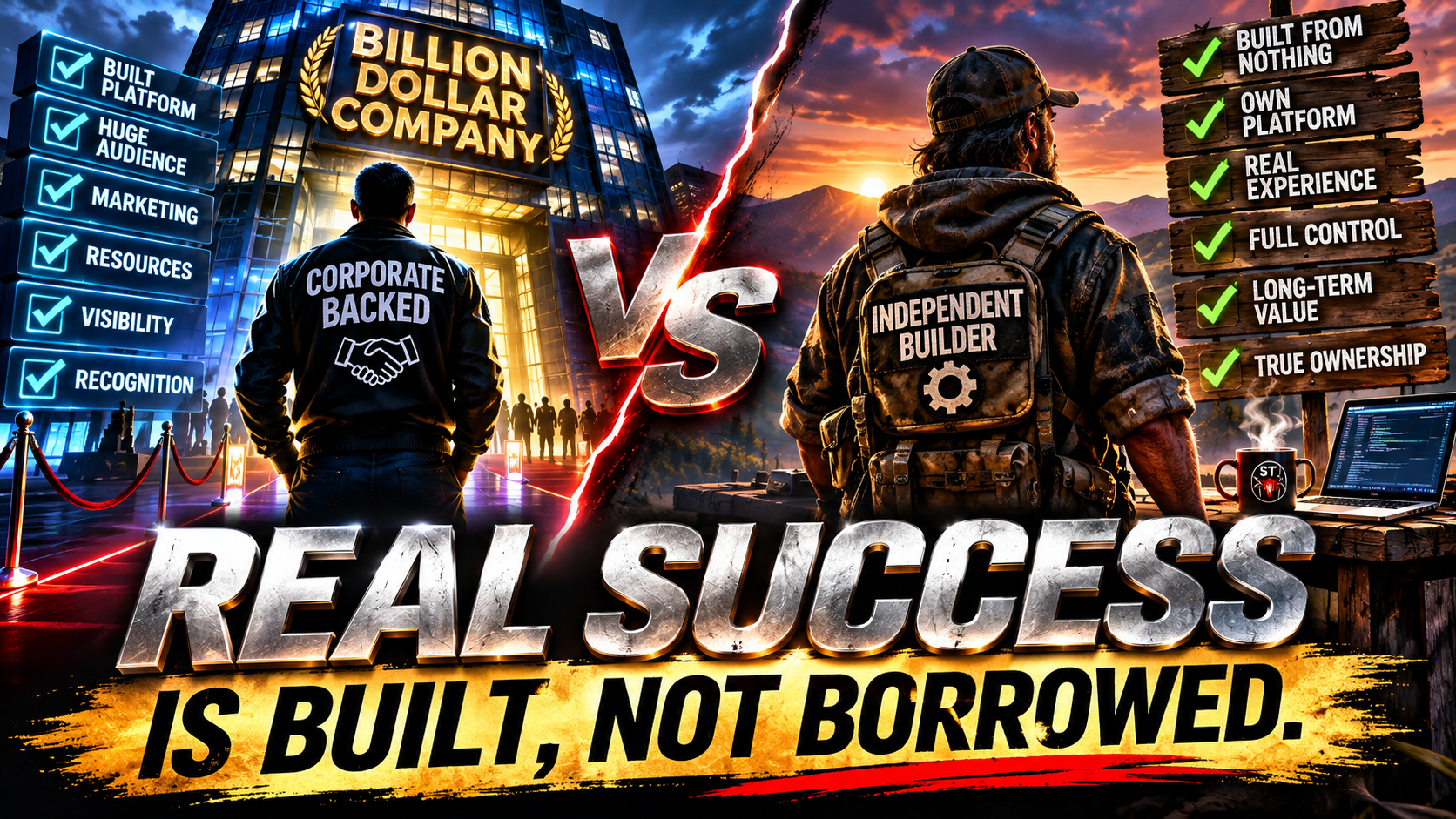
Not All Success Is Built the Same Way
There is a significant difference between building something from nothing and becoming successful within a system that someone else has already built.
Both can require effort, dedication, and skill. But pretending the two accomplishments represent the same journey ignores a fundamental distinction.
One person may spend decades developing technology, building websites, creating businesses, establishing audiences, solving technical problems, and financing their own operations.
Another may become recognized through a mentorship program, creator partnership, or promotional opportunity provided by a corporation worth billions of dollars.
Both individuals may achieve recognition.
But the resources, risks, responsibilities, and ownership behind their accomplishments can be dramatically different.
There is a difference between building the machine and becoming successful because a powerful company lets you operate inside it.
That distinction matters, especially when corporate-backed individuals begin presenting themselves as authorities over independent creators and business owners.
The Billion-Dollar Advantage
A major corporation can provide resources that independent creators often spend years trying to develop.
Established gaming companies may already possess enormous audiences, recognizable brands, international distribution, sophisticated technology, marketing departments, and extensive promotional infrastructure.
When an individual receives recognition through one of those companies, they may gain access to opportunities that would otherwise require substantial independent investment.
Their content may benefit from an established game's popularity.
Their visibility may improve through official recognition.
Their credibility may increase because they are associated with a recognizable corporate brand.
And their audience may grow because millions of potential viewers already have an interest in the company's products.
None of that automatically means the individual lacks talent or has not worked hard.
However, it does mean their success should be evaluated in the context of the advantages available to them.
Corporate backing can amplify talent. It does not prove that the individual could independently build the system responsible for amplifying it.
Independent Success Requires Building the Foundation
Now consider the independent creator or entrepreneur who has no billion-dollar corporation providing the foundation.
They must develop their own infrastructure.
They must attract their own audience.
They must establish their own reputation.
They must troubleshoot their own failures.
They must create opportunities instead of waiting for someone else to provide them.
In many cases, they must also pay for hosting, development, domains, security, marketing, software, and the countless operational expenses involved in maintaining a digital business.
Their success is not simply measured by how many people recognize their name.
It is measured by what they have actually created.
A functioning platform represents technical execution.
An independently developed audience represents market development.
A business that operates without depending on a corporate sponsor represents a different level of operational responsibility.
And a network of independently operated websites and services represents something that cannot be measured by gaming rankings, promotional badges, or corporate recognition alone.
There is a difference between being part of somebody else's ecosystem and building an ecosystem of your own.
Recognition Is Not the Same as Ownership
One of the most overlooked differences between corporate-backed creators and independent entrepreneurs is ownership.
A gaming company owns its game.
It controls its servers, intellectual property, rules, monetization systems, and many of the opportunities available to its community.
A creator who becomes popular through that game may develop a valuable personal brand and audience, but they do not automatically acquire ownership of the underlying product.
The company can change its policies.
It can restructure its programs.
It can reduce promotional support.
It can discontinue features or even shut down the game.
The creator may have little influence over those decisions.
An independent platform owner faces different risks, but also retains a different degree of control.
They can develop new features, establish business relationships, expand into additional markets, and determine the direction of their own properties.
Their work can become an asset that exists independently of a single game or corporate promotional program.
That is a meaningful distinction.
A company recognizing you is not the same thing as owning the company, platform, or infrastructure that makes your success possible.
A Full Hangar Is Not a Business Empire
Gaming communities sometimes confuse in-game wealth, premium equipment, high rankings, and corporate recognition with broader professional success.
A player may possess an extremely expensive collection of virtual equipment.
They may have access to powerful robots, weapons, upgrades, and resources.
They may be associated with a developer's creator or mentorship program.
But none of those things automatically establishes expertise in business development, software engineering, digital publishing, entrepreneurship, or platform ownership.
Having access to expensive virtual assets is not the same as creating valuable real-world assets.
Being promoted by a gaming company is not the same as developing an independent distribution network.
And receiving a mentorship title is not equivalent to building and operating a technology business.
These are fundamentally different accomplishments.
That does not diminish competitive gaming achievements.
It simply recognizes that gaming performance and entrepreneurial success should not be treated as interchangeable.
The Real Test: What Happens When Corporate Support Disappears?
One of the most revealing questions about corporate-backed success is surprisingly simple.
What remains if the corporation stops providing support?
If the promotional program ends, does the individual still have an independent audience?
If the game loses popularity, can the creator successfully transition into another market?
If the company withdraws recognition, does the individual still possess valuable assets, products, services, or infrastructure?
If the corporate brand disappears from their profile, what have they independently established?
These questions do not automatically discredit corporate-backed creators. Many build sustainable businesses and loyal audiences that survive well beyond their original partnerships.
But the answers help distinguish genuine independent capability from dependence on a larger organization's resources.
A creator who can survive the loss of a corporate relationship has demonstrated a form of resilience that promotional recognition alone cannot establish.
A creator who has built their own infrastructure, audience relationships, and diversified business operations has developed something beyond temporary corporate visibility.
Thirty-Five Years of Building Cannot Be Replaced by a Badge
Consider the difference between someone who has spent 35 years developing websites, adapting to technological change, creating digital systems, and building online businesses, and someone who has received recognition through a gaming company's mentorship program.
The mentor may possess valuable knowledge about that particular game.
But their corporate designation does not automatically outweigh decades of experience in technology and business.
The independent professional may have worked through multiple generations of internet development.
They may have built systems before modern social media platforms existed.
They may understand server administration, databases, search infrastructure, digital publishing, content distribution, and monetization from direct experience.
Those accomplishments are not erased because another individual has a title bestowed by a large company.
Nor should the experienced professional be expected to accept that title as evidence of superior authority.
A corporate badge can be awarded. Decades of demonstrated experience must be earned.
Corporate Support Is an Advantage, Not a Personal Accomplishment
There is nothing inherently wrong with accepting corporate assistance.
Businesses sponsor creators, support community leaders, fund events, and provide opportunities because those relationships can benefit both sides.
The problem arises when individuals confuse the advantages provided by those relationships with accomplishments they achieved entirely on their own.
A corporate platform may provide visibility, but the creator still needs to earn an audience's attention.
A company may offer equipment or resources, but the individual must still use them effectively.
A partnership may open doors, but walking through those doors is not the same as constructing the building.
Successful partnerships deserve recognition.
So does independent achievement.
What should be avoided is pretending the two journeys involved identical levels of risk, investment, ownership, and responsibility.
Success Should Be Measured by Substance
Subscriber counts, follower totals, gaming rankings, and corporate titles can all indicate certain forms of achievement.
But they do not tell the entire story.
A creator with a smaller audience may own a profitable business.
A developer with little public recognition may operate substantial digital infrastructure.
An entrepreneur may spend years building a platform network whose value cannot be measured by a single social media account.
Meanwhile, someone with a much larger public following may depend heavily on one corporation, one game, or one promotional relationship.
Neither situation automatically establishes which person is more successful.
The meaningful questions concern what each person has built, what they control, what value they provide, and whether their achievements can survive changing circumstances.
Real business success is not determined by how powerful the company standing behind you happens to be.
Building an Empire Is Different From Borrowing an Audience
An independent digital media network can connect multiple websites, audiences, publishing systems, creator services, and revenue opportunities.
Each property can contribute to the growth of the others.
A visitor discovering one website may eventually become a subscriber, customer, or participant elsewhere in the network.
That creates opportunities for growth that do not depend entirely on one outside company's promotional decisions.
Building such a system requires infrastructure, integration, technical knowledge, long-term planning, and continued execution.
It is a fundamentally different undertaking from building a following around a single corporate-owned product.
One model operates primarily within an existing ecosystem.
The other attempts to create an ecosystem.
Both can be legitimate businesses, but their scale, complexity, and ownership structures should not be confused.
The Danger of Mistaking Corporate Association for Superiority
A mentor, influencer, or creator who receives recognition from a major company should be careful about using that association to dismiss others.
Being affiliated with a billion-dollar corporation does not make someone a billionaire.
Representing a successful game does not mean the individual created that game's success.
And holding a recognized position within a community does not establish authority over independent business owners who have spent decades building their own operations.
Corporate recognition may indicate that an individual provides value to the company.
It does not establish that their accomplishments exceed those of everyone outside the program.
Professional credibility should be evaluated through actual work, demonstrated knowledge, and measurable contributions.
Not through the financial strength of an organization standing behind someone.
Final Word: Did You Build It, or Did Someone Build It for You?
Success comes in many forms, and corporate-backed creators can absolutely achieve meaningful things.
But there is a distinction between receiving an opportunity and creating one.
Between using established infrastructure and developing your own.
Between participating in a successful brand and owning an independent business.
Between being recognized by a powerful company and creating something valuable without that company's support.
The distinction becomes especially important when someone begins using corporate recognition to claim superiority over independent professionals.
A billion-dollar company can provide extraordinary advantages.
It cannot automatically transfer its history, expertise, accomplishments, or business value to every individual it recognizes.
Standing beside a billion-dollar company does not mean you built a billion-dollar achievement.
And someone who has spent decades creating independent systems does not need corporate approval to establish the legitimacy of their work.
A Question Every Creator Should Ask
If the company behind your success disappeared tomorrow, what would you still own?
Would your audience follow you?
Would your business survive?
Would your accomplishments stand independently?
Would you still have something valuable that you created?
Those are questions worth asking before comparing corporate-backed recognition with independent entrepreneurship.
To readers: Do you believe corporate-sponsored creators receive too much credit for opportunities provided by the companies behind them? Should independently built businesses and platforms receive greater recognition?
Share your perspective and experiences.
Because there is a difference between riding a successful machine and being the person who built one.