
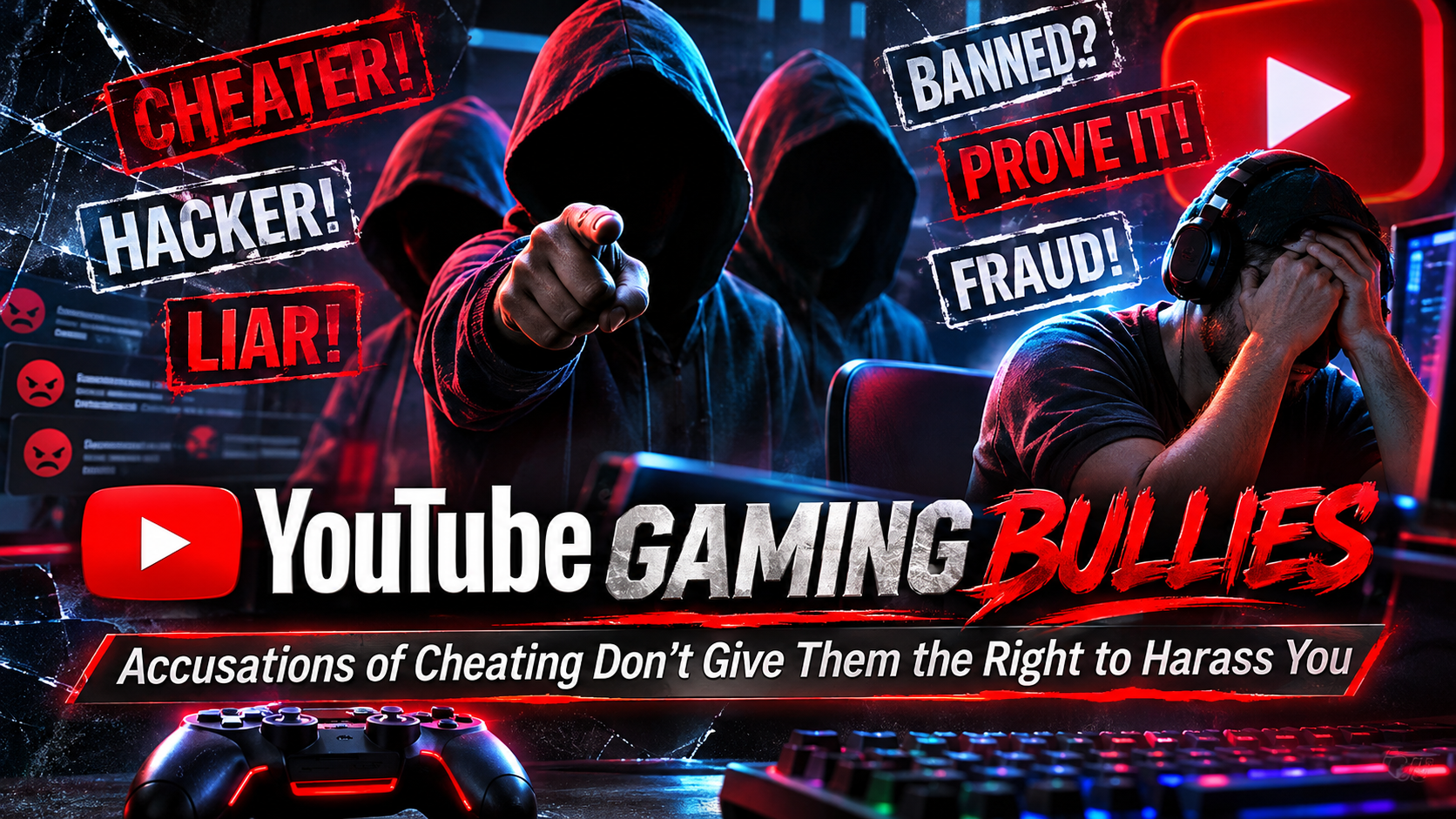
When Fighting Cheaters Becomes an Excuse for Bullying
Across YouTube gaming communities, accusations of cheating have become a convenient weapon for individuals who want to publicly discredit, ridicule, or attack other players and content creators.
Some accusations may be supported by evidence. Others are based on suspicion, personal opinions, jealousy, or disagreements.
But there is something far more important than whether the accused person actually cheated.
A bully who targets someone accused of cheating is still a bully.
And anyone willing to bully another person because they believe that individual has done something wrong is demonstrating a willingness to mistreat people they disagree with.
Today, the target might be someone accused of cheating.
Tomorrow, it could be a successful creator, a competing YouTuber, someone who questions a game developer, or simply someone who refuses to agree with the crowd.
The justification changes. The bullying remains the same.
An Accusation Is Not a Conviction
One of the most disturbing trends in gaming communities is the willingness to publicly label someone a cheater without presenting credible evidence.
A player performs unusually well, and accusations begin.
Someone wins repeatedly, and suddenly their achievements are questioned.
A creator grows faster than expected, and people begin suggesting something dishonest must be happening.
Instead of investigating the facts, some individuals immediately begin using labels to destroy another person's reputation.
The accused individual may find themselves facing hostile comments, personal insults, ridicule during livestreams, and repeated allegations across multiple platforms.
And once an accusation spreads, correcting misinformation can become considerably more difficult.
Suspicion is not proof. Repetition is not evidence. And popularity does not determine guilt.
Just because a well-known YouTuber calls someone a cheater does not make the accusation true.
The responsibility to substantiate an allegation belongs to the person making it.
Even When Cheating Is Proven, Bullying Is Still Wrong
Here is the issue that many self-appointed defenders of gaming communities appear to overlook.
Even if someone is caught cheating, that does not make harassment acceptable.
Cheating can justify reporting an account, requesting an investigation, or supporting legitimate enforcement of a game's rules.
It does not justify personal attacks, threats, humiliation, or encouraging an audience to harass someone.
A person cannot claim to be defending fair play while engaging in conduct that undermines the basic standards of a respectful community.
If someone believes another player deserves to be bullied because they cheated, what happens when that same person decides someone deserves bullying for disagreeing with them?
What happens when the next target is a creator who refuses to follow their advice?
Or someone who criticizes their favorite gaming company?
Once bullying becomes acceptable against one person, the bully has already demonstrated a willingness to use it against others.
That is the warning gaming communities should be paying attention to.
YouTube Creators Who Encourage Bullying Are Setting a Dangerous Example
YouTube personalities have influence.
Some have thousands of subscribers. Others have tens or hundreds of thousands of viewers who follow their opinions, participate in their livestreams, and repeat their statements.
That influence carries responsibility.
When a creator repeatedly labels someone a cheater, mocks them publicly, or encourages an atmosphere of hostility, their audience may interpret that behavior as permission to participate.
What begins as one person's accusation can turn into a much larger campaign of ridicule and harassment.
The situation becomes particularly concerning when other creators, moderators, or community personalities join the attacks.
Instead of asking for evidence, individuals may simply repeat whatever the most influential person has said.
The accused person becomes the target of a crowd.
And the crowd may begin believing that its size somehow makes its actions justified.
It does not.
A thousand people repeating an unsupported accusation still does not turn that accusation into evidence.
And a thousand people bullying one person does not make the bullying acceptable.
The Bully's Real Problem May Be Disagreement, Not Cheating
There is a question every gaming community should ask when witnessing someone repeatedly attacking another person.
Is this individual genuinely concerned about cheating, or are they using cheating accusations as an excuse to attack someone they dislike?
The distinction is important.
A person genuinely concerned about cheating can present evidence, report suspicious behavior, and allow an appropriate investigation to take place.
A bully may continue attacking even after making the accusation.
They may repeatedly bring up the targeted individual during livestreams, use insulting labels, mock their achievements, or encourage others to view them negatively.
At that point, the behavior has moved beyond a discussion about cheating.
It has become personal.
And when someone makes a habit of attacking people they disagree with, there is little reason to assume the behavior will remain limited to one issue.
A bully does not suddenly become a respectable community member simply because they have selected a target other people dislike.
When Success Becomes Another Reason to Attack Someone
Gaming communities should be places where people can improve, compete, create content, and celebrate achievements.
Unfortunately, success can sometimes attract hostility.
A player becomes exceptionally skilled.
A YouTube creator experiences rapid subscriber growth.
Someone builds an independent gaming platform.
A smaller creator begins gaining recognition.
Rather than congratulating that individual, critics may begin questioning whether the success is legitimate.
Accusations of cheating, buying subscribers, manipulating statistics, or receiving unfair advantages may follow.
Some accusations may warrant investigation when credible evidence exists. Others may be nothing more than attempts to undermine someone else's accomplishments.
The important point is that success alone is not evidence of misconduct.
Nobody should have to defend legitimate achievements simply because another person cannot accept that they succeeded.
Gaming communities should encourage achievement, not automatically treat it as suspicious.
Mentors, Moderators, and Community Leaders Should Be Held to Higher Standards
The problem becomes even more serious when bullying comes from individuals who hold recognized positions within gaming communities.
Mentors are supposed to guide.
Moderators are supposed to maintain order.
Community representatives are supposed to encourage constructive participation.
And established creators should recognize the influence their words can have on their audiences.
None of these positions should provide immunity from accountability.
A mentor who publicly humiliates another player is not demonstrating effective mentorship.
A moderator who participates in harassment is undermining the standards they are supposed to enforce.
A creator who repeatedly attacks people they disagree with should not be surprised when viewers begin questioning their judgment.
Titles, subscriber counts, and recognition from gaming companies do not automatically establish good character or responsible leadership.
Leadership is demonstrated through conduct, especially when dealing with people you disagree with.
Gaming companies should also consider whether individuals representing their communities are encouraging respectful participation or contributing to public hostility.
Bullying One Person Sends a Warning to Everyone
One of the biggest mistakes people make is assuming that bullying is only a problem when they personally become the target.
They may watch someone else being ridiculed and decide it does not concern them.
They may even join in because they dislike the accused individual.
But that overlooks what the bully's behavior reveals.
If someone is willing to harass another person because they believe that person cheated, they have already demonstrated that they consider harassment acceptable under certain circumstances.
Those circumstances can change.
Today, someone is accused of cheating.
Tomorrow, someone criticizes a game update.
Next week, someone refuses to support a popular creator.
Later, someone starts a competing community or becomes more successful than expected.
The same hostility can be directed toward any of them.
When you excuse bullying because you dislike the victim, you are helping establish a standard that could eventually be used against you.
That is why the behavior itself must be challenged, regardless of who is being targeted.
Disagreement Is Not Permission to Attack Someone
People will disagree in gaming communities.
They will disagree about gameplay, weapons, rankings, updates, developers, monetization, cheating allegations, and the direction of their favorite games.
Disagreement is normal.
It can even be valuable when people exchange evidence, explain their positions, and challenge questionable claims.
But disagreement does not justify harassment.
Someone can be wrong without deserving abuse.
Someone can make a mistake without deserving public humiliation.
Someone can criticize a company without becoming an enemy of its supporters.
And someone can refuse to agree with a popular YouTuber without deserving a campaign of personal attacks.
A community that cannot tolerate disagreement is not demonstrating strength.
It is demonstrating an inability to handle independent opinions.
YouTube Gaming Communities Must Stop Rewarding Bullies
Viewers have more influence than they sometimes realize.
Every time someone shares an unsupported accusation, participates in ridicule, or rewards a creator for attacking another person, they may contribute to an environment where harassment becomes entertainment.
That behavior should not be celebrated.
Creators should be expected to provide evidence for serious allegations.
Moderators should address harassment consistently.
Mentors should demonstrate the conduct they expect from others.
And gaming companies should evaluate whether the personalities they recognize are actually helping their communities.
YouTube audiences should also recognize the difference between legitimate criticism and targeted abuse.
Holding someone accountable for misconduct is appropriate.
Turning that person into a target for ongoing humiliation is not.
The gaming community does not need more self-appointed judges who believe they can determine who deserves public mistreatment.
It needs people willing to defend fair treatment, even when the person being treated unfairly is someone they do not particularly like.
Final Word: A Bully Is a Bully, Regardless of the Excuse
The central issue is simple.
Cheating is wrong.
Making unsupported accusations is wrong.
Bullying is wrong.
And none of those actions excuses another.
A YouTuber who attacks someone accused of cheating does not automatically become a hero for the gaming community.
A mentor who publicly humiliates someone does not become a better mentor because the target is unpopular.
A group of creators who ridicule another individual does not become respectable simply because they agree with one another.
If you are willing to bully someone because you disagree with them, you are showing everyone else how you may treat them when they disagree with you.
That is the real warning.
It is not just about the person being attacked today.
It is about every player, creator, and community member who could become tomorrow's target.
A Message to Every Gaming Creator and Viewer
The next time you see someone being publicly labeled a cheater, ask for evidence.
The next time you see a creator encouraging personal attacks, question their conduct.
The next time you see a mentor or community leader participating in harassment, ask whether that individual is demonstrating the standards their position should represent.
And the next time someone tells you that bullying is justified because the target supposedly did something wrong, remember this:
You do not have to defend someone's actions to defend their right not to be bullied.
Gaming communities should be built on fair competition, honest criticism, independent thinking, and mutual respect.
Do not reward bullying with attention, agreement, or participation.
Do not allow popularity to replace evidence.
And do not wait until you become the target before deciding that harassment is unacceptable.
A bully to one person can become a bully to anyone. Stop excusing the behavior simply because you agree with the accusation.