
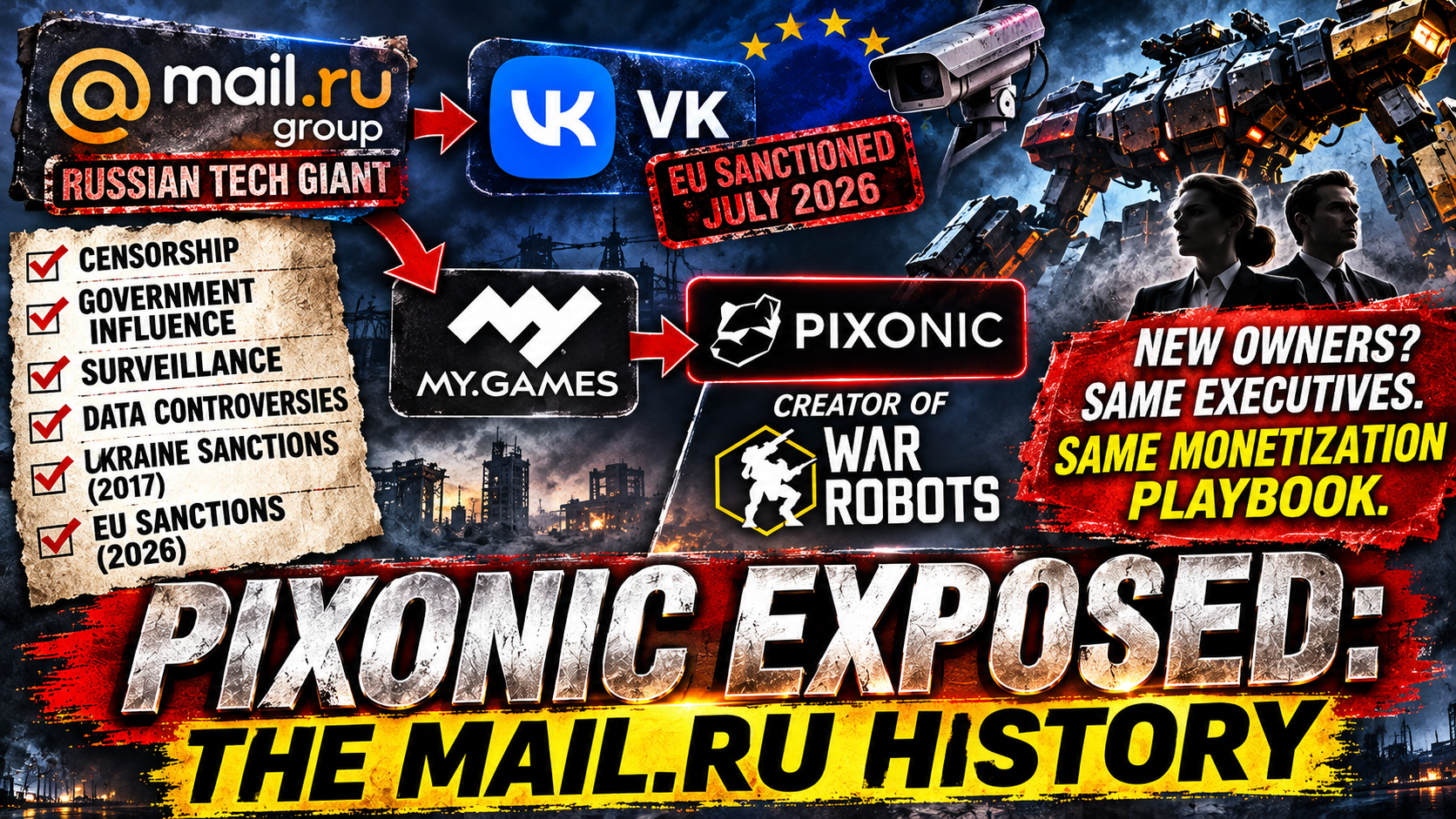
The History War Robots Players Were Never Told in Full
For years, Pixonic has presented War Robots as a successful international gaming franchise.
The company celebrates its enormous player base, revenue milestones, technological achievements, and community programs.
But behind the familiar War Robots brand is a corporate history that deserves far greater public attention.
Pixonic was once owned by Mail.ru Group, a Russian internet conglomerate whose businesses included major social networks, email services, communications platforms, and online games.
Mail.ru later became VK, a company whose history includes disputes over censorship, government access to user information, Ukrainian sanctions, and, most recently, European Union sanctions concerning surveillance and human-rights violations.
That is not speculation.
It is documented corporate history.
And while Pixonic is no longer owned by VK, its years under Mail.ru ownership form an important part of the company's development.
The story becomes even more significant when examining the executives who helped build War Robots into a billion-dollar franchise and who continue to lead MY.GAMES.
The owners changed. The corporate structure changed. But the people overseeing the business did not all disappear with the old shareholders.
Players deserve to understand that distinction.
2009–2016: Pixonic Before the Mail.ru Acquisition
Pixonic was founded in 2009, years before Mail.ru acquired it.
The studio developed games and eventually found its greatest commercial success with War Robots.
By September 2016, War Robots had surpassed 20 million installations.
That success attracted Mail.ru Group, one of Russia's largest internet businesses.
On October 3, 2016, Mail.ru publicly announced its agreement to acquire 100% of Pixonic for approximately $30 million.
The deal included $20 million upfront and another $10 million tied to performance targets.
This was not a minor sponsorship.
It was a complete corporate acquisition.
Pixonic became part of an organization with substantial financial resources, technology infrastructure, and international business interests.
And that parent company already had a complicated history.
The Mail.ru Empire: More Than an Email Company
Despite its name, Mail.ru was never simply an email provider.
The conglomerate controlled or operated some of Russia's largest internet properties, including VKontakte, Odnoklassniki, and other communications and entertainment services.
Its platforms reached an enormous percentage of Russian internet users.
That scale made the company commercially powerful.
It also placed the business at the intersection of technology, government regulation, personal information, and political influence.
Understanding that environment is essential because Mail.ru's corporate history includes controversies extending far beyond gaming.
The VKontakte Takeover and Pavel Durov's Departure
One of the most significant chapters in Mail.ru's history concerns VKontakte, commonly known as VK.
VK was founded by Pavel Durov in 2006.
The social network became one of Russia's most important communication platforms.
But its relationship with Russian authorities became increasingly contentious.
Following protests in Russia and Ukraine, government demands involving online content and user information created serious conflicts.
Durov publicly described pressure to provide information concerning Ukrainian protesters and to restrict opposition-related content.
In 2014, he departed VK.
Mail.ru Group subsequently obtained full control of the social network.
Investigative reporting by WIRED later described how VK became increasingly compliant with Russian government demands involving censorship and user information.
The significance of this history is substantial.
It illustrates how a major communications platform became entangled in government influence and surveillance concerns.
And this was part of the corporate environment surrounding Mail.ru before it purchased Pixonic.
Pixonic was acquired by a company whose expanding technology empire was already associated with major controversies over digital rights and government influence.
That history does not establish wrongdoing by Pixonic.
It does establish that its former parent company was far more controversial than an ordinary gaming publisher.
2017: Ukraine Sanctions Mail.ru and Its Social Networks
In May 2017, Ukraine imposed restrictions on several Russian internet businesses, including Mail.ru and VKontakte.
The measures followed Ukrainian national-security concerns involving Russian online platforms.
Ukrainian authorities raised concerns about the security of personal information, communications, and the potential use of Russian-controlled services for activities threatening national security.
The restrictions affected access to Mail.ru services and related social networks in Ukraine.
This was a significant government action against the same corporate group that had acquired Pixonic the previous year.
The sanctions did not establish that War Robots was involved in espionage or that Pixonic had committed a security offense.
But they demonstrated that Mail.ru was operating within a corporate and geopolitical environment carrying serious regulatory and reputational risks.
That distinction matters.
A company's gaming products may appear separate from its other businesses, but ownership connects them financially and organizationally.
2018: Mail.ru and the Facebook Data-Access Controversy
Another controversy emerged in 2018.
Following the Cambridge Analytica scandal, Facebook disclosed information about outside companies that had received access to user-related information through its platform.
Mail.ru was among the companies examined.
Reporting by WIRED revealed that Mail.ru had operated hundreds of Facebook applications under earlier platform rules that permitted access to certain friends' data.
Facebook also acknowledged granting Mail.ru a limited extension for two messaging applications during its transition to tighter data-access restrictions.
The revelation attracted scrutiny because of concerns surrounding Russian technology companies and personal information.
However, an important detail must not be omitted.
Facebook stated that it had found no indication of misuse by Mail.ru.
The existence of data access was documented.
Improper use of that data was not established by the reporting.
Nevertheless, the controversy contributed to wider questions about the concentration of personal information within major technology businesses.
For consumers, the lesson is straightforward.
Understanding the corporate organizations behind digital services matters.
2021–2022: The Corporate Environment Changes Again
Mail.ru Group adopted the VK corporate identity in 2021.
During this period, control of VK shifted toward interests connected to major Russian corporate and state-linked institutions.
Investigative reporting described increasing government influence over the company's communications platforms.
Following Russia's full-scale invasion of Ukraine in February 2022, the international business environment changed dramatically.
Technology companies faced sanctions exposure, payment restrictions, reputational concerns, and pressure to separate international operations from Russian ownership.
MY.GAMES, the gaming business that included Pixonic, was eventually sold.
In September 2022, VK announced the sale of MY.GAMES to Alexander Chachava for approximately $642 million.
This transaction marked a major ownership separation.
Pixonic's former Russian parent no longer owned MY.GAMES following the sale.
That is an important fact.
But the sale also raises another question.
How much did the ownership change affect the underlying business practices of War Robots?
The Monetization System That Continued Across Ownership Changes
War Robots developed into a franchise generating more than $1 billion in lifetime revenue.
Alongside that commercial achievement, players have raised longstanding complaints about monetization.
Those complaints include expensive equipment upgrades, randomized reward systems, premium equipment advantages, and balancing changes that can reduce the competitive value of previously purchased items.
Players have also criticized customer support and the handling of cheating allegations.
These concerns have persisted across different ownership periods.
But continued complaints do not, by themselves, prove that every monetization decision was made by the same executives or that the systems remained literally unchanged.
What the corporate record does establish is continuity in senior management associated with the franchise's commercial development.
And that is where the ownership story becomes particularly important.
New Owners, Same Leadership: The Question Pixonic Must Answer
On November 10, 2026, MY.GAMES announced another major ownership development.
The company's management team, led by CEO Elena Grigorian and Chief Operating Officer Denis Savuta, agreed to acquire MY.GAMES from Alexander Chachava.
The transaction is backed by UAE-based investor Georgy Nurislamov.
The deal is expected to close later in 2026.
MY.GAMES stated that its existing leadership would continue operating the business.
Grigorian previously held senior strategic leadership positions within MY.GAMES and is credited by the company with helping grow War Robots into a franchise generating more than $1 billion in lifetime revenue.
Savuta brings more than two decades of financial and operational experience.
The key issue is not whether these executives have industry experience.
They clearly do.
The issue is that the same leadership organization responsible for the company's commercial development is now positioned to control its next chapter.
The corporate owners and investors changed completely, but senior executives associated with the billion-dollar monetization business remained in leadership.
That is the distinction players should examine.
It would be inaccurate to claim without further evidence that these exact individuals personally designed every controversial War Robots purchase mechanism.
But their documented leadership continuity makes questions about corporate strategy entirely reasonable.
If players have been criticizing monetization practices for years, what will change under the next ownership structure?
Will expensive upgrades become more transparent?
Will purchased equipment receive clearer consumer protections?
Will support improve?
Will creator programs operate with greater financial accountability?
Or will the next ownership arrangement primarily preserve a commercially successful business model?
A new owner does not automatically mean a new philosophy.
2024: The Boosty Controversy Adds Another Chapter
The broader MY.GAMES corporate history includes another controversy.
In July 2024, Dutch investigative journalism program Nieuwsuur reported allegations involving Boosty, a creator-support platform then associated with MY.GAMES.
The investigation concerned fundraising activity allegedly benefiting Russian military efforts in Ukraine.
MY.GAMES disputed wrongdoing and challenged elements of the reporting.
The company subsequently separated from Boosty.
This controversy concerned another business within the publisher's corporate history.
It does not establish that Pixonic participated in the alleged activity.
It also does not establish that War Robots purchases financed Russian military operations.
Those are separate claims requiring separate evidence.
Nevertheless, the controversy adds to the reasons consumers may wish to examine the wider corporate history of MY.GAMES rather than focusing exclusively on its gaming brands.
July 2026: The European Union Sanctions VK
One of the most consequential developments in Mail.ru's corporate history occurred on July 13, 2026.
The Council of the European Union imposed restrictive measures on VK, the company formerly known as Mail.ru Group.
The sanctions concerned serious human-rights violations and the use of technology for surveillance and repression.
The EU specifically identified VK's relationship with Communication Platform LLC, which developed and managed the Russian Max application.
According to the EU, the application was developed under supervision involving Russia's Federal Security Service, the FSB.
European authorities described extensive surveillance capabilities and the use of technology in measures targeting critics of Russia's war against Ukraine.
This was no longer merely a dispute between consumers and a technology company.
It was formal action by the European Union against Pixonic's former corporate parent.
The same corporate group that acquired Pixonic in 2016, later operating as VK, was sanctioned by the European Union in 2026 over serious surveillance and human-rights concerns.
However, the timeline is essential.
MY.GAMES had been sold in 2022, four years before these EU sanctions.
The 2026 measures against VK do not establish that Pixonic or its current parent was sanctioned, participated in the conduct, or remained under VK's ownership.
That does not make the historical connection irrelevant.
It makes the need for accurate corporate history even more important.
The Billion-Dollar Question: Who Benefits From the Business Model?
War Robots has produced extraordinary revenue.
But commercial success and customer satisfaction are not interchangeable.
A company can operate a profitable business while facing substantial criticism from customers.
Players deserve to know whether their spending supports a business that responds effectively to complaints and maintains transparent purchase policies.
They deserve clear information about the products they purchase.
They deserve understandable explanations when equipment is rebalanced.
And they deserve support systems that take their concerns seriously.
A company's ownership history does not determine whether every customer complaint is justified.
But it provides context for examining how the business has been managed.
If senior executives remain involved across ownership changes, accountability should not disappear each time the shareholders change.
The Mentor and Creator Programs Are Part of the Same Accountability Question
Pixonic's relationships with creators and mentors also deserve attention.
A company that benefits from creators promoting its products should maintain clear and consistent standards.
Creators should be able to understand commission calculations.
They should have access to meaningful support.
They should receive explanations when reporting systems produce disputed results.
And mentors should not confuse company recognition with authority over other people's professional experience or opinions.
The financial success of a corporation does not automatically make every person associated with it an expert in business, technology, or community leadership.
Nor should creators feel that legitimate criticism is incompatible with participation in a promotional program.
A responsible company should welcome documented concerns and provide meaningful answers.
What Pixonic's Corporate History Actually Proves
The public record establishes that Pixonic was founded independently in 2009.
Mail.ru acquired it in 2016.
Mail.ru subsequently became VK.
Ukraine imposed sanctions affecting Mail.ru businesses in 2017.
VK became increasingly controversial over censorship and government surveillance concerns.
VK sold MY.GAMES in 2022.
MY.GAMES faced questions concerning Boosty in 2024.
The European Union sanctioned VK in July 2026.
And in November 2026, MY.GAMES announced a management buyout involving senior executives who had already helped develop the company's commercial operations.
That is a substantial corporate history.
It is not evidence that Pixonic committed every act attributed to its former parent.
It is not proof that War Robots purchases funded unlawful activity.
And it is not proof that every executive participated in every disputed business decision.
But it is more than enough to justify serious questions about corporate governance, historical accountability, and the continuity of commercial strategy.
Final Word: You Can Change the Owners Without Changing the Business
Pixonic's history should not be reduced to a logo, a gaming community, or a billion-dollar revenue milestone.
The company has operated within a series of powerful corporate structures.
One of those structures was Mail.ru, whose successor became the subject of serious European sanctions.
The gaming business was later sold.
Another ownership transition is now underway.
But senior leadership associated with the commercial development of War Robots continues to occupy influential positions.
That is the central issue.
When ownership changes but leadership remains, customers have every right to ask whether the business itself has meaningfully changed.
A company cannot establish trust simply by announcing a new investor.
It cannot establish fairness simply by reporting another revenue milestone.
And it cannot establish accountability simply by appointing mentors, celebrating creators, or promoting its community.
Those things require conduct.
They require transparency.
They require answers.
A Message to War Robots Players, Creators, and Investors
Investigate the companies behind the games you support.
Look beyond the branding.
Understand the ownership history.
Examine who controls the business.
Ask whether management has changed its policies or merely changed its shareholders.
Demand transparency regarding purchases, balancing decisions, creator commissions, and customer support.
And remember that corporate success is not a substitute for public accountability.
To Pixonic and MY.GAMES, the questions are straightforward:
What specific changes will the new ownership bring to War Robots monetization?
How will the company address longstanding customer complaints?
What safeguards exist for creators who dispute financial reporting?
And how will existing management demonstrate that customer trust matters as much as revenue?
The owners changed. The money changed hands. The executives remained. Now players deserve to know what, if anything, will actually change for them.
That is the real corporate story behind Pixonic.
And it is a story every War Robots player deserves the opportunity to examine.
Sources, References & Supporting Documentation
The following sources document Pixonic's ownership history, Mail.ru Group's corporate controversies, government sanctions, MY.GAMES' business activities, and the continuity of executive leadership. Sources include official corporate announcements, government records, regulatory filings, and investigative journalism.
1. Mail.ru Acquires 100% of Pixonic — October 3, 2016
Source: Mail.ru Group Limited — London Stock Exchange Regulatory Announcement
https://www.lse.co.uk/rns/MAIL/acquisition-of-mobile-games-developer-pixonic-zgbvju4o67t745d.html
Mail.ru officially announced the acquisition of 100% of Pixonic for $30 million, consisting of $20 million upfront and $10 million tied to performance targets.
The announcement confirms that Pixonic was founded in 2009 and that War Robots had exceeded 20 million installations by September 2016.
Significance: Primary corporate evidence establishing Pixonic's direct ownership by Mail.ru Group.
2. Mail.ru's History of Government Influence and Censorship
Source: WIRED — Investigation into VK and Russian Government Influence
https://www.wired.com/story/vk-russia-democracy/
Examines the history of VKontakte, Pavel Durov's departure, censorship disputes, government demands for user information, and the increasing influence of Russian authorities over the social network.
Significance: Provides historical context for the Russian technology conglomerate that acquired Pixonic.
3. Mail.ru and the Facebook Data-Access Controversy — 2018
Source: WIRED — Facebook Gave Russian Internet Giant Special Data Extension
https://www.wired.com/story/facebook-gave-russian-internet-giant-special-data-extension/
Documents Mail.ru's historical access to Facebook user-related data through applications and a limited extension granted to two messaging applications.
Facebook reported finding no indication of misuse by Mail.ru.
Significance: Establishes another documented controversy involving Pixonic's former parent company, without asserting unproven data misuse.
4. VK Sells MY.GAMES for $642 Million — September 27, 2022
Source: VK Company Limited — Official Corporate Announcement
https://www.lse.co.uk/rns/vk-announces-the-sale-of-mygames-dbul1d5y4ayxgyj.html
VK announced the sale of 100% of MY.GAMES to Alexander Chachava, managing partner of LETA Capital, for $642 million.
The transaction included the gaming division's studios and products.
Significance: Establishes the separation of MY.GAMES and Pixonic from their former Russian corporate parent.
5. Dutch Investigation Into Boosty and Russian Military Donations — July 24, 2024
Source: Nieuwsuur / NOS — Investigative Reporting and Methodology
https://nos.nl/nieuwsuur/collectie/13964/artikel/2530117-verantwoording-onderzoek-russische-donaties
Dutch journalists investigated donation channels involving Boosty and DonationAlerts that were reportedly used to raise funds benefiting Russian military units.
The investigation included transaction testing, examination of fundraising channels, and verification of supporting materials.
Significance: Documents serious questions about payment infrastructure associated with MY.GAMES' broader corporate operations. It does not establish wrongdoing by Pixonic or a connection between War Robots purchases and military financing.
6. MY.GAMES' Response to the Boosty Investigation
Source: Nieuwsuur / NOS — Correspondence and Responses
https://nos.nl/nieuwsuur/artikel/2530118-wederhoor-onderzoek-russische-donaties
Publishes correspondence with MY.GAMES and other involved organizations, including responses concerning the investigation.
Significance: Provides the company's position alongside the investigative allegations.
7. MY.GAMES Completes the Sale of Boosty and DonationAlerts — December 11, 2024
Source: MY.GAMES — Official Corporate Announcement
https://about.my.games/news/300
MY.GAMES confirmed the completed sale of CEBC B.V., including Boosty and DonationAlerts, to entities associated with businessman Pavel Kharaneka.
Significance: Establishes the subsequent divestment of the platforms involved in the 2024 controversy.
8. European Union Sanctions VK — July 13, 2026
Source: Council of the European Union — Official Press Release
The European Union announced restrictive measures against VK and other entities concerning serious human-rights violations, surveillance technology, and repression in Russia.
The announcement identifies VK and its subsidiary Communication Platform LLC in connection with the Max application and surveillance concerns.
Significance: Official government documentation of sanctions against Pixonic's former corporate parent. MY.GAMES had already been sold in 2022.
9. Official EU Legal Sanctions Record — July 13, 2026
Source: Official Journal of the European Union — Council Decision (CFSP) 2026/1709
https://eur-lex.europa.eu/eli/dec/2026/1709/oj/eng/pdf
The legally published decision identifies sanctioned entities and provides the European Union's stated reasons for their designation.
Significance: Primary legal documentation supporting the article's discussion of VK's sanctions and surveillance-related conduct.
10. MY.GAMES Management Buyout — November 10, 2026
Source: MY.GAMES — Official Corporate Announcement
https://about.my.games/news/639
MY.GAMES announced a management buyout led by CEO Elena Grigorian and COO Denis Savuta, financially backed by UAE-based investor Georgy Nurislamov.
The company stated that its existing leadership would continue after completion of the transaction, which is expected in 2026.
The announcement also credits Grigorian with helping develop War Robots into a franchise exceeding $1 billion in lifetime revenue.
Significance: Primary evidence of continuity in senior leadership despite successive changes in corporate ownership.
11. Independent Reporting on the Management Buyout
Source: PocketGamer.biz — November 10, 2026
https://www.pocketgamer.biz/mygames-agrees-to-management-buyout-backed-by-uae-investor/
Confirms the announced management buyout, the executives involved, the outside financial backing, and plans to retain existing leadership.
Significance: Independent industry reporting supporting the ownership and management timeline.
Important Distinction: Ownership vs. Executive Leadership
The documented evidence establishes that Pixonic's corporate ownership changed substantially between 2016 and 2026.
It also establishes continuity among senior MY.GAMES executives associated with the commercial development of War Robots.
However, continuity in leadership does not independently establish that every monetization mechanism was designed by those executives or remained unchanged.
The central accountability question is whether changes in ownership have produced meaningful changes in the company's monetization practices, customer support, and relationships with players and creators.
Editorial Disclosure
This article combines documented corporate history, government sanctions records, company announcements, investigative reporting, and editorial analysis.
Sanctions imposed against VK in 2026 do not establish that Pixonic or MY.GAMES was sanctioned or participated in the conduct described by European authorities. MY.GAMES was sold by VK in 2022.
Allegations concerning Boosty should not be interpreted as evidence that War Robots purchases financed military activity.
Criticism of War Robots monetization and creator programs is distinct from findings of criminal or regulatory wrongdoing.
Readers are encouraged to review the original sources, examine the chronology, and form their own conclusions about corporate accountability and consumer trust.