
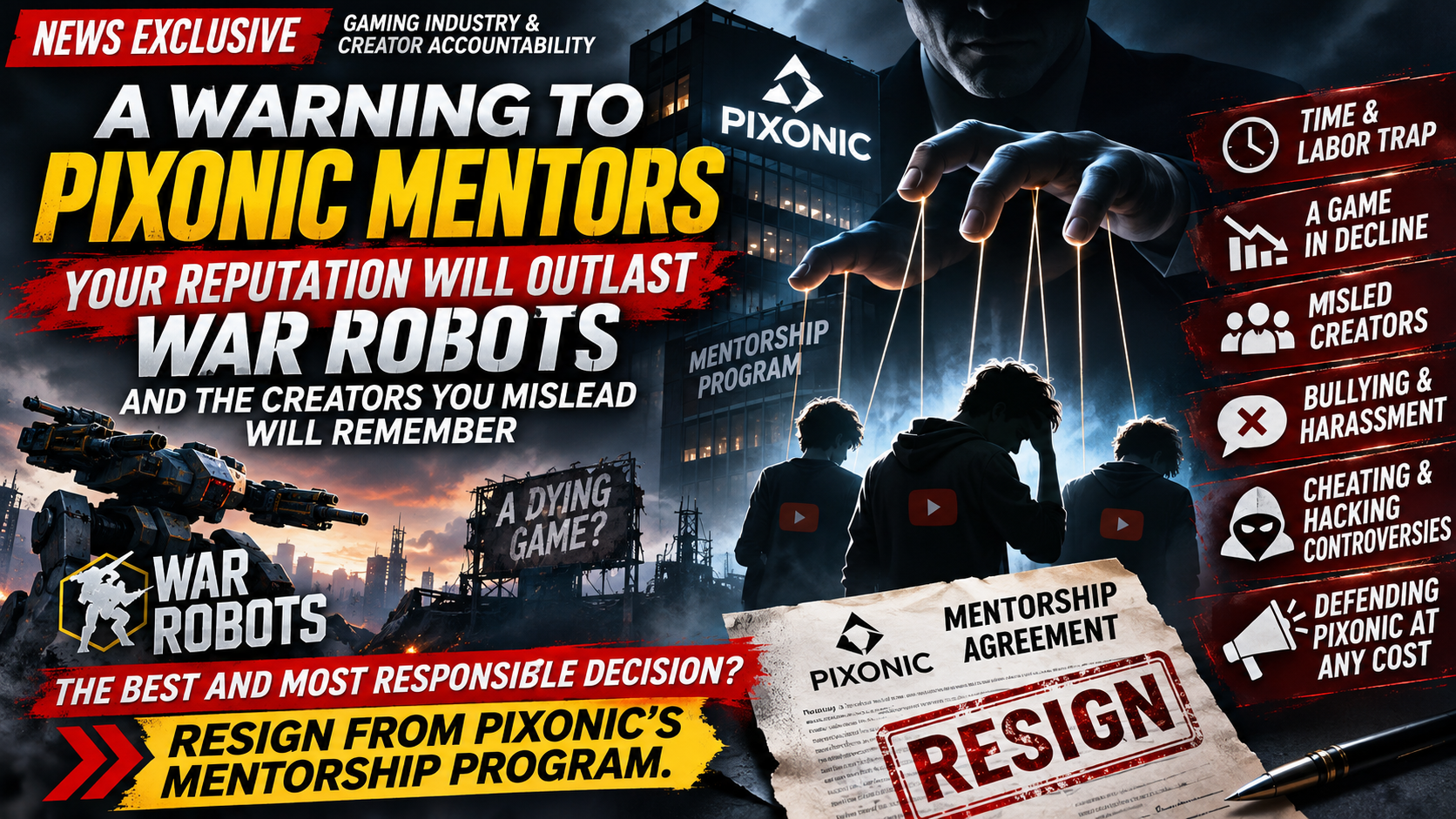
The Reputation You Are Building Today Could Follow You for the Rest of Your YouTube Career
There is a warning that every mentor associated with Pixonic and War Robots needs to hear.
Your relationship with a game developer is temporary. Your reputation as a content creator can follow you for the rest of your career.
Some mentors may believe that representing a developer, maintaining their position within a gaming community, or remaining in good standing with a company is the ultimate achievement.
But what happens when that company faces growing criticism, when creators question the value of their participation, and when the people who trusted the mentorship system begin examining what they actually received in return?
What happens when years of encouragement, promises of opportunity, and countless hours of work lead aspiring creators to discover that the journey was never what they believed it would be?
The people who encouraged that journey have questions to answer.
And hiding behind a corporate relationship will not answer them.
The Time and Labor Trap Nobody Wants to Discuss
Building a successful YouTube channel requires enormous dedication.
Creators invest hundreds or thousands of hours producing videos, livestreaming, editing, developing communities, promoting games, and attempting to build an audience.
They sacrifice personal time, invest money in equipment, and sometimes structure their entire content strategy around one game.
When established creators and officially recognized mentors encourage newcomers to make those investments, their advice carries influence.
That influence comes with responsibility.
A mentor should never encourage someone to invest years of labor without helping them understand the risks, limitations, and uncertain returns.
This becomes especially important when the game itself faces questions about its long-term health, player satisfaction, monetization practices, and community confidence.
War Robots has faced criticism from members of its community, and Pixonic's creator relationships have become the subject of increasingly public complaints.
A mentor who promotes the opportunities while ignoring the risks is not providing a complete picture.
They may be recruiting enthusiasm rather than developing successful creators.
And when newcomers eventually discover that their investment has produced little lasting value, they may remember exactly who encouraged them to begin.
When Mentorship Becomes Corporate Representation
There is a fundamental difference between helping people succeed and helping a company maintain its influence.
Real mentorship is built around the interests of the person receiving guidance.
Corporate representation is built around the interests of the organization being represented.
Those interests can overlap, but they are not automatically the same.
A mentor who genuinely cares about creators should be willing to discuss declining engagement, questionable incentives, monetization concerns, limited growth opportunities, and the possibility that building an entire channel around one game could become a serious mistake.
They should also be willing to question the developer when its decisions appear to undermine the people supporting its product.
If a mentor cannot criticize a company without fearing the loss of their position, how independent is that mentorship?
A title does not establish integrity.
A badge does not establish credibility.
And a relationship with a developer does not automatically make someone qualified to guide another person's professional future.
Bullying, Harassment, Cheating, and Hacking Allegations Can Follow a Creator for Years
There is another warning that mentors and prominent War Robots personalities should take seriously.
The way you treat other people can become a permanent part of your public reputation.
Bullying, harassment, intimidation, coordinated personal attacks, and attempts to silence critics are not harmless community disagreements.
Neither are credible allegations of cheating, hacking, exploiting game systems, or knowingly protecting people engaged in those activities.
These are matters that deserve proper evidence and investigation rather than automatic assumptions of guilt.
But where misconduct is established, a creator's involvement can have consequences extending well beyond War Robots.
Screenshots can survive.
Videos can survive.
Public conversations can survive.
And documented patterns of conduct can resurface years after the original controversy.
A mentor who participates in bullying, excuses harassment, or knowingly shields misconduct because the people involved support Pixonic is risking far more than a temporary community position.
A gaming company cannot guarantee that the internet will forget how you treated people.
The same applies to creators who use their influence to discredit others without evidence, organize hostile campaigns, or encourage audiences to attack people who raise legitimate concerns.
Being associated with a developer does not provide immunity from accountability.
And defending questionable conduct simply because it benefits a company's public image can make the defender's own judgment part of the controversy.
Every Attempt to Make Pixonic Look Good Could Become Part of Your Own Record
Mentors should consider something that may be uncomfortable.
Every public defense of Pixonic becomes part of their own professional history.
Every time they dismiss a legitimate concern without examining the evidence, they put their credibility behind that dismissal.
Every time they excuse misconduct, overlook a serious complaint, or promote an opportunity without acknowledging its risks, they take personal responsibility for the statements they make.
And every time they attempt to improve Pixonic's reputation by undermining another creator, they risk damaging their own.
You cannot continually put your name behind a company's decisions and then expect your audience to separate you from those endorsements when the decisions are questioned.
There is nothing inherently wrong with praising a developer for something it does well.
The problem arises when praise becomes automatic, criticism becomes forbidden, and corporate loyalty becomes more important than honesty.
If serious problems are later substantiated, the people who dismissed the warnings may face renewed scrutiny.
Their old statements may be examined.
Their treatment of critics may be revisited.
Their audiences may ask why they defended practices that deserved investigation.
The damage to their reputation could last far longer than the professional benefits they received.
You Cannot Build Trust by Defending Everything a Developer Does
Companies have investors, revenue targets, commercial objectives, and business strategies.
Those are normal realities of operating a business.
But the financial priorities of a game developer should never automatically become the personal priorities of independent creators.
Creators have their own businesses to build.
They have audiences to protect.
They have reputations that may extend far beyond a single game.
When mentors defend corporate decisions without examining how those decisions affect ordinary players and creators, they risk turning their own channels into extensions of a company's public relations operation.
Because when public confidence in the company declines, the credibility of its most vocal defenders can decline alongside it.
You do not have to abandon a game to maintain your integrity. But you do have to recognize when loyalty is interfering with your judgment.
Mentors should be capable of supporting War Robots while holding Pixonic accountable.
Anything less raises questions about whose interests they are actually serving.
The Game Could Fade. Your YouTube History Will Remain.
No online game is guaranteed permanent success.
Communities evolve. Players move on. Developers change direction. Games lose relevance, and content creators eventually find themselves searching for new audiences.
But a creator's history does not simply disappear when the game they promoted loses popularity.
Videos remain.
Public statements remain.
Recommendations remain.
The way someone treated other creators can become part of their professional reputation.
Imagine spending years encouraging people to dedicate themselves to a gaming ecosystem, only for those people to conclude that the opportunities were overstated, the risks were minimized, and their concerns were ignored.
What happens when those same people begin asking why their mentors never warned them?
What happens when they realize that the people they trusted appeared more interested in maintaining corporate favor than protecting the interests of aspiring creators?
Your YouTube channel belongs to you. Your credibility belongs to you. Why would you put both at risk to defend decisions you did not make?
A Mentor Who Leads People in the Wrong Direction Is Not Building a Legacy
The purpose of mentorship should be to help others make informed decisions and avoid unnecessary mistakes.
It should not be to create a continuous supply of enthusiastic newcomers who invest their time and labor into supporting a company's commercial ecosystem.
There is nothing wrong with encouraging people to enjoy War Robots.
There is nothing wrong with producing content, participating in community events, or working with Pixonic.
The problem begins when mentors blur the distinction between enjoying a game and building a sustainable career around it.
Those are two entirely different propositions.
A person can love a game without making it their business.
A creator can participate in a community without surrendering their independence.
And a mentor can support a developer without becoming an unquestioning defender of its decisions.
The most valuable mentors teach people how to succeed beyond a single product.
The least useful mentorship leaves people dependent on the very ecosystem they were supposed to learn to navigate.
Pixonic's Current Controversies Should Be a Wake-Up Call
NewsSpoiler has raised concerns about Pixonic's creator program, including allegations involving communication failures, disputed performance metrics, commission accountability, and inconsistent treatment of participating creators.
These concerns warrant transparent responses and independent examination. They should not be treated as established findings against every individual associated with the company.
Nevertheless, mentors should recognize the implications.
When a creator raises a legitimate concern, the appropriate response is to examine the evidence.
When a developer fails to answer important questions, mentors should not automatically dismiss the people asking them.
And when a creator reports a problem involving compensation, program administration, or professional treatment, other creators should be able to request accountability without being subjected to personal attacks or exclusion.
A mentorship program cannot claim to promote community development while treating reasonable scrutiny as disloyalty.
Mentors have an opportunity to demonstrate independence by demanding answers, encouraging transparency, and treating creators fairly regardless of whether they agree with the company.
Choosing silence may protect a relationship in the short term.
It may do little to protect credibility in the long term.
Perhaps the Most Responsible Decision Is to Resign From Pixonic's Mentorship Program
At some point, every mentor must decide whether remaining associated with a company is worth the reputational consequences.
Given the serious concerns being raised about Pixonic's creator relationships, mentors should be asking whether continued participation is compatible with their responsibility to the people who trust them.
Resigning from Pixonic's mentorship program may be the strongest statement of professional independence a mentor can make.
Resignation does not mean abandoning War Robots.
It does not mean abandoning the gaming community.
It does not mean giving up a YouTube channel, losing an audience, or refusing to create future content about the game.
It means refusing to allow a corporate relationship to determine personal principles.
A creator can continue enjoying War Robots without carrying a mentorship title.
They can continue helping players without representing Pixonic.
They can continue producing videos without feeling obligated to defend the developer's business decisions.
And they can build a reputation based on independent judgment rather than corporate approval.
For mentors who believe Pixonic's current conduct conflicts with their professional standards, resignation deserves serious consideration.
No corporate badge is worth sacrificing your credibility, your independence, or the trust of the people who helped build your channel.
If the company addresses its problems, demonstrates accountability, and rebuilds confidence, creators can reassess their relationships.
Until then, remaining in an official mentorship position is a choice that deserves careful examination.
To the Mentors Who Have Chosen Corporate Favor Over Independent Judgment
Consider what you are actually building.
Are you building a reputation as someone who helps people succeed?
Or are you building a reputation as someone who will defend a company regardless of how its decisions affect the community?
Are you preparing aspiring creators for long-term independence?
Or are you encouraging them to invest enormous amounts of time in an ecosystem whose future you cannot guarantee?
Are you willing to challenge the company when necessary?
Or has maintaining your position become more important than the people who trusted your advice?
And perhaps most importantly, have you ever participated in, encouraged, or excused conduct toward other creators that you would be unwilling to defend publicly years from now?
These are not questions that can be answered with another promotional livestream or another declaration of loyalty.
They are answered through conduct.
They are answered by how you treat people who disagree with you.
They are answered by whether you acknowledge legitimate problems.
And they are answered by whether the people you mentor are better prepared for the future because of your guidance.
Being recognized by a developer is not the same as being respected by a community.
One can be granted by a company.
The other must be earned.
Your Legacy Is Bigger Than a Game Developer's Business Plan
Every creator associated with War Robots should recognize one fundamental reality:
Pixonic is responsible for its business.
You are responsible for your reputation.
The company's investors, executives, and management will make decisions according to their own priorities.
Those priorities may change tomorrow.
Your audience, however, will judge you according to the decisions you made and the people you helped or harmed along the way.
If you have encouraged others to follow a path without adequately explaining the risks, now is the time to correct that.
If you have dismissed reasonable complaints because they challenged the company, reconsider that position.
If you have treated independent creators as adversaries simply because they demanded accountability, recognize the damage that conduct can cause.
If you have knowingly tolerated bullying, harassment, cheating, or other misconduct to protect relationships within the gaming community, understand that those decisions may eventually be examined.
Do not sacrifice a lifetime of credibility for a temporary position in somebody else's business strategy.
A Final Warning: People Remember Who Led Them—and Who Stood in Their Way
The greatest measure of mentorship is not how many people followed your advice.
It is whether those people benefited from following it.
When the excitement fades, when the promotions end, and when creators examine what their years of work actually produced, they will remember who gave them guidance.
They will remember who provided honest warnings.
They will remember who defended their interests.
They may also remember who dismissed their concerns, who encouraged hostility against them, and who placed corporate relationships ahead of fairness.
And they may remember who encouraged them to continue investing time and money while refusing to acknowledge the warning signs.
To every Pixonic mentor: You are not obligated to sacrifice your professional future to protect a game developer's reputation.
You have the ability to make independent decisions.
You have the ability to speak openly.
You have the ability to reject bullying, misconduct, and questionable corporate practices.
And you have the ability to walk away from a mentorship position that no longer reflects your professional standards.
The game may not last forever.
Your reputation could.
If remaining a Pixonic mentor requires defending what you believe is wrong, the responsible decision is to resign—not to sacrifice your integrity for a company that can replace your title while you remain responsible for your own actions.
The people who trusted you deserve better than blind corporate loyalty.
Your future audience deserves better.
And your professional legacy deserves better.
A Message to War Robots Players and Aspiring Creators
Before investing years of your time into any game-based creator program, investigate the opportunities independently.
Ask what compensation is available, how performance is measured, what happens when participation ends, and whether your work can support a sustainable audience outside the game.
Demand clear answers.
Keep records of your agreements, performance, and earnings.
Document harassment or suspected misconduct and report it through appropriate channels rather than repeating unverified accusations.
Never confuse a mentor's popularity or corporate recognition with a guarantee of professional success.
Your time has value. Your labor has value. Your independence has value.
Do not surrender those things merely because someone with a title tells you the opportunity is worth pursuing.