
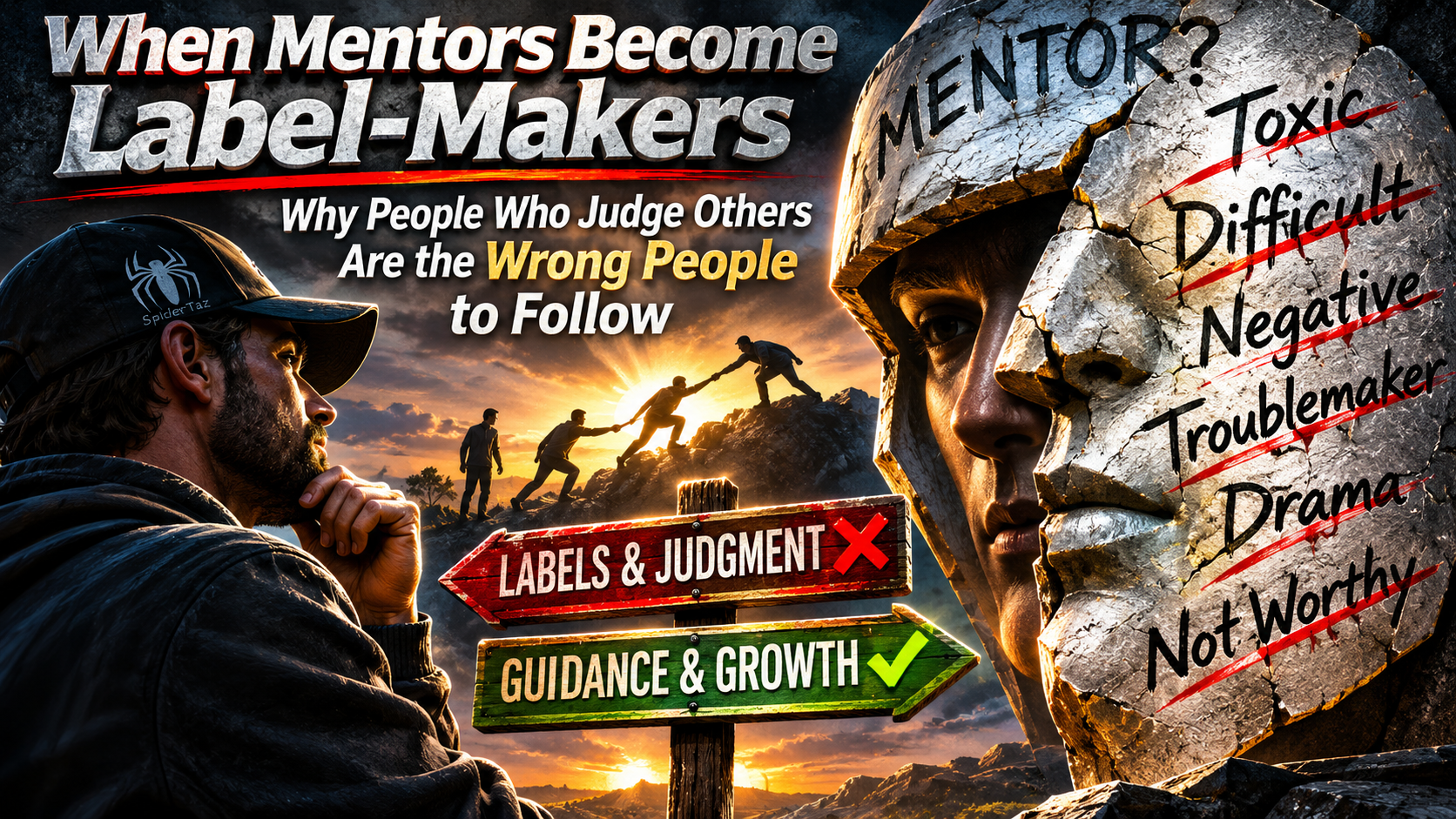
When Mentorship Becomes Judgment
There is a fundamental difference between someone who mentors others and someone who simply sits around judging them.
A mentor teaches. A mentor guides. A mentor shares experience, encourages improvement, and helps people discover opportunities they might otherwise overlook.
A label-maker does something entirely different.
They categorize people. They assign negative descriptions. They make assumptions about personalities, intentions, and character without necessarily understanding the circumstances.
And in some communities, these individuals are given positions of influence over the very people they should be helping.
That raises an important question: Why would anyone seek guidance from someone whose first instinct is to label people instead of understanding them?
Labels Are Not Evidence
Calling someone toxic does not make them toxic.
Calling someone difficult does not mean they are wrong.
Calling someone negative does not invalidate their concerns.
And calling someone a troublemaker does not establish that they have actually caused trouble.
Words are easy. Evidence requires effort.
When someone repeatedly uses labels instead of presenting facts, they are not demonstrating leadership. They are demonstrating an unwillingness to examine the situation beyond their own judgment.
A person asking questions may be seeking accountability.
A person challenging an established system may have identified a legitimate problem.
A person refusing to agree with the majority may simply be thinking independently.
Disagreement is not misconduct. Criticism is not automatically hostility. Independence is not a character flaw.
Any mentor who cannot recognize those distinctions should reconsider their approach to mentorship.
A Title Does Not Make Someone a Mentor
Being appointed a mentor, receiving recognition from a company, or holding influence in a community does not automatically establish someone's ability to guide others.
Titles are assigned. Respect is earned.
The real measure of a mentor is found in their actions.
Do they help struggling members improve?
Do they share knowledge without expecting obedience?
Do they listen before forming conclusions?
Do they encourage people to think independently?
Or do they spend their time deciding which individuals deserve negative labels?
A mentor who consistently chooses the latter is failing the fundamental purpose of mentorship.
If your primary contribution to a community is telling everyone what is wrong with other people, you are not building that community.
You are helping create divisions within it.
The Danger of Turning Personal Opinions Into Community Reputations
The problem becomes more serious when influential individuals repeat negative descriptions of others.
An unsupported opinion can gradually become accepted as fact simply because enough people repeat it.
Someone gets labeled difficult.
Others begin treating that description as established truth.
Before long, the individual is judged not by their actual conduct but by a reputation constructed through repeated claims.
This can create an environment where accusations receive more attention than evidence and popularity becomes more important than fairness.
Mentors should be working against that behavior, not contributing to it.
Their responsibility should be to encourage constructive communication, examine disputes fairly, and distinguish documented conduct from personal opinion.
Mentorship Is Not About Controlling People
A healthy mentor does not require everyone to agree with them.
They do not demand unquestioning loyalty.
They do not treat independent thinking as a threat.
And they do not use their position to determine who is worthy of participation based solely on personal preferences.
The purpose of mentorship is to develop stronger, more capable individuals.
That includes helping people become confident enough to make their own decisions, ask difficult questions, and disagree respectfully.
A mentor who cannot tolerate those qualities may be more interested in maintaining influence than developing talent.
The goal of mentorship should be to create people who no longer need constant guidance, not people who are afraid to think without permission.
Companies and Communities Need to Examine Who Represents Them
Organizations that establish mentorship programs should look beyond popularity, visibility, and personal relationships when selecting representatives.
A person's ability to attract attention does not necessarily translate into an ability to teach.
Someone may be highly skilled at a game, successful as a content creator, or well-known within a community while still lacking the judgment required to mentor others effectively.
Organizations should evaluate how mentors communicate, handle disagreement, resolve conflict, and treat individuals who challenge their opinions.
They should also establish clear expectations against harassment, unsupported personal accusations, and the misuse of authority.
When mentorship positions become social status symbols rather than responsibilities, the people those programs are intended to serve can lose out.
Stop Labeling People and Start Helping Them
There is nothing impressive about sitting around identifying everything supposedly wrong with other people.
Anyone can criticize.
Anyone can assign a label.
Anyone can repeat an accusation.
But teaching someone something valuable takes knowledge, patience, and effort.
Helping someone overcome an obstacle requires commitment.
Recognizing potential in someone others have dismissed requires an open mind.
Those are the qualities that distinguish meaningful mentorship from ordinary judgment.
A genuine mentor should leave people better informed, more capable, and more confident than they were before the interaction.
If all someone leaves behind is a collection of negative labels, what exactly have they contributed?
The Bottom Line: Choose Mentors Who Build, Not Those Who Label
People seeking guidance should pay attention to how potential mentors treat others, especially those who disagree with them.
Watch what they do when someone makes a mistake.
Watch how they respond to legitimate criticism.
Watch whether they offer solutions or simply assign blame.
And watch whether their involvement produces actual improvement.
The wrong mentor teaches you who to dislike. The right mentor teaches you how to become better.
That distinction matters in gaming, business, education, content creation, and virtually every community where experienced individuals are expected to guide others.
Mentorship should never become an excuse to judge people from a position of perceived superiority.
It should be an opportunity to share knowledge and create opportunities for others.
A Question Every Community Should Be Asking
Before accepting someone's authority as a mentor, ask one simple question:
What have they actually helped someone accomplish?
Not how many people they have criticized.
Not how many labels they have assigned.
Not how much influence they claim.
What have they taught? What have they improved? Who have they helped succeed?
Those answers reveal far more about someone's qualifications than any title ever could.
Because a person who spends their time labeling others may know how to judge people, but that does not mean they know how to mentor them.
Reader Call to Action
Have you encountered a mentor, community leader, or influential individual who seemed more interested in labeling people than helping them?
What should organizations do when people entrusted with mentorship use their influence to judge rather than guide?
Share your experiences and join the discussion.
Communities grow stronger when people share knowledge, challenge ideas fairly, and build opportunities instead of tearing down individuals.
NewsSpoiler.com — Question the labels. Examine the evidence. Judge leadership by its actions.