
Months Later, What Has Pixonic Actually Fixed?
In June 2026, NewsSpoiler published concerns about Pixonic's War Robots Creator Program, including questionable performance statistics, the classification of unrelated videos, and a support process that reportedly failed to deliver meaningful answers.
Nearly five months later, the central questions remain.
And the controversy has expanded.
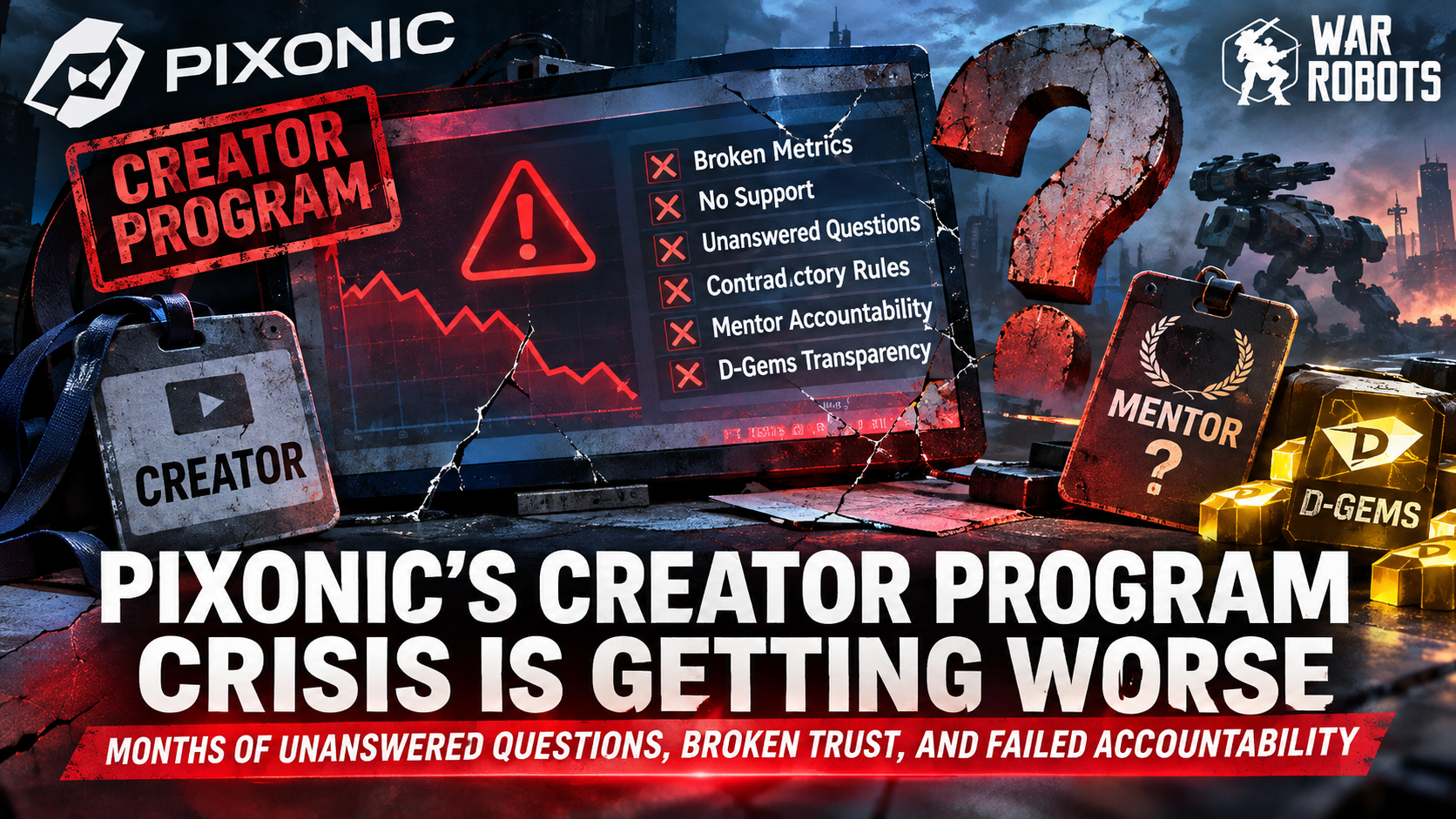
What began with concerns about automated statistics now includes creator independence, unanswered communications, monetization transparency, the treatment of independent community builders, and the accountability of individuals receiving official recognition through Pixonic's Mentor program.
The latest reports raise a disturbing question:
How many problems can a company leave unresolved before the problems themselves become evidence of a much larger failure in leadership?
Pixonic may have explanations. It may have made internal changes that have not been communicated publicly. But from the perspective documented in these reports, the essential problem remains: the affected creator still lacks satisfactory answers.
And that is not progress.
The Original Problems Have Not Gone Away
The June 21 investigation identified a specific concern involving Pixonic's Creator Program dashboard.
A video titled "The YouTube Algorithm Isn't Broken... You're Playing The Wrong Game" appeared among content associated with War Robots creator statistics, despite being a general discussion about YouTube rather than War Robots gameplay.
That raised questions about how Pixonic identifies eligible content and whether unrelated videos could affect creator evaluations.
The concern was never simply about one incorrectly classified video.
It was about the reliability of a system that creators are expected to trust.
If a company evaluates creators through automated statistics, those statistics must be accurate, explainable, and open to correction.
Otherwise, creators cannot independently verify whether they are being treated fairly.
The original reporting also described unsuccessful attempts to obtain meaningful support.
Months later, NewsSpoiler has not established that the underlying classification issue has been corrected or that the affected creator has received a satisfactory resolution.
A problem does not become resolved simply because enough time passes without an answer.
Creator Freedom Means Nothing Without Reliable Systems
Pixonic's Creator Program has communicated that participating creators are free to produce content beyond War Robots.
That is an important principle.
Creators should be able to expand their audiences, cover additional games, discuss technology, publish educational content, and build independent businesses.
But the earlier reporting raised a contradiction.
If unrelated content can be classified as War Robots content, how can creators trust that expanding their channels will not interfere with their program statistics?
A creator should not have to consider whether a harmless word in a video title might trigger an incorrect classification.
Nor should a creator have to choose between developing an independent brand and maintaining confidence in a company's automated evaluation system.
The problem is not necessarily that Pixonic deliberately restricts creators.
The problem is that unreliable systems can undermine the very independence a company claims to support.
Until the classification process is transparent and creators have an effective dispute mechanism, the original concern remains legitimate.
The Silence Has Become Part of the Story
When NewsSpoiler first raised these issues, the immediate concern was whether Pixonic would investigate and respond.
Now, the duration of the unresolved concerns has become significant.
A delayed response can be explained.
A technical problem can be investigated.
A mistake can be corrected.
But repeated questions without meaningful answers create a different problem: the absence of visible accountability.
According to SpiderTaz, communications concerning creator participation, monetization, support, and other program issues have not produced satisfactory responses.
That account deserves examination, not automatic dismissal.
It also leaves Pixonic with an opportunity to provide its own explanation.
Has the company reviewed the reported classification issue?
Has it established a reliable correction process?
Has it explained how creators can challenge inaccurate evaluations?
Has it addressed concerns about its D-Gems purchasing system and creator participation?
These are practical business questions.
They should not require months of public criticism to receive answers.
Now the Mentor Program Is Under Scrutiny
The controversy has moved beyond software and customer support.
On November 13, NewsSpoiler published an examination of Pixonic's Mentor program, questioning whether the company's use of the Mentor designation is supported by appropriate expectations and accountability.
The distinction matters.
A popular content creator is not automatically an effective mentor.
A large subscriber count does not establish integrity.
Official recognition does not establish sound judgment.
And access to a gaming company does not make someone qualified to guide an entire community.
Mentorship involves teaching, supporting, encouraging, and helping others develop.
It should never become an excuse for superiority, exclusion, favoritism, or the dismissal of legitimate criticism.
The November 13 report questioned whether Pixonic applies meaningful standards to people who receive this recognition.
Those questions do not establish misconduct by any particular Mentor.
They do, however, identify an important responsibility belonging to Pixonic.
When a company awards a title associated with trust and leadership, the company becomes responsible for explaining what that title represents and how its standards are enforced.
If mentorship is supposed to benefit the community, its success should be measured by the assistance, knowledge, and opportunities it creates—not merely by the visibility of the people selected.
Independent Creators Are Building What Companies Should Be Supporting
Another issue has emerged from the continuing dispute.
Independent creators are no longer limited to operating YouTube channels.
They build websites, communities, applications, publishing systems, creator services, and their own distribution networks.
SpiderTaz, founder of the SpiderTaz Network, has developed independent platforms including WRUniverse.com, which provides a separate community destination for War Robots players.
These efforts represent investment in the broader gaming ecosystem.
They also demonstrate why evaluating creators solely through individual video metrics or subscriber counts provides an incomplete picture of their contributions.
A creator operating an independent community platform may contribute value through player engagement, discovery, information, events, and infrastructure that a conventional creator dashboard does not capture.
Pixonic is not obligated to endorse every independent project.
It is not obligated to agree with every criticism.
But a company that promotes community participation should have a credible process for engaging with the people investing resources into that community.
Independence should not make a creator invisible.
The D-Gems Questions Add Another Layer
Concerns about Pixonic's D-Gems purchasing infrastructure have added another dimension to the dispute.
SpiderTaz has questioned the visibility of creator-support mechanisms, the handling of creator inquiries, and the transparency of purchasing-related information.
These concerns are separate from the original creator-statistics issue, but they point toward the same underlying requirement.
Transparency.
When a company operates a purchasing system alongside a creator ecosystem, participants should be able to understand how those systems interact.
Can players support their preferred creators?
What participation options exist?
How are creators informed about eligibility and opportunities?
Where can they obtain authoritative answers?
These questions do not establish that Pixonic has violated a law or deliberately withheld benefits.
They establish that meaningful explanations are needed.
And once again, the reported difficulty obtaining answers has become part of the controversy.
Four Reports, One Recurring Problem
Across four NewsSpoiler articles, the subjects have expanded considerably.
First came the concerns about inaccurate creator metrics and ineffective support.
Then came the contradiction between promised creator independence and the behavior of automated tracking.
Next came questions about Pixonic's communication with independent creators and its handling of creator-related concerns.
Finally came scrutiny of the Mentor designation and whether recognized community leaders are held to appropriate standards.
Different issues.
Different responsibilities.
One recurring question:
Where is the accountability?
A creator program cannot rely on trust while leaving its evaluation methods difficult to challenge.
A company cannot promote creator independence without ensuring its systems respect that independence.
A community program cannot celebrate leadership without establishing standards for that leadership.
And a support operation cannot measure its success by whether a message was received rather than whether the underlying concern was addressed.
What Has Actually Gotten Worse?
The original June reporting focused primarily on a technical problem and the response to it.
The November reporting describes a broader breakdown in confidence.
The scope of the criticism has expanded from automated statistics to multiple areas of Pixonic's creator relationships.
The amount of time without a satisfactory resolution has increased.
Additional questions about creator recognition, monetization, and communication have entered the discussion.
And the continuing lack of satisfactory answers has made the original complaints harder to separate from the company's overall approach to creator relations.
That does not prove every alleged problem has worsened technically.
It does mean the documented dispute has grown more extensive, more persistent, and more consequential.
What started as a question about whether the numbers could be trusted has become a question about whether the program itself can be trusted.
Pixonic Has Had Time to Respond
The company does not need another public-relations slogan.
It needs to provide verifiable answers.
Publish clear explanations of how creator statistics are calculated.
Provide a process for correcting incorrectly classified content.
Clarify how creator independence is protected.
Explain how D-Gems creator participation works.
Establish meaningful standards and accountability for the Mentor program.
And provide a dependable route for resolving creator complaints.
These are not extraordinary demands.
They are reasonable expectations for a company operating an official creator program.
If Pixonic believes the published criticism is inaccurate, it should identify the inaccuracies and provide supporting information.
If the problems have been corrected, it should explain what changed.
If investigations remain ongoing, it should communicate that clearly.
Silence leaves the questions unanswered.
The Community Deserves Better Than Another Five Months
War Robots players and creators have spent years contributing to the game's visibility, entertainment value, and community identity.
Their work should not be reduced to numbers on a dashboard.
Their questions should not disappear into unanswered communication channels.
And official recognition should never become a substitute for actual contribution or accountability.
The fundamental issue is not whether Pixonic agrees with SpiderTaz, NewsSpoiler, or any other independent critic.
The issue is whether Pixonic can demonstrate that its systems, policies, and community programs operate according to the standards it promotes.
That is a question the company should welcome the opportunity to answer.
The Bottom Line: The Problems Have Outgrown the Original Complaint
In June, the question was whether Pixonic could fix an apparent problem with creator statistics.
In November, the question is much larger.
Can Pixonic restore confidence in a Creator Program now facing criticism over data reliability, communication, creator independence, monetization transparency, and mentorship accountability?
The company still has the opportunity to respond.
But time alone will not repair the damage to confidence.
Another unanswered inquiry will not repair it.
Another title, badge, announcement, or promotional campaign will not repair it.
Accountability requires action. Transparency requires answers. Trust requires both.
And until Pixonic provides those answers, NewsSpoiler will continue examining the questions its creator community deserves to have addressed.
A Call to War Robots Creators and Players
If you participate in Pixonic's Creator Program, review your statistics. Check which videos are being counted. Document discrepancies. Preserve correspondence concerning unresolved support requests.
If you have experience with the Mentor program, creator eligibility, D-Gems participation, or official community support, share specific, verifiable information.
The goal should not be to manufacture allegations or target individuals without evidence.
The goal should be to establish what is happening, what has been corrected, what remains unresolved, and who is responsible for providing answers.
War Robots belongs to Pixonic. But the voices, work, communities, and independent platforms built around it belong to the people who created them.
Those voices deserve to be heard.