
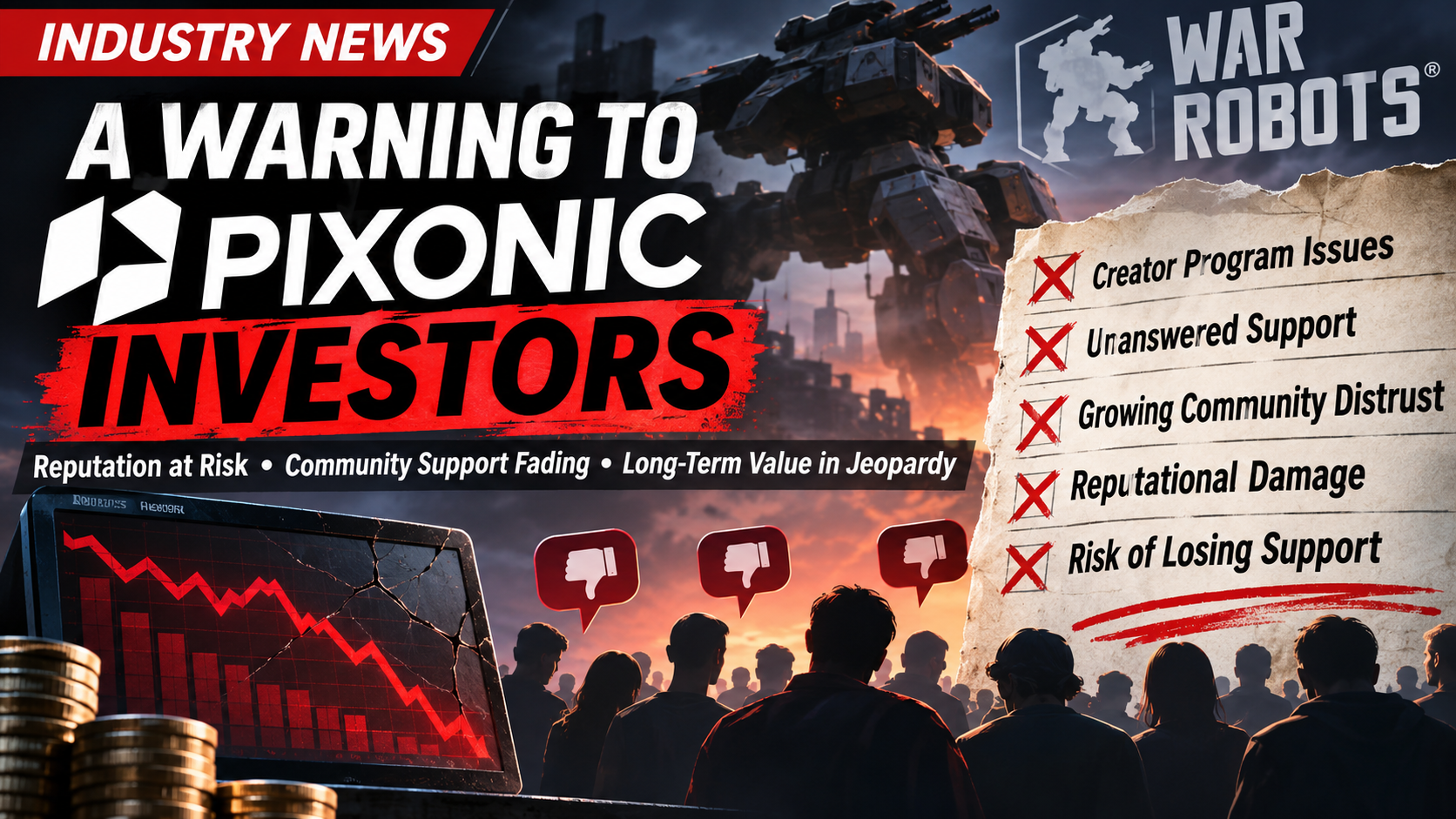
To the Investors Behind Pixonic: Are You Paying Attention?
This article is directed at the investors, shareholders, financial stakeholders, and corporate decision-makers with an interest in Pixonic and its future.
You have a financial interest in a company whose success depends on more than developing video games, selling digital products, and generating revenue.
Your investment also depends on the people who keep those games alive.
The players who spend money. The creators who produce content. The communities that promote the games. The independent platforms that provide exposure without demanding payment.
Those relationships have value.
And when a company repeatedly mishandles those relationships, it risks destroying something that cannot simply be purchased back: public trust.
Pixonic, the developer behind War Robots, is facing public criticism concerning its creator program, communication practices, support responsiveness, and treatment of independent community contributors.
These concerns deserve attention from anyone financially invested in the company's long-term success.
Because the problem is no longer simply whether an individual creator receives an answer.
The bigger question is whether Pixonic's management recognizes the reputational damage its decisions may be creating for everyone associated with the business.
Your Investment Is Being Represented by These Decisions
Investors do not personally answer creator support requests.
They do not necessarily manage community programs, establish creator eligibility requirements, or decide which complaints receive responses.
But the people responsible for those decisions represent the company in which investors have placed their confidence.
Every ignored complaint, unexplained decision, inconsistent policy, and unresolved creator dispute can become another reason for people to question the company.
That reputation extends beyond Pixonic itself.
When a company develops a reputation for disregarding its own community, stakeholders may find themselves associated with management decisions they never personally approved.
Investors should be asking whether Pixonic's current community-management practices are protecting the company's long-term value or unnecessarily putting it at risk.
A profitable product does not automatically mean a healthy relationship with its customers.
Strong sales today do not guarantee community loyalty tomorrow.
And a company that assumes its audience will remain indefinitely, regardless of how it is treated, may discover that loyalty has limits.
Creators Are Providing Something Pixonic Would Otherwise Have to Pay For
Consider the value independent creators provide.
They produce videos, livestream gameplay, explain updates, introduce new players, organize events, maintain communities, and keep War Robots visible across digital platforms.
Much of this work happens without direct compensation from Pixonic.
Some creators invest their own money into websites, equipment, hosting, software, giveaways, and community infrastructure.
That activity generates attention and engagement that benefits the game's ecosystem.
In conventional business terms, these creators contribute to customer acquisition, brand awareness, audience retention, and community engagement.
Yet serious concerns have been raised about whether Pixonic's creator program adequately recognizes and supports those contributions.
SpiderTaz, an independent creator and platform operator, has publicly criticized the company's creator-program metrics, support responsiveness, communication, and apparent inconsistencies between stated policies and their application.
These are reported concerns and allegations, not independently established findings about every creator's experience.
Nevertheless, they raise questions that investors should expect management to answer.
Why would a company risk alienating people who voluntarily promote its products?
And why would investors accept avoidable reputational risk without demanding an explanation?
A Creator Program That Loses Trust Becomes a Business Liability
Creator programs should establish productive relationships between developers and the people who promote their games.
The arrangement should be straightforward.
Creators receive clear rules, consistent treatment, dependable communication, and reasonable opportunities to participate.
The company receives exposure, community activity, feedback, and a network of people invested in the game's continued success.
But that relationship begins breaking down when creators believe the rules are inconsistent, performance metrics are unreliable, or support channels are ineffective.
The damage can extend beyond any one creator.
Other creators may begin questioning whether participation is worthwhile.
Independent communities may become less willing to organize promotional activities.
Players may start questioning the company's commitment to the people supporting its products.
Potential partners may become reluctant to associate their own reputations with the brand.
None of these outcomes is inevitable, and the scale of any existing financial damage has not been established.
But the underlying business risk is clear.
A company that weakens its own promotional community may eventually have to spend more money replacing support it previously received voluntarily.
That is a legitimate concern for investors.
Silence Is Not a Business Strategy
One of the most damaging aspects of the criticism directed at Pixonic is the reported lack of meaningful communication.
When creators raise questions about program rules, eligibility, metrics, or treatment, they should receive substantive responses.
A company does not have to agree with every complaint.
It does not have to grant every request.
It does not have to give every creator special treatment.
But it should be able to explain its policies and provide a reasonable process for resolving disputes.
When concerns remain unanswered, the company leaves people to draw their own conclusions.
And when complaints become public, silence can create the appearance that management is either unwilling or unable to address them.
Investors should not confuse a lack of corporate response with a resolution.
An unanswered problem is still a problem. Ignoring criticism does not make the underlying business risk disappear.
Pixonic Could Lose More Than a Few Creators
The greatest danger is not necessarily that one creator stops producing War Robots content.
It is the possibility of a broader erosion of voluntary community support.
A creator can stop promoting a game.
A website operator can redirect attention toward competing titles.
A community organizer can stop arranging events.
A player can decide that future purchases are no longer worthwhile.
And potential newcomers can choose another game before ever becoming paying customers.
These are individual decisions, but their combined effect can become significant.
The gaming industry offers players and creators numerous alternatives competing for their time, attention, and money.
Pixonic cannot assume that its community has nowhere else to go.
Nor should investors assume that existing brand recognition guarantees permanent loyalty.
Community support is an asset. Treating it as disposable is a risk.
The Investors Deserve Answers, Not Excuses
Those with a financial interest in Pixonic should be asking management some direct questions:
- How many creator complaints remain unresolved, and what is their average response time?
- Are creator-program metrics independently checked for accuracy and consistency?
- Are published creator-program rules applied uniformly?
- What process exists for appealing disputed creator decisions?
- Does management measure creator satisfaction, retention, and participation?
- How does Pixonic assess the promotional value of independent creators and community platforms?
- What corrective actions are taken when communication or support systems fail?
- What safeguards exist to prevent avoidable community disputes from becoming reputational liabilities?
These are not unreasonable demands.
They are ordinary questions about operational accountability, brand management, and the protection of business value.
A responsible company should be able to explain how it maintains productive relationships with the communities that help sustain its products.
Your Name Is Attached to the Company's Reputation
To Pixonic's investors and financial stakeholders:
You may have invested because you believed in the games, the technology, the market opportunity, or the company's ability to generate returns.
But the people managing that investment also have a responsibility to protect the company's reputation.
When customers and creators publicly question how they are treated, those concerns deserve investigation.
When support systems are accused of failing, management should demonstrate that they function.
When program rules are disputed, the company should provide transparency.
And when independent contributors believe their work is being disregarded, the company should evaluate whether its practices are damaging valuable relationships.
You should not have to wait for declining engagement, reduced spending, or lost partnerships before asking whether management has created an avoidable problem.
By the time reputational damage appears clearly in financial results, rebuilding lost relationships may be considerably more difficult.
This Is an Opportunity for Pixonic to Correct Its Course
The solution does not require Pixonic to surrender control of its creator program.
It requires accountability.
Publish clear program requirements. Verify performance measurements. Establish dependable support channels. Provide meaningful responses to unresolved disputes. Apply policies consistently.
Most importantly, recognize that independent creators are not simply interchangeable promotional accounts.
They are people and businesses that have invested time, resources, and credibility into building audiences around Pixonic's products.
The company has an opportunity to strengthen those relationships rather than allowing disputes to escalate.
But that opportunity requires action.
Final Message to Pixonic's Investors: Do Not Wait Until the Support Is Gone
Pixonic's investors should be concerned about any management practices that unnecessarily jeopardize customer loyalty, creator participation, or the company's public reputation.
No verified evidence presented here establishes that Pixonic has already suffered measurable investment losses from these disputes.
That is precisely why investors should seek answers now, rather than waiting for potential consequences to become measurable.
The criticism is public.
The questions are legitimate.
The opportunity to respond remains.
Pixonic does not own the loyalty of its players. It does not own the independent creators who promote its games. And it does not own the communities that have helped make War Robots recognizable.
Those people can choose where to spend their time, money, and influence.
If Pixonic continues allowing unresolved concerns to damage its relationships with independent supporters, it risks losing something much more valuable than a single promotional opportunity.
It risks losing the community confidence that helps sustain its business.
To the investors: Your money may support the company, but the community supports the game. You should be demanding that Pixonic protect both.