
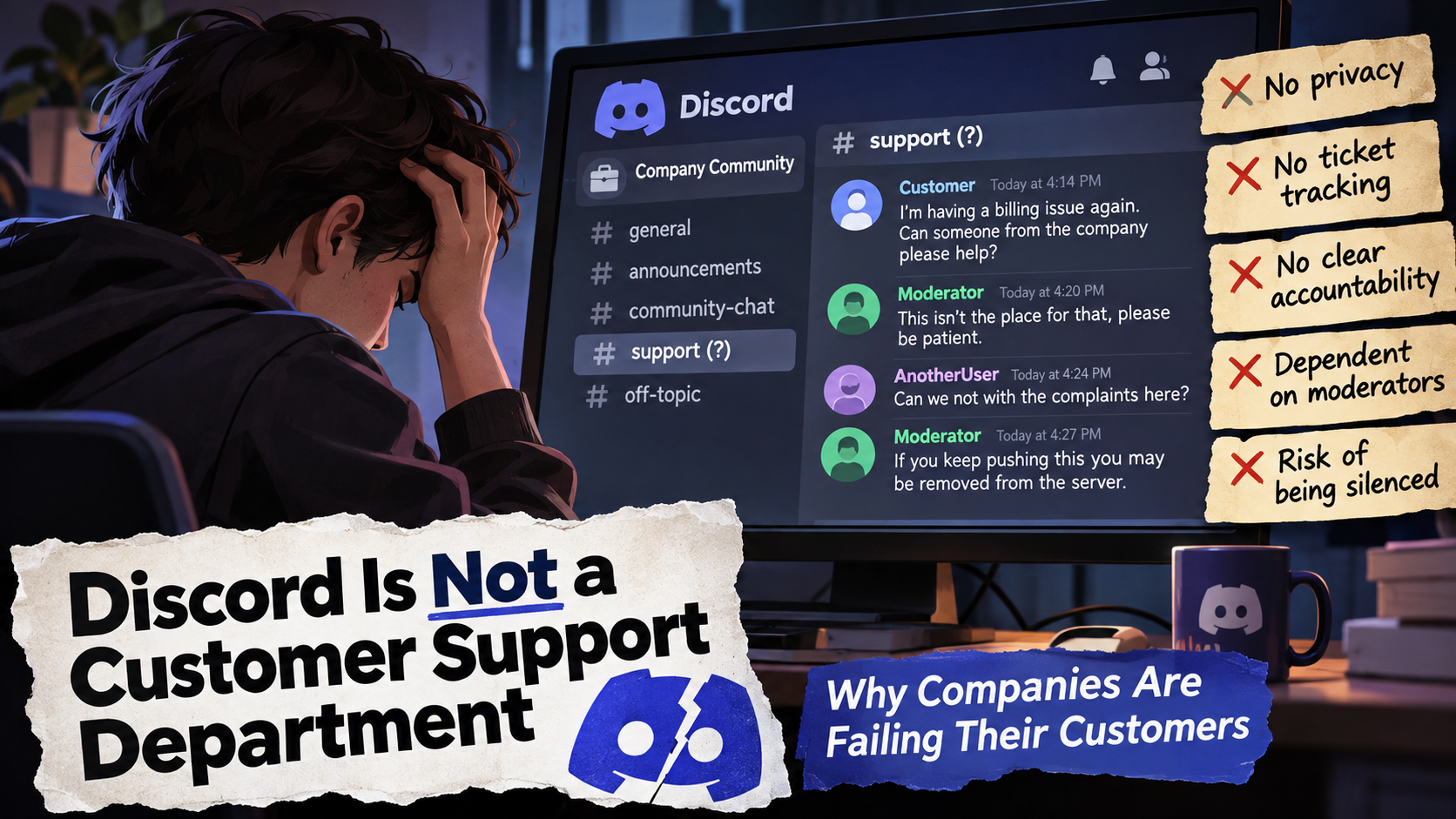
The Growing Problem With Discord-Based Customer Support
There is a growing trend among gaming companies, software developers, and online service providers to use Discord as a primary customer support channel.
What began as a platform for community communication has increasingly become a substitute for structured customer service.
And that raises a serious question:
When did companies decide that customers should have to enter a social community just to receive professional support?
Discord was designed around communities, conversations, and real-time interaction. It can be useful for announcements, discussions, and connecting people with shared interests.
But community interaction and professional customer support are two very different responsibilities.
A company collecting money from customers should provide a reliable, accountable, and private method of resolving problems.
A Discord server does not automatically provide any of those things.
Customers Should Not Have to Join a Social Club to Get Support
When someone purchases a product, subscribes to a service, or participates in a company's commercial program, they establish a business relationship.
That relationship should not require participation in a social environment.
Customers should not have to:
- Join a Discord server to report a problem.
- Navigate dozens of channels looking for assistance.
- Discuss private business matters in front of strangers.
- Depend on volunteer moderators to recognize legitimate complaints.
- Risk harassment or ridicule while requesting support.
- Wait for someone to notice their message in an active conversation.
- Remain in a community where they may be unwelcome just to maintain access to assistance.
None of these requirements represents a professional customer support framework.
A customer requesting assistance is not asking to socialize. They are asking a company to fulfill its responsibilities.
Volunteer Moderators Are Not a Substitute for Accountable Employees
One of the most concerning aspects of Discord-based support is the reliance on community moderators.
Some moderators are responsible and capable. Others may lack professional customer service training, knowledge of company policies, or authority to resolve disputes.
Yet companies sometimes place these individuals between customers and the people actually responsible for providing support.
That creates an obvious accountability problem.
Who is responsible when a moderator dismisses a legitimate complaint?
Who reviews situations where a customer is publicly insulted or intimidated?
Who ensures that moderators are not allowing personal disagreements to influence business decisions?
And who holds the company accountable when a customer is removed from the server before their issue is resolved?
A company cannot reasonably treat community moderation as a replacement for professional customer service accountability.
If a business chooses to delegate customer-facing responsibilities, it should maintain oversight, escalation procedures, and clear standards of conduct.
Customer Support Should Never Become a Public Spectacle
Some customer complaints involve financial transactions, commissions, account restrictions, billing disputes, personal information, or business relationships.
These are not matters that should be casually discussed in public channels.
When a company directs customers into Discord for support, it must distinguish between community discussion and confidential business communication.
Publicly discussing someone's financial arrangements or unresolved commercial dispute can create unnecessary privacy and reputational risks.
Customers should have access to secure, private communication channels where their concerns can be documented and reviewed by authorized company representatives.
A public chatroom is not an appropriate substitute for that process.
Discord Can Create an Environment Where Customers Are Silenced
Another serious concern is the power imbalance between customers and those controlling a Discord server.
A moderator may be able to delete messages, restrict participation, remove access, or ban individuals.
Those powers can serve legitimate community management purposes.
But when the same server functions as a company's primary support channel, those moderation decisions can interfere with a customer's ability to obtain assistance.
Consider what happens when a customer repeatedly reports a problem that the company has failed to resolve.
Instead of receiving a support ticket, an escalation, or a documented response, the customer may find their messages removed or their participation restricted.
At that point, the issue is no longer simply community moderation.
It becomes a question of whether the company has provided a meaningful way to pursue customer support independently of its community rules.
Deleting a complaint does not resolve the complaint. Banning a customer does not eliminate the company's responsibilities.
The Missing Paper Trail
Professional customer support systems are designed to maintain records.
A properly managed support ticket can document when a complaint was submitted, who handled it, what actions were taken, and whether the issue was resolved.
Discord conversations do not inherently provide the same structured customer-service recordkeeping.
Messages can become buried in conversation, deleted, edited, or difficult to retrieve.
Even private Discord messages do not automatically provide the reporting, escalation, retention, and auditing capabilities expected from a professional support system.
This becomes especially concerning when disputes involve payments, contractual obligations, creator commissions, or access to purchased services.
A business should be able to demonstrate what happened to a customer's complaint without relying on someone searching through thousands of chat messages.
Companies Should Stop Confusing Community Engagement With Customer Service
There is nothing inherently wrong with businesses operating Discord communities.
Discord can be valuable for product announcements, player discussions, feedback, community events, and peer-to-peer assistance.
The problem begins when companies confuse those activities with their obligation to provide dependable customer support.
Community engagement is optional.
Professional customer service should not be.
A company can operate an excellent Discord community while maintaining a dedicated support portal, secure ticketing system, official email contact, and clearly defined escalation process.
These services are not mutually exclusive.
In fact, separating community interaction from formal customer support can protect both customers and moderators from unnecessary conflict.
Companies That Profit From Customers Must Accept Responsibility
Businesses cannot reasonably expect customers to make purchases, promote products, generate revenue, or participate in commercial programs while treating professional support as an optional courtesy.
Customer support is part of operating a responsible business.
If a company has enough infrastructure to collect payments, manage subscriptions, track commissions, and distribute products, it should also invest in systems that address problems arising from those activities.
Customers should not have to publicly argue for basic assistance.
They should not have to depend on personal relationships with moderators.
And they should not have to repeatedly explain the same problem because the company lacks a proper system for documenting complaints.
If a company can build a system to collect your money, it can build a system to address your problems.
The Bigger Issue: Accountability Cannot Be Outsourced to a Chatroom
The most troubling part of this trend is not Discord itself.
It is the willingness of some businesses to place an informal communication platform between themselves and the people they serve.
When a customer cannot identify who is responsible for handling a complaint, how to escalate it, or where to obtain a formal response, the support structure has failed its purpose.
A Discord moderator is not automatically a customer service representative.
A community announcement is not a support resolution.
A private message is not necessarily a formal complaint record.
And a Discord server is not automatically a professional customer support department simply because a company calls it one.
What Companies Need to Change
Companies relying on Discord should establish an independent customer support system with secure ticket submission, reference numbers, documented responses, defined escalation procedures, and appropriate privacy protections.
Discord can remain a secondary communication tool, but it should not be the only realistic avenue for resolving commercial disputes.
Customers must also retain access to formal support when they leave a community, are removed from a server, or experience a conflict with its moderators.
A company's obligations should not depend on whether a customer remains welcome in its Discord community.
Final Word: Customers Deserve Support, Not a Popularity Contest
Customer service should never depend on who likes you, which moderator is online, how popular you are in a community, or whether your complaint makes a company uncomfortable.
Businesses must learn to separate community management from commercial accountability.
Discord is a communication platform. It is not an excuse to avoid responsibility.
The companies that recognize this distinction will be better positioned to earn long-term customer trust.
Those that continue using community servers to deflect complaints, obscure accountability, or substitute informal conversations for actual support should expect their customers to question the professionalism of their operations.
Customers are not asking companies to do them a favor. They are asking companies to stand behind the products, services, and business relationships from which those companies profit.
And that should never require permission from a Discord moderator.