
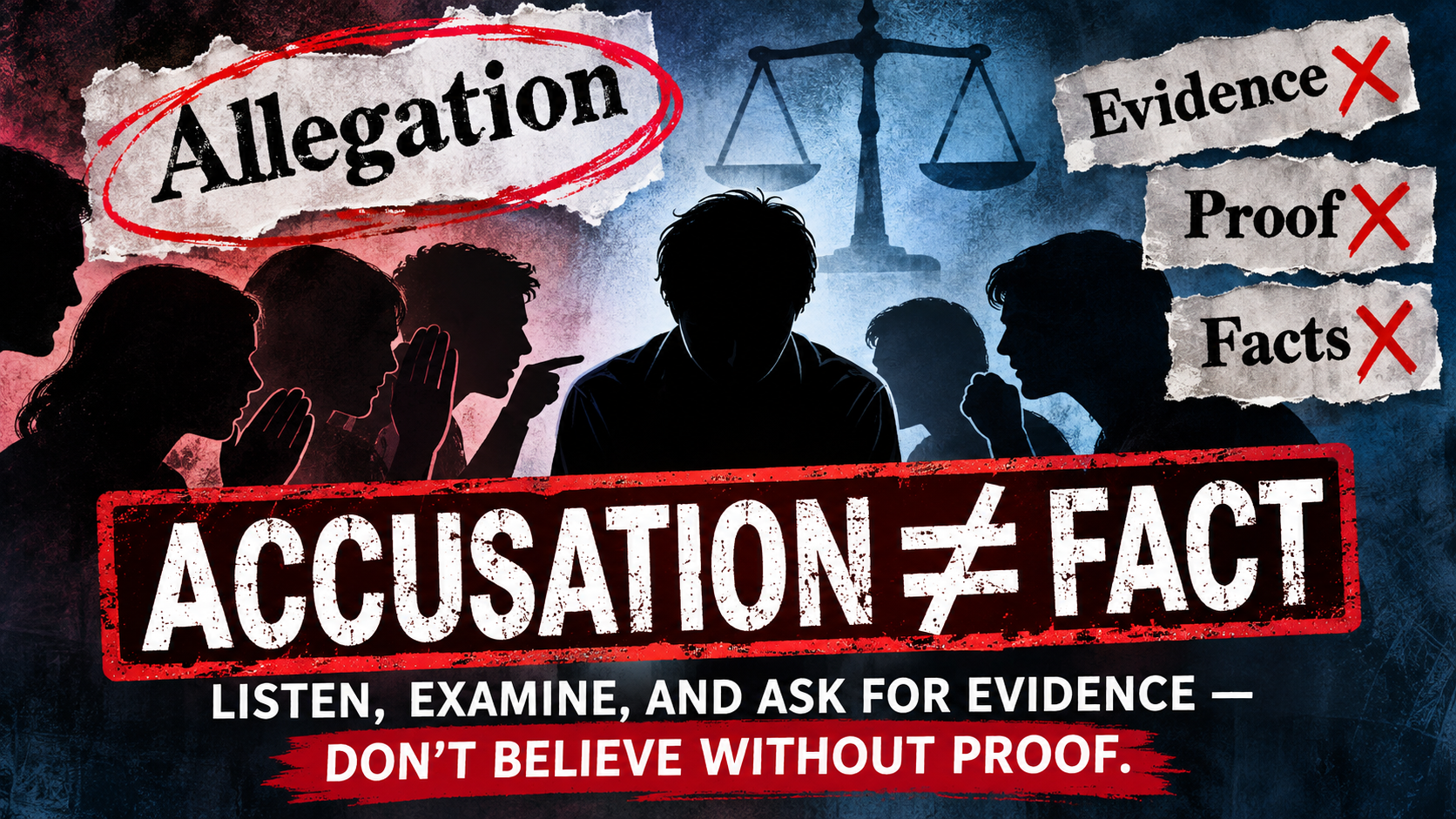
When Did an Accusation Become the Same Thing as a Fact?
Anyone can make an allegation. Anyone can point a finger, tell a story, or accuse another person of wrongdoing.
But when did simply saying something make it true?
Across social media, online communities, workplaces, and public discussions, accusations are sometimes accepted without meaningful examination. Someone makes a statement, others repeat it, and suddenly the accused person is expected to defend themselves against something that has never been established as fact.
Where is the evidence? Where are the facts? And why are people being pressured to believe allegations simply because someone made them?
These are questions society should be asking far more often.
An Allegation Is Not a Fact
There is a fundamental difference between making a claim and proving that claim.
A person can accuse someone of lying, bullying, harassment, dishonesty, or misconduct. But the accusation itself does not establish that any of those things occurred.
An allegation is a statement that something happened.
Evidence is information that helps determine whether it actually happened.
The two should never be confused.
Yet online, the distinction frequently disappears.
Someone makes an accusation, and rather than asking what supports it, others immediately begin choosing sides.
The accused person becomes the subject of criticism, ridicule, or exclusion before anyone has established what actually happened.
Making an accusation does not make someone a victim. Being accused does not make someone guilty. The facts must determine what conclusions are justified.
Why Do People Believe Something Without Asking for Evidence?
One of the most concerning aspects of online accusations is how quickly they can spread through groups.
A single individual makes a claim.
Another agrees.
Several more repeat the accusation.
Soon, an entire community may be discussing the allegation as though it has already been proven.
But what has actually changed?
Nothing.
The original allegation remains exactly what it was: a claim requiring examination.
Ten people repeating an unsupported allegation do not transform it into a verified fact.
A hundred people agreeing with an accusation do not establish its truth.
And a thousand people sharing it do not eliminate the need for evidence.
Popularity is not proof. Group agreement is not verification. Repetition does not create facts.
The Danger of Online Groups That Reinforce Accusations
Online communities can be valuable places for discussion, collaboration, and friendship.
However, they can also become environments where allegations are reinforced rather than questioned.
When group members automatically support accusations made by friends, moderators, administrators, or influential personalities, the opportunity for impartial examination can disappear.
Instead of asking whether an allegation is supported, members may begin asking who they should support.
Instead of reviewing evidence, they may repeat the statements of people they trust.
And instead of allowing the accused person to respond, they may treat any disagreement as further evidence of wrongdoing.
This creates a dangerous situation.
An individual can face widespread criticism based on allegations that nobody in the group has independently verified.
A group of people agreeing to believe something does not mean they have established that it happened.
Listening to Someone Does Not Require Blind Belief
Everyone deserves to be heard.
That includes people reporting wrongdoing, individuals raising concerns, and those responding to accusations.
But listening and believing are not identical.
A person may genuinely believe their account is accurate while misunderstanding important details.
Someone may repeat information they received from another person without knowing whether it is true.
Others may omit context, exaggerate circumstances, or intentionally make false statements.
That is why allegations should be evaluated rather than automatically accepted or dismissed.
It is also important to recognize that firsthand testimony can itself be evidence. Not every genuine incident leaves behind a recording, screenshot, or document.
The proper standard is not that every accusation must come with physical proof.
The standard is that conclusions should reflect the strength, reliability, and limitations of the available evidence.
Taking an allegation seriously means examining it responsibly, not declaring it true before examining the facts.
What Happened to Asking Questions?
There was a time when asking someone to explain or substantiate a serious claim was considered a reasonable part of determining the truth.
Today, some online discussions treat those questions as attacks.
Ask for evidence, and someone may accuse you of defending the person being criticized.
Request context, and you may be told you are taking sides.
Suggest hearing both accounts, and suddenly you are considered part of the problem.
But asking questions is not wrongdoing.
Questioning an allegation does not automatically mean rejecting it.
Requesting evidence does not mean supporting misconduct.
And refusing to participate in an online pile-on does not make someone guilty by association.
If a claim is worth making publicly, it should also be open to reasonable examination.
The Damage Can Begin Before the Truth Comes Out
An unsupported allegation can have consequences long before anyone determines whether it is accurate.
People may lose friendships, professional opportunities, community relationships, or their reputations.
Content creators may find themselves targeted by coordinated criticism.
Community members may be excluded from groups.
Businesses and individuals may face public backlash based on incomplete or misleading information.
And even when an allegation is later corrected, the original accusation may continue circulating.
The problem is not that people should remain silent about wrongdoing.
The problem is treating allegations as established facts before the available information justifies that conclusion.
Nobody should have to prove their innocence to an online crowd that has already decided they are guilty.
Accountability Should Apply to Everyone
If accountability matters, it must apply equally.
People accused of wrongdoing should be held responsible when credible evidence establishes their conduct.
But people making accusations also have a responsibility to distinguish between verified facts, personal interpretations, suspicions, and information received from others.
That responsibility becomes especially important when accusations are made publicly.
A person should not be able to use popularity, friendships, community influence, or administrative authority as a substitute for supporting information.
Nor should an accusation be treated as automatically credible because the person making it belongs to a particular group.
The same standard should apply regardless of who is involved.
If evidence matters when someone accuses you, it should matter just as much when you accuse someone else.
Stop Turning Allegations Into Public Verdicts
There is nothing wrong with listening to someone who believes they have been mistreated.
There is nothing wrong with investigating allegations.
There is nothing wrong with holding people accountable for conduct that has been established through credible evidence.
What is wrong is skipping the examination entirely and proceeding directly to public condemnation.
An accusation should begin a process of determining what happened.
It should not automatically end that process.
Online communities should encourage responsible reporting, preserve relevant evidence, consider context, and avoid presenting disputed claims as settled facts.
People should also be willing to correct inaccurate statements when new information becomes available.
Because the objective should be discovering the truth, not winning a popularity contest.
Final Thought: If You Are Going to Make an Allegation, Be Prepared for Questions
People should never be afraid to report genuine wrongdoing.
But neither should anyone be expected to accept every allegation without examining the available evidence.
The right to speak does not create an automatic right to be believed.
The right to accuse does not eliminate another person's right to respond.
And having an audience does not make a statement factual.
Society needs to stop confusing confidence with credibility, repetition with verification, and accusations with proven misconduct.
Listen to what people say. Examine what supports their claims. Consider the complete circumstances. And never confuse an allegation with an established fact.
Because the truth does not depend on who speaks first, who speaks loudest, or who has the most people standing behind them.
The truth depends on what actually happened.
And until the available evidence establishes what happened, an allegation should be reported as exactly that.
An allegation. Not a verdict.
Reader Call to Action
The next time you see someone being publicly accused of wrongdoing, ask yourself one question:
Am I looking at verified facts, or am I being asked to believe someone simply because they said it?
Before sharing an accusation, joining a public attack, or condemning another person, examine the information supporting the claim.
Do not let popularity replace evidence.
Do not let group loyalty replace independent judgment.
And do not allow an unverified accusation to become your version of the truth simply because everyone around you repeats it.
Share this article if you believe facts should matter more than accusations, and evidence should matter more than popularity.