
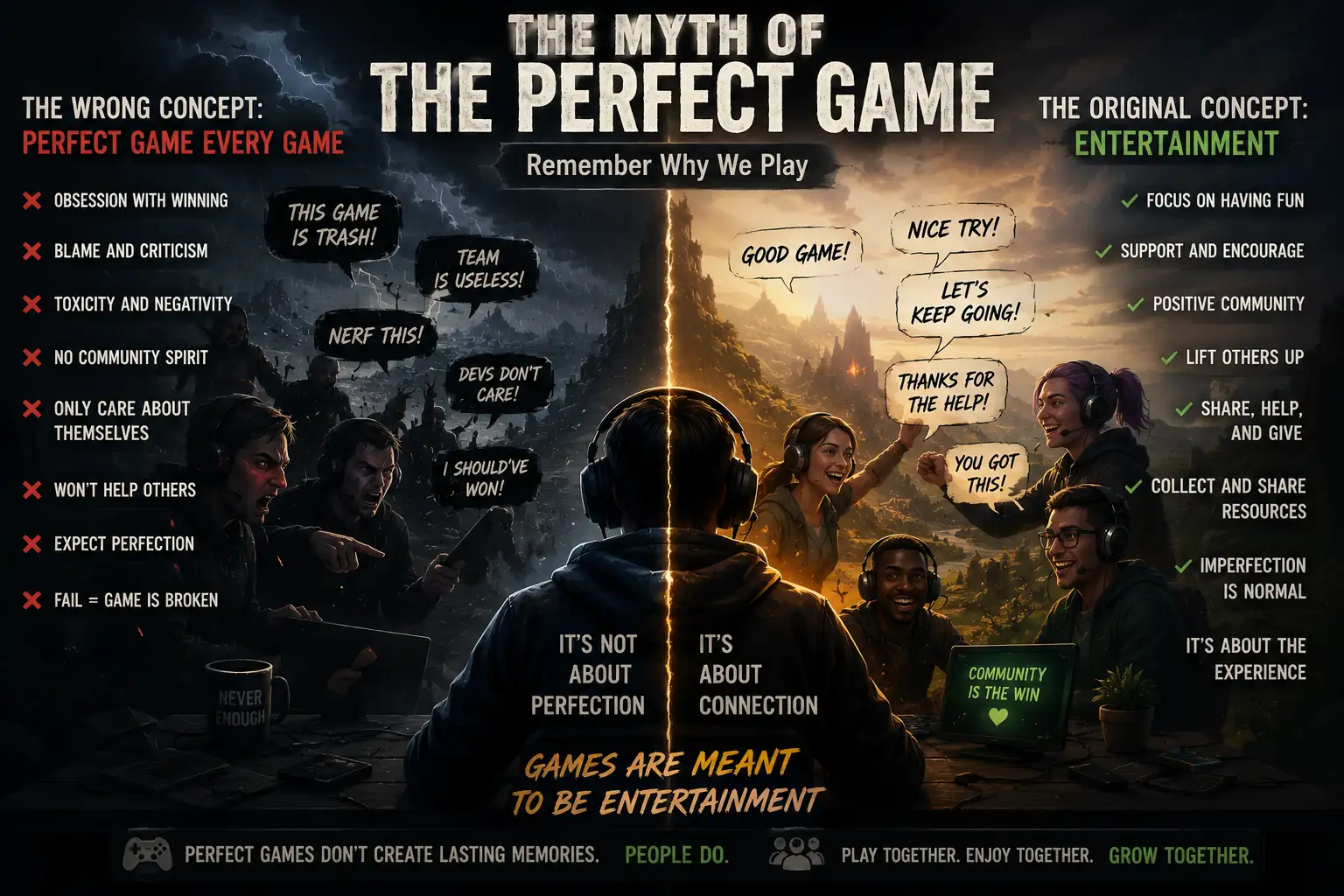
There was a time when the purpose of a game was simple:
Entertainment.
People played games because they were fun. They gathered with friends, shared experiences, laughed at failures, celebrated victories, and created memories. Nobody expected perfection. Nobody expected every mechanic to be flawless. Nobody expected every update to satisfy every player.
Somewhere along the way, that changed.
Today, many gaming communities have become trapped in the pursuit of the "perfect game." Every balance issue becomes a crisis. Every bug becomes proof that a game is failing. Every loss becomes evidence that something is broken. Instead of asking whether they enjoyed their time, many players immediately begin searching for flaws.
The result is that games are no longer judged by whether they are entertaining. They are judged by whether they meet an impossible standard of perfection.
The truth is simple:
No game has ever been perfect.
No game will ever be perfect.
And no amount of updates, patches, balancing, redesigns, or developer effort will ever create a game that satisfies every player simultaneously.
The Psychology of Perfection
The interesting part is that this is not really a gaming problem.
It is a human psychology problem.
Human beings naturally focus more on negative experiences than positive ones. Psychologists call this "negativity bias." A hundred enjoyable matches can be forgotten because of one frustrating loss.
The human brain evolved to identify problems.
It is constantly scanning for threats, unfairness, mistakes, disadvantages, and risks. In the real world, this helped our ancestors survive.
In gaming communities, it often creates something entirely different.
Players begin treating every inconvenience as evidence of failure.
The game crashes once.
The matchmaking feels unfair.
A balance change affects their favorite build.
A reward isn't what they expected.
A teammate makes a mistake.
Suddenly the discussion shifts from a specific issue to a much larger conclusion:
"The game is broken."
"The developers don't care."
"The community is dead."
"The entire system is a failure."
The brain takes a small frustration and expands it into a global judgment.
This is known as overgeneralization, and it happens everywhere—not just in gaming.
Why Losing Feels Like Something Is Broken
Many players have unknowingly developed another psychological habit.
They associate success with fairness.
If they win, the game feels balanced.
If they lose, something must be wrong.
But competition does not work that way.
Someone wins.
Someone loses.
Someone makes a better decision.
Someone gets lucky.
Someone has more experience.
Someone simply has a better day.
Yet many modern players have become conditioned to believe that frustration itself is proof of bad design.
The possibility that they were outplayed, underprepared, distracted, impatient, or simply unlucky is often dismissed.
The game becomes the target because it is easier to blame a system than confront disappointment.
That does not mean games are never flawed.
They absolutely are.
But not every negative outcome is evidence that the entire game is failing.
The Consumer Mindset Trap
Another psychological shift has happened over the years.
Players increasingly view themselves as customers evaluating a product rather than participants in an experience.
Every update is graded.
Every event is scored.
Every reward is measured.
Every decision is analyzed.
In moderation, this is healthy.
Feedback improves games.
Constructive criticism helps developers.
But when every interaction becomes a review, something important disappears.
Gratitude.
Wonder.
Curiosity.
Fun.
The player stops experiencing the game and starts auditing it.
Instead of asking, "Did I enjoy tonight?"
They ask, "Was tonight perfect?"
The answer is almost always no.
The Decline of Community Contribution
The pursuit of perfection creates another problem that often goes unnoticed.
It changes how people view contribution.
Many players will gladly collect free rewards, consume guides, use community resources, watch videos, join events, and benefit from the work of others.
Yet when someone spends hours helping the community, the response is often confusion.
"Why would you do that?"
"What's in it for you?"
"You don't even play that much."
That question reveals something important.
People have become so focused on personal gain that they struggle to understand community-driven contribution.
Communities were never built by people asking what they could get.
They were built by people asking what they could give.
Some people create guides.
Some people moderate discussions.
Some people answer questions.
Some people organize tournaments.
Some people run fan sites.
Some people collect information.
Some people simply help others.
None of those things require a perfect game.
They require people who care about other people.
My Own Experience
I have spent years collecting information, opportunities, resources, rewards, and community knowledge for other players.
Ironically, there are times when I play less than many of the people I am helping.
The question I hear is often:
"Why collect this stuff for us if you hardly play?"
The answer is simple.
Because the people matter more than the game.
Many of the reasons I continue participating in gaming communities have very little to do with the game itself.
The friendships.
The conversations.
The creators.
The shared experiences.
The communities.
Those things often outlive the game.
Yet many players have become trapped in a mindset where every flaw becomes a catastrophe and every frustration becomes proof that something is fundamentally broken.
The game is expected to deliver perfection.
The community is expected to deliver perfection.
The developers are expected to deliver perfection.
The players themselves are expected to perform perfectly.
None of that is realistic.
The Games We Remember Were Never Perfect
The funny thing is that the games people remember most fondly were never perfect.
They had bugs.
They had balance issues.
They had frustrating mechanics.
They had server problems.
They had exploits.
They had controversial updates.
But people stayed because they were having fun.
They stayed because of their friends.
They stayed because of their communities.
They stayed because entertainment mattered more than perfection.
The greatest gaming memories rarely come from flawless experiences.
They come from unexpected moments.
The comeback nobody thought was possible.
The ridiculous bug everyone laughed about.
The friend who stayed up helping.
The clan that rallied together.
The community event that brought people together.
The reward earned through effort.
The game itself is only half of the experience.
The people are the other half.
Maybe the gaming industry does not need more perfect games.
Maybe players need to stop searching for perfection in the first place.
Because perfection was never the original purpose.
Entertainment was.
Community was.
Friendship was.
Fun was.
And the moment we forget that is the moment we stop enjoying the very thing we started playing for.