
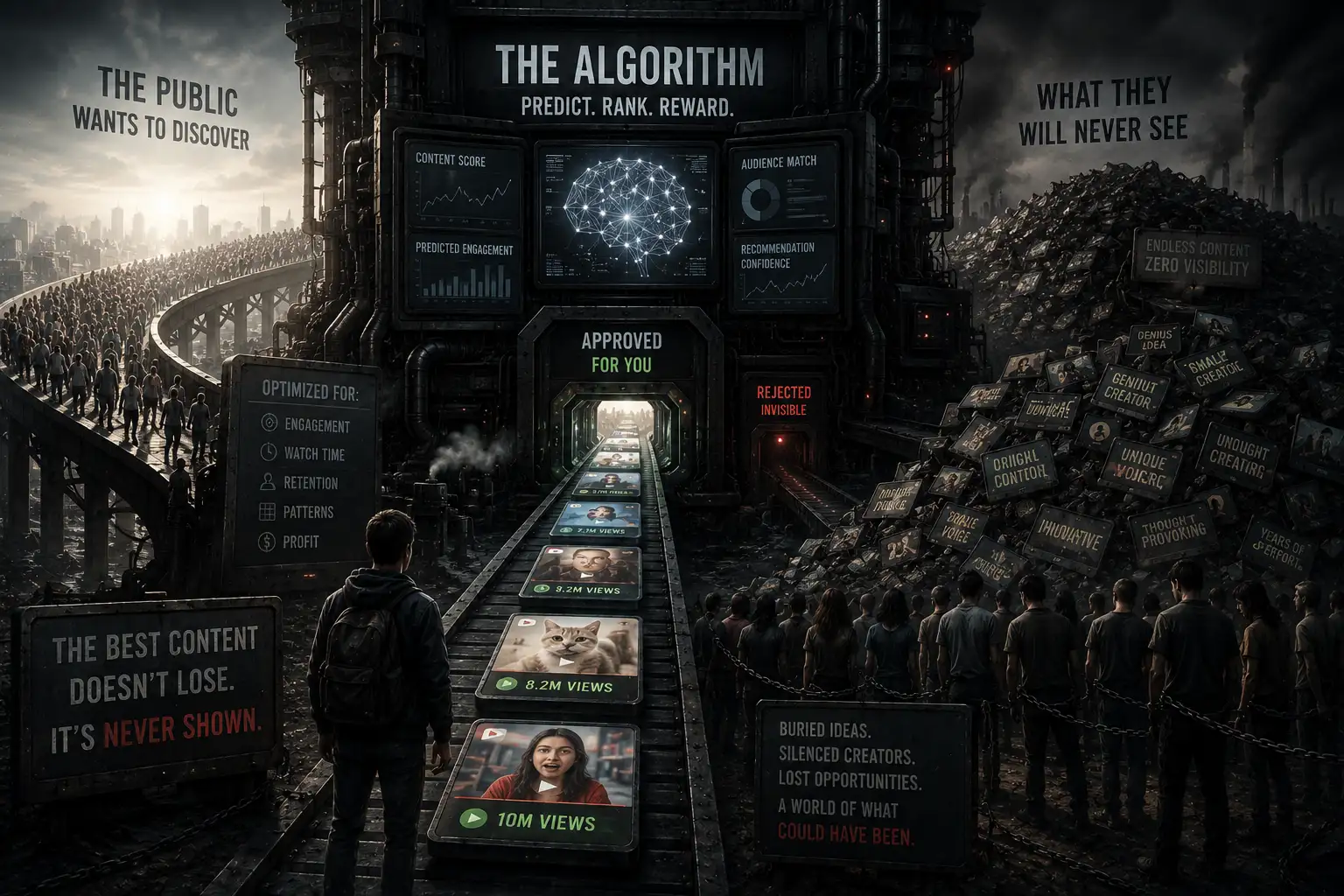
Humanity may be witnessing one of the most important cultural shifts in modern history.
Most people have not noticed it.
Most people do not even realize it is happening.
Yet it affects almost everything they see, read, watch, purchase, discuss, support, and believe.
The shift is simple:
Human discovery is being replaced by machine selection.
For thousands of years, people discovered the world through direct experience, recommendations from other people, communities, exploration, curiosity, and chance encounters.
You found a local business because someone told you about it.
You found a musician because a friend handed you a CD.
You found a website because somebody linked to it.
You found a creator because someone shared their work.
You found a game because a community talked about it.
The process was messy.
The process was imperfect.
The process was human.
Today, an increasing amount of discovery happens differently.
Machines decide what appears in search.
Machines decide what appears in feeds.
Machines decide what appears in recommendations.
Machines decide which videos are promoted.
Machines decide which articles are surfaced.
Machines decide which creators gain exposure.
Machines decide which websites receive traffic.
Machines decide which conversations continue and which disappear.
And perhaps most importantly, machines decide what most people never see.
That last part is where the real danger exists.
The Internet Was Supposed To Be Infinite
The original promise of the internet was abundance.
Anyone could build.
Anyone could publish.
Anyone could participate.
Anyone could compete.
The barriers were removed.
The gatekeepers were supposed to lose power.
Instead, something unexpected happened.
The gatekeepers did not disappear.
They evolved.
The newspaper editor became a ranking system.
The television executive became a recommendation engine.
The publishing board became an algorithm.
The new gatekeepers are not people.
They are mathematical systems.
The problem is that mathematical systems do not understand value.
They understand signals.
Those are not the same thing.
Machines Cannot Measure What Matters
A machine can measure clicks.
A machine cannot measure importance.
A machine can measure watch time.
A machine cannot measure future significance.
A machine can measure engagement.
A machine cannot measure whether an idea might change someone's life ten years from now.
A machine can measure patterns.
A machine cannot understand originality.
This distinction matters because some of the most important things in human history looked worthless when they first appeared.
New inventions looked ridiculous.
New businesses looked risky.
New art looked strange.
New ideas looked wrong.
New communities looked insignificant.
Innovation rarely announces itself as innovation.
Most breakthroughs begin as outliers.
The problem is that prediction systems are designed to suppress outliers.
Their entire purpose is identifying what already works.
Their entire purpose is predicting what already resembles success.
But the future does not resemble the past.
That is why it is the future.
The Invisible Graveyard
When people talk about algorithmic systems, they often focus on what succeeds.
The videos that went viral.
The websites that ranked.
The creators that exploded.
The companies that dominated.
The stories that spread.
That is the wrong place to look.
The real story is everything that disappeared.
The creator who quit after years of producing quality work.
The website that never received visibility.
The business that never found customers.
The game community that never reached critical mass.
The article that never reached readers.
The innovation that never found investors.
The solution that never found a problem to solve.
History remembers winners.
Machines silently erase possibilities.
Nobody can calculate what was lost because nobody can see what never surfaced.
Every day, millions of pieces of content are created.
Most will never receive meaningful exposure.
Not because people rejected them.
Because machines never selected them.
That is an entirely different thing.
The Rise Of Synthetic Popularity
Perhaps the most dangerous side effect is that popularity itself is becoming synthetic.
People assume popularity reflects public choice.
Increasingly, popularity reflects visibility allocation.
A person cannot choose something they never encounter.
A viewer cannot watch a video they never see.
A reader cannot read an article that never appears.
A customer cannot support a business they never discover.
A community cannot grow if nobody knows it exists.
Visibility comes first.
Choice comes second.
Yet society often pretends the order is reversed.
We celebrate success without examining exposure.
We analyze outcomes without examining opportunity.
We confuse visibility with merit.
We confuse reach with quality.
We confuse popularity with value.
Those assumptions become increasingly dangerous as machine systems gain greater control over discovery.
The Death Of The Unknown
The internet once excelled at creating surprises.
You stumbled into strange websites.
You discovered niche communities.
You found creators nobody had heard of.
You explored because exploration itself was the experience.
Today, discovery increasingly resembles a guided tour.
The same recommendations.
The same topics.
The same personalities.
The same conversations.
The same narratives.
The same sources.
The same feedback loops.
Prediction systems naturally move toward certainty.
Certainty naturally moves toward repetition.
Repetition naturally moves toward sameness.
The result is a world that appears larger than ever while becoming increasingly filtered.
An infinite internet viewed through a narrowing lens.
Artificial Intelligence Accelerates The Problem
Artificial intelligence introduces an entirely new layer.
Now machines are not only selecting information.
They are summarizing information.
Interpreting information.
Rewriting information.
Explaining information.
Recommending information.
In many cases, machines are becoming the first reader, first viewer, first editor, first curator, and first distributor.
The danger is not malicious intent.
The danger is scale.
When billions of decisions are made by systems that cannot truly understand meaning, subtle distortions become cultural realities.
Entire industries begin optimizing for machine interpretation.
Entire creators begin optimizing for machine approval.
Entire businesses begin optimizing for machine visibility.
The machine becomes the audience before the human ever arrives.
What Happens Next?
The question facing society is not whether algorithms are useful.
They are.
The question is not whether artificial intelligence is powerful.
It is.
The question is whether humanity is comfortable allowing systems designed around prediction to become the primary mechanism through which reality is discovered.
Because the greatest ideas in history were rarely predictable.
The greatest communities in history were rarely predictable.
The greatest creators in history were rarely predictable.
The greatest innovations in history were rarely predictable.
Yet we are increasingly building a world that rewards predictability above all else.
And if that trend continues, humanity may eventually discover something ironic.
The greatest threat posed by intelligent machines is not that they replace human creativity.
It is that they slowly convince humanity to stop looking for it.