
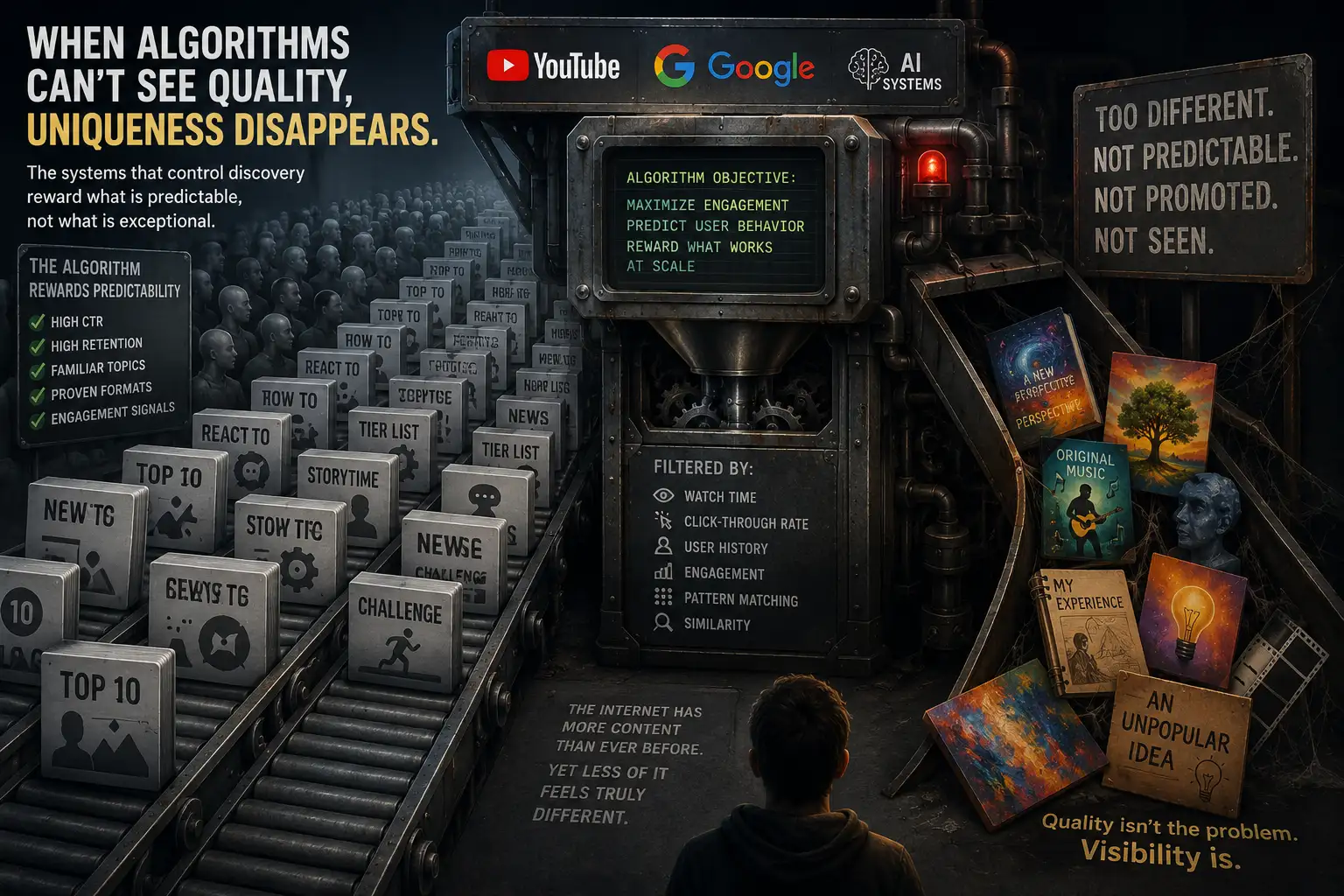
For decades, the internet promised something extraordinary: a place where anyone with talent, knowledge, creativity, or a unique perspective could be discovered.
Today, many creators, publishers, developers, artists, and community builders are beginning to ask a difficult question:
What happens when the systems responsible for discovery can no longer recognize uniqueness?
The modern internet is increasingly controlled by recommendation engines, search engines, and artificial intelligence systems. YouTube decides what videos are promoted. Google decides what information is visible. AI systems decide which sources are summarized, referenced, or ignored.
The problem is that these systems do not experience quality the way humans do.
They experience patterns.
And patterns are not the same thing as value.
Quality vs. Predictability
A human can recognize originality.
A human can see years of experience inside a creator's work.
A human can identify expertise, personality, authenticity, and innovation.
Algorithms often cannot.
Instead, they rely on measurable signals:
- Click-through rates
- Watch time
- Retention
- Engagement
- Similarity patterns
- User behavior predictions
- Historical performance
The result is that systems become increasingly good at finding what is statistically familiar while becoming increasingly poor at identifying what is genuinely different.
What rises to the top is not always the best content.
It is often the most predictable content.
The Homogenization Effect
When creators learn what algorithms reward, behavior changes.
Titles become similar.
Thumbnails become similar.
Articles begin sounding alike.
Videos begin following identical structures.
Entire industries start producing content designed for machine recognition rather than human appreciation.
The outcome is a gradual erosion of uniqueness.
Creators who once experimented begin optimizing.
Writers stop exploring and start formatting.
Developers stop innovating and start copying successful formulas.
Instead of a diverse ecosystem, platforms slowly drift toward sameness.
Researchers have repeatedly found that recommendation systems can narrow exposure and influence the diversity of content users encounter. Studies examining YouTube recommendations have identified patterns where algorithms push users toward increasingly similar content over time.
The AI Amplification Problem
Artificial intelligence introduces a second layer to this issue.
Modern AI systems learn from existing content.
They predict likely outputs based on what has already been created.
This makes AI exceptionally good at producing averages.
It can replicate styles.
It can mimic structures.
It can generate endless variations of existing ideas.
What it struggles to do is identify truly novel thinking before the crowd recognizes it.
The danger is not that AI creates bad content.
The danger is that AI naturally gravitates toward consensus.
Consensus is safe.
Consensus is predictable.
Consensus is easy to train.
Innovation is none of those things.
As AI-generated material expands across the web, concerns about creative homogenization and declining originality continue to grow among both creators and audiences.
When Discovery Engines Become Gatekeepers
Search engines and recommendation systems were originally designed to help people find information.
Increasingly, they are becoming information itself.
Google's AI-generated summaries, AI Overviews, and similar systems across the industry are shifting users away from exploring multiple sources and toward consuming a single synthesized answer. Researchers and publishers have raised concerns about the impact this has on traffic, attribution, and source visibility.
This creates a troubling possibility.
A creator may produce the most insightful article on the internet.
A developer may create the most innovative game.
A researcher may publish groundbreaking work.
Yet if the systems controlling discovery fail to recognize it, the work effectively becomes invisible.
Not because it lacks value.
Because it lacks the signals the machine understands.
The Cost to Communities
Perhaps the greatest casualty is community.
Communities thrive on diversity.
They thrive on unique personalities, unconventional ideas, and people willing to challenge assumptions.
Algorithms, however, are often designed to maximize engagement efficiency.
Efficiency is not the same thing as cultural health.
A community built entirely around optimization eventually loses the human qualities that made it valuable in the first place.
The internet becomes larger.
Yet somehow smaller.
More content exists than ever before.
Yet less of it feels truly different.
The Future Depends on Human Judgment
Ironically, even the largest technology companies acknowledge the importance of originality, expertise, and people-first content. Google's public guidance repeatedly emphasizes helpful, reliable, experience-based content rather than content created solely to satisfy algorithms.
The challenge is that measuring those qualities at global scale remains extraordinarily difficult.
No algorithm can fully understand passion.
No search engine can perfectly measure creativity.
No AI can accurately determine the future value of an idea that has never existed before.
That responsibility still belongs to people.
The greatest innovations in history rarely looked important when they first appeared.
They looked strange.
Different.
Unexpected.
If the digital world loses its ability to recognize those qualities, it risks creating a future where originality survives—but discovery does not.
And when discovery fails, quality doesn't disappear.
It simply becomes invisible.