
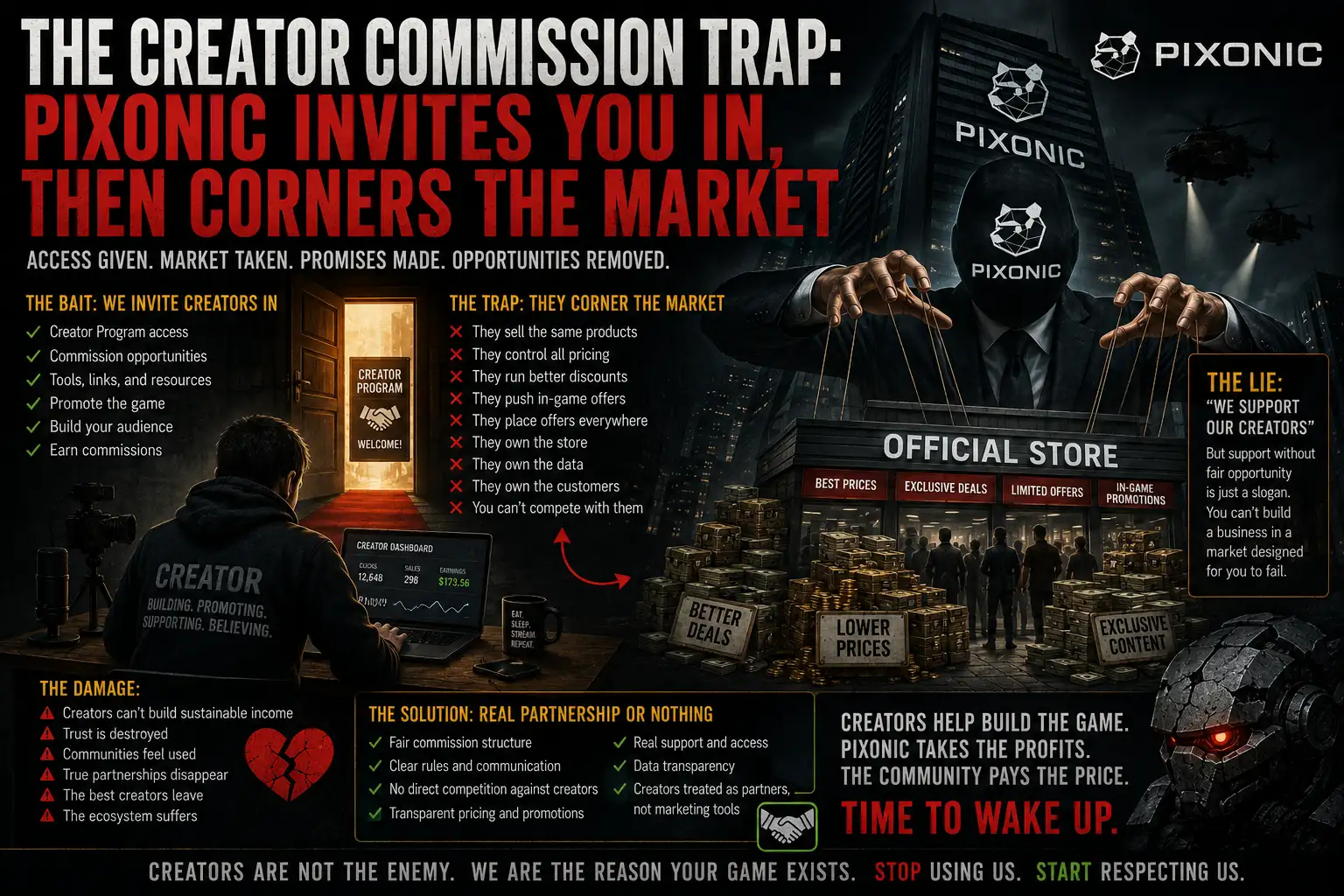
The gaming industry loves the word partnership.
Creator partnership.
Affiliate partnership.
Community partnership.
Revenue partnership.
The word sounds equal. It sounds professional. It sounds like two sides building something together.
But in too many cases, what is being sold as a partnership is really something much weaker:
A controlled marketing arrangement where the creator provides the audience, the trust, the content, the time, and the promotion — while the company keeps the power.
That is the uncomfortable question surrounding creator commission programs in modern gaming, including programs tied to companies like Pixonic:
Are creators being given a real opportunity?
Or are they being used as a temporary sales force while the company keeps total control over the market?
The Promise Sold To Creators
The pitch is easy to understand.
A creator builds an audience.
The company gives that creator a link, a code, or access to a commission program.
The creator promotes products to their community.
If the audience buys, the creator earns something.
On paper, that sounds fair.
The creator gets rewarded.
The company gets sales.
The community gets access to offers.
Everyone wins.
That is the version companies want people to believe.
But the reality is more complicated.
Because the creator does not control the product.
The creator does not control the price.
The creator does not control the discount.
The creator does not control availability.
The creator does not control checkout.
The creator does not control whether the company launches a better offer through its own channels the next day.
And most importantly:
The creator does not control whether the company decides to compete directly against them.
That is not a balanced partnership.
That is a relationship where one side owns the entire battlefield.
The Company Controls The Store And The Rules
A creator commission program only works if creators have a fair chance to sell.
But how fair can the opportunity really be when the company controls every major part of the transaction?
The company owns the game.
The company owns the store.
The company controls the pricing.
The company controls the promotion schedule.
The company controls special offers.
The company controls the data.
The company controls the customer relationship.
The company controls the payment system.
The creator is left with one thing:
Their audience.
That audience is valuable. In many cases, it is the only reason the sale happens at all.
But once the audience has been trained to buy directly from the company, where does that leave the creator?
If the company can offer the same product more visibly, more conveniently, or at a better deal, then the creator is not being supported.
The creator is being used to warm up the customer.
The Marketplace Problem
Imagine a large corporation invites small shop owners to sell its products.
The shop owners spend months advertising those products.
They build relationships.
They answer questions.
They create demonstrations.
They explain why people should buy.
Then the corporation opens its own giant store in the same market, sells the same products, controls the prices, controls the discounts, and places its own store directly in front of every customer.
Would anyone call that a fair opportunity?
No.
They would call it what it is:
A marketplace controlled by the supplier.
The creator is not really competing with other creators.
The creator is competing with the company itself.
And that is a fight creators cannot win.
The Lie Behind The Word Partnership
This is where the word "partnership" starts to fall apart.
A real partnership means both sides have a meaningful opportunity to benefit.
A real partnership means both sides understand the rules.
A real partnership means one side is not secretly building a better path around the other.
But when a company gives creators commission access while also dominating the same sales lane, the message becomes confusing at best and dishonest at worst.
It tells creators:
"Promote this for us."
"Build trust for us."
"Convince your audience for us."
"Take the risk for us."
"But when the money is ready to move, we still control where it goes."
That is not creator empowerment.
That is creator extraction.
Creators Are Not Just Traffic Sources
The biggest mistake companies make is thinking creators are simply traffic sources.
They are not.
Creators are trust engines.
A viewer may ignore an advertisement, but listen to a creator.
A player may skip a corporate announcement, but watch a stream.
A buyer may distrust a company promotion, but believe someone who has spent years playing the game in public.
That trust does not belong to the company.
It belongs to the creator.
And when a company uses creator trust to build demand, then redirects that demand into its own controlled sales system, the creator is left asking a very reasonable question:
What exactly was I invited to build?
A business?
Or a funnel?
The Risk Is Not Shared Equally
This is another part of the system that deserves attention.
Creators take real risks.
They risk their reputation.
They risk audience trust.
They risk time.
They risk opportunity cost.
They risk being seen as corporate mouthpieces.
They risk promoting something that changes later.
They risk attaching their name to offers, systems, or products they do not control.
The company, meanwhile, controls the environment.
If the program changes, the company moves on.
If the commission structure changes, the company moves on.
If the product changes, the company moves on.
If the creator loses trust with their audience, that damage stays with the creator.
That imbalance matters.
Because when the creator carries the reputational risk while the company controls the financial upside, the relationship is not equal.
It is exploitative in structure, even if it is marketed with friendly language.
The Data Problem
There is also the question of data.
When creators send people into a company-controlled store or system, what does the creator actually get back?
Do they get meaningful insight?
Do they know what worked?
Do they know what failed?
Do they know whether their content created a sale later through another channel?
Do they know how many people were influenced by their promotion but bought directly from the company instead?
Usually, the answer is no.
The company gets the data.
The company gets the customer.
The company gets the long-term value.
The creator may get a small commission only if the system credits the sale correctly.
That is not a creator-owned business.
That is renting access to a black box.
The Direct Sales Conflict
The most serious conflict appears when the company offers direct sales, in-game deals, limited-time bundles, or exclusive promotions that compete with creator commission opportunities.
At that point, creators may be trying to sell the same type of product the company is pushing through official channels.
But the official channel has every advantage.
It has placement inside the game.
It has direct access to players.
It has control over notifications.
It has the ability to discount.
It has the authority of the brand.
It has the checkout system.
It has the customer relationship.
The creator has to work outside that system and convince people to use their path instead.
That is not a level playing field.
That is asking creators to compete against the house.
And the house writes the rules.
Why This Matters For Pixonic
For companies connected to successful live-service games, this issue becomes even more important.
Games like War Robots depend heavily on long-term community energy.
They depend on creators keeping the conversation alive.
They depend on guides, showcases, streams, giveaways, clan activity, and player discussions.
If a company wants creators to help sell products, promote the ecosystem, and keep players engaged, then the company must understand something very basic:
Creators are not disposable.
They are not just free advertising.
They are not just a cheaper version of paid marketing.
They are business partners in the public imagination, whether the company treats them that way or not.
So when creators are given commission opportunities while the company also controls and dominates the same sales environment, it creates a serious trust problem.
The question becomes unavoidable:
Is this a real creator opportunity?
Or is it a way to make creators promote a store they do not own, a market they cannot control, and products they cannot price?
The Long-Term Damage
The damage from this kind of structure does not always show up immediately.
At first, creators may still participate.
Some may hope the program improves.
Some may accept the arrangement because they love the game.
Some may stay quiet because they do not want to lose access.
Some may believe any commission is better than none.
But over time, the resentment builds.
Creators begin to notice the imbalance.
They notice when the company benefits more than they do.
They notice when they are expected to promote but not protected.
They notice when the company calls them partners but treats them like replaceable traffic.
And once creators start seeing the system that way, trust becomes hard to rebuild.
The Next Generation Is Watching
This is the part companies should worry about most.
The current creators may already be invested.
They may have channels built around the game.
They may have communities that expect certain content.
They may feel locked into the ecosystem.
But new creators are not locked in.
They have choices.
They can build around other games.
They can build around other platforms.
They can build their own websites.
They can create independent communities.
They can avoid ecosystems where the company controls everything and gives creators very little leverage.
The next generation will ask different questions:
Can I actually make money here?
Can I reach someone if something goes wrong?
Will this company protect my opportunity?
Will this company compete against me after inviting me in?
Will this program help me build something real, or just use my audience until it no longer needs me?
Those are fair questions.
And companies that cannot answer them should not be surprised when serious creators build elsewhere.
What A Fair System Would Look Like
A better creator commission system is not impossible.
It would require transparency.
Clear commission rules.
Clear product eligibility.
Clear reporting.
Clear attribution windows.
Clear conflict-of-interest policies.
Clear communication channels.
Clear protection against the company undercutting creators without warning.
If a company wants creators to sell, then creators need confidence that the system is not quietly working against them.
That does not mean a company cannot sell its own products.
Of course it can.
But if it invites creators into a commission structure, it should not pretend the relationship is equal while reserving every advantage for itself.
A fair system recognizes the value creators bring.
It gives them tools.
It gives them information.
It gives them support.
It gives them a real lane to operate in.
Most importantly, it gives them trust.
The Real Question
The real question is not whether companies have the legal right to sell their own products.
They do.
The question is whether they should keep calling these systems partnerships when creators have so little control.
Because if the company owns the product, the price, the store, the data, the customer, the discount, the rules, and the final transaction, then what exactly does the creator own?
The answer is uncomfortable:
The creator owns the risk.
The company owns the reward.
That is the creator commission trap.
And the gaming industry should stop pretending otherwise.
Final Word
Creators helped build the modern gaming economy.
They made games visible.
They kept communities alive.
They turned updates into events.
They turned gameplay into entertainment.
They turned player frustration into conversation.
They turned loyalty into revenue.
If companies want creators to keep doing that work, they need to stop treating creator programs like one-way marketing machines.
A creator commission program should not be a costume for corporate control.
It should be a real opportunity.
Because when a company invites creators to help sell the dream, then corners the market around them, the message becomes clear:
The creator was never the partner.
The creator was the advertisement.
And once creators understand that, the whole illusion starts to collapse.