
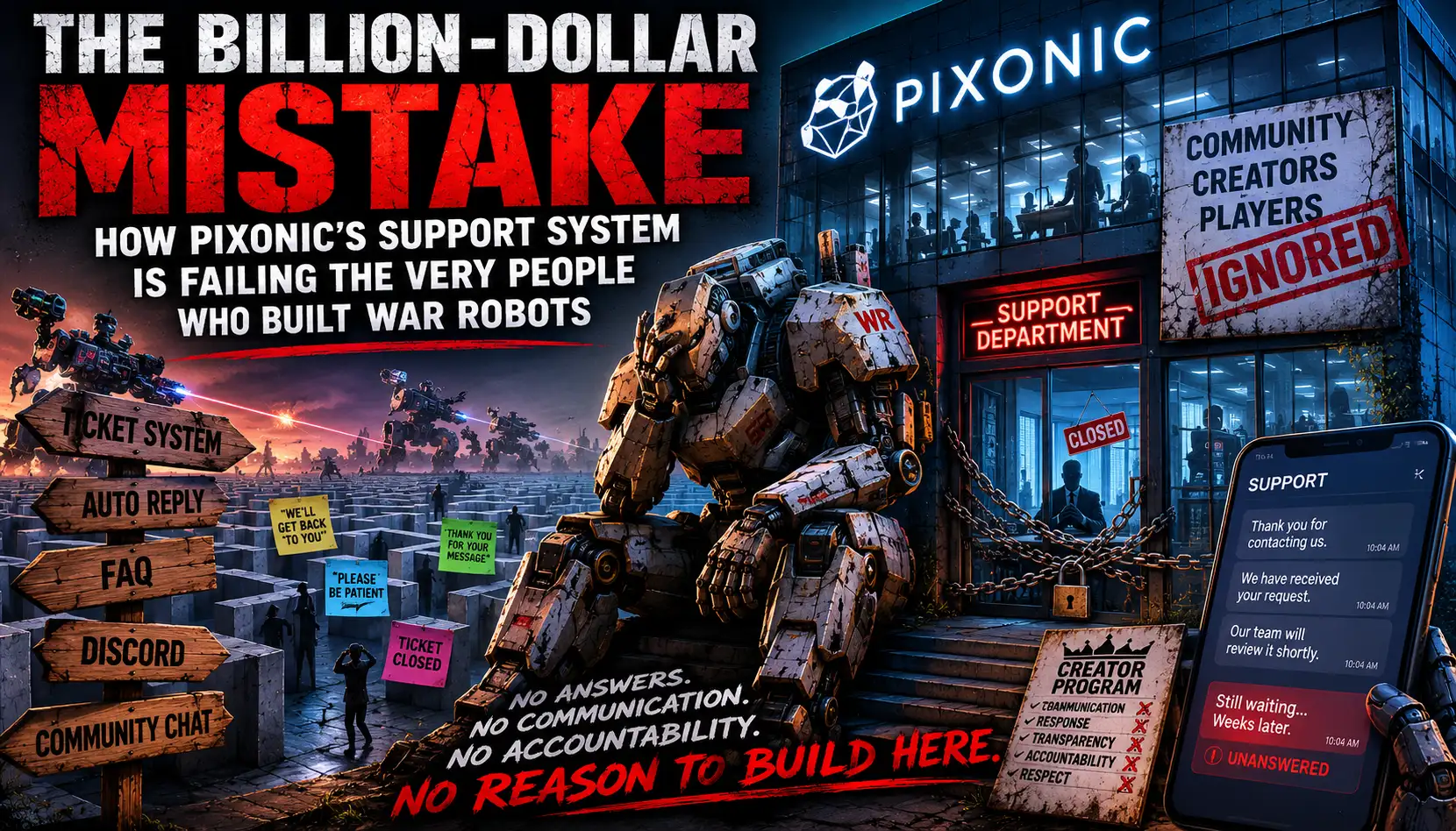
There is a simple truth that every successful gaming company eventually discovers:
Games do not become legends because of code alone.
They become legends because of people.
The players who log in every day.
The veterans who stay through difficult updates.
The creators who produce thousands of videos.
The community leaders who organize events.
The websites that archive information.
The volunteers who answer questions when official channels are nowhere to be found.
The clans that give players a reason to keep returning.
These people are not a side feature of a successful game.
They are part of its infrastructure.
And the moment a company starts treating that infrastructure as expendable, it begins damaging something far more valuable than a quarterly revenue report:
Trust.
The Illusion of Community Support
Modern gaming companies often celebrate the word "community."
They put it in press releases.
They put it in creator programs.
They put it on banners and social media posts.
But community is not a substitute for responsibility.
A Discord server is not a support department.
A FAQ is not a conversation.
An automated response is not a relationship.
Community spaces are incredible tools for players to connect with each other.
They were never meant to become a wall between the company and the people who helped make its success possible.
A company asking players to solve each other's problems while removing clear paths to the people with authority sends a dangerous message:
"We want your loyalty, but we do not want the responsibility that comes with earning it."
The Creator Economy Has Changed
Twenty years ago, a fan with a website or a YouTube channel was just a hobbyist.
Today, creators are businesses.
They build audiences.
They create marketing campaigns.
They generate millions of impressions.
They teach new players.
They create tutorials.
They keep old players engaged during difficult periods.
Many companies understand this.
That is why creator programs exist.
But a creator program without communication is little more than a badge.
A dashboard without a relationship is just a webpage.
A partnership without access is not truly a partnership.
And this raises a serious question:
Why would a new creator choose to invest thousands of hours building around a game if they cannot confidently say that someone will be available when a serious issue arises?
The Silent Cost of Ignoring Your Builders
The greatest danger to a gaming company is not always a competitor releasing a better game.
Sometimes the danger is much quieter.
The next creator chooses a different game.
The next tournament organizer chooses a different community.
The next fan website is never built.
The next guide is never written.
The next hundred videos are never uploaded.
Those losses never appear on a financial report.
There is no graph showing the communities that never existed.
No chart showing the creators who looked at the situation and said:
"That is not a foundation I want to build my future on."
But the damage is real.
It happens slowly.
Then all at once.
The Support Problem Is a Business Problem
Companies often view support as an expense.
A department that costs money.
A team that does not directly generate revenue.
That thinking is one of the greatest strategic mistakes a company can make.
Support is not just about fixing bugs.
Support is public relations.
Support is community retention.
Support is creator retention.
Support is brand reputation.
Every ignored message tells a story.
Every unanswered ticket creates a conversation.
Every creator who cannot find a human being to speak to becomes a warning to the next creator considering whether they should get involved.
A successful company should not have a "good luck finding someone who can help you" problem.
A Warning To The Entire Industry
This is not just a Pixonic problem.
It is a growing problem across gaming.
Too many companies have become comfortable building their communities on borrowed platforms while reducing direct communication with the people who represent their games every day.
The gaming industry has entered a new era.
The companies that succeed will not simply have the biggest marketing budgets, the most advanced technology, or the flashiest trailers.
They will be the companies that understand a simple reality:
A community is not an asset to be managed.
It is a relationship to be maintained.
And relationships do not survive on silence.
The future of gaming will belong to the companies that answer the door when their communities knock.
The ones who do not may eventually discover they were never losing players.
They were losing the people who convinced others to play in the first place.
The Unpaid Front Line
Perhaps one of the most overlooked realities in modern gaming is who often ends up dealing with the consequences when a game's biggest problems reach the community.
It is not always the corporation.
It is often the creators.
The streamers who spend hours moderating their chats.
The community leaders who calm frustrated players.
The clan leaders who try to keep their members engaged.
The volunteers who answer questions and explain systems that the company itself should be able to communicate clearly.
When issues such as cheating, hacking, exploits, or other forms of unfair play damage the player experience, those frustrations frequently land directly on the people most visible in the community.
Creators become the public face of a problem they did not create and do not have the authority to solve.
That raises an uncomfortable question:
Why are independent creators expected to absorb the reputation damage, frustration, and workload of problems that should be addressed through professional community management, security investment, and accessible support systems?
The gaming industry has created a strange situation where some of its most valuable ambassadors are expected to perform public relations, customer service, and community crisis management for free.
A company with a successful global game has the resources to invest in the systems necessary to protect the community that generates its revenue.
That means effective anti-cheat efforts.
That means transparent communication.
That means responsive support.
That means having actual people available when creators, players, and community leaders need answers.
A healthy relationship between a company and its community should not feel like the community is carrying the company's responsibilities on its own.
The people who promote a game should not have to fight its battles alone.