
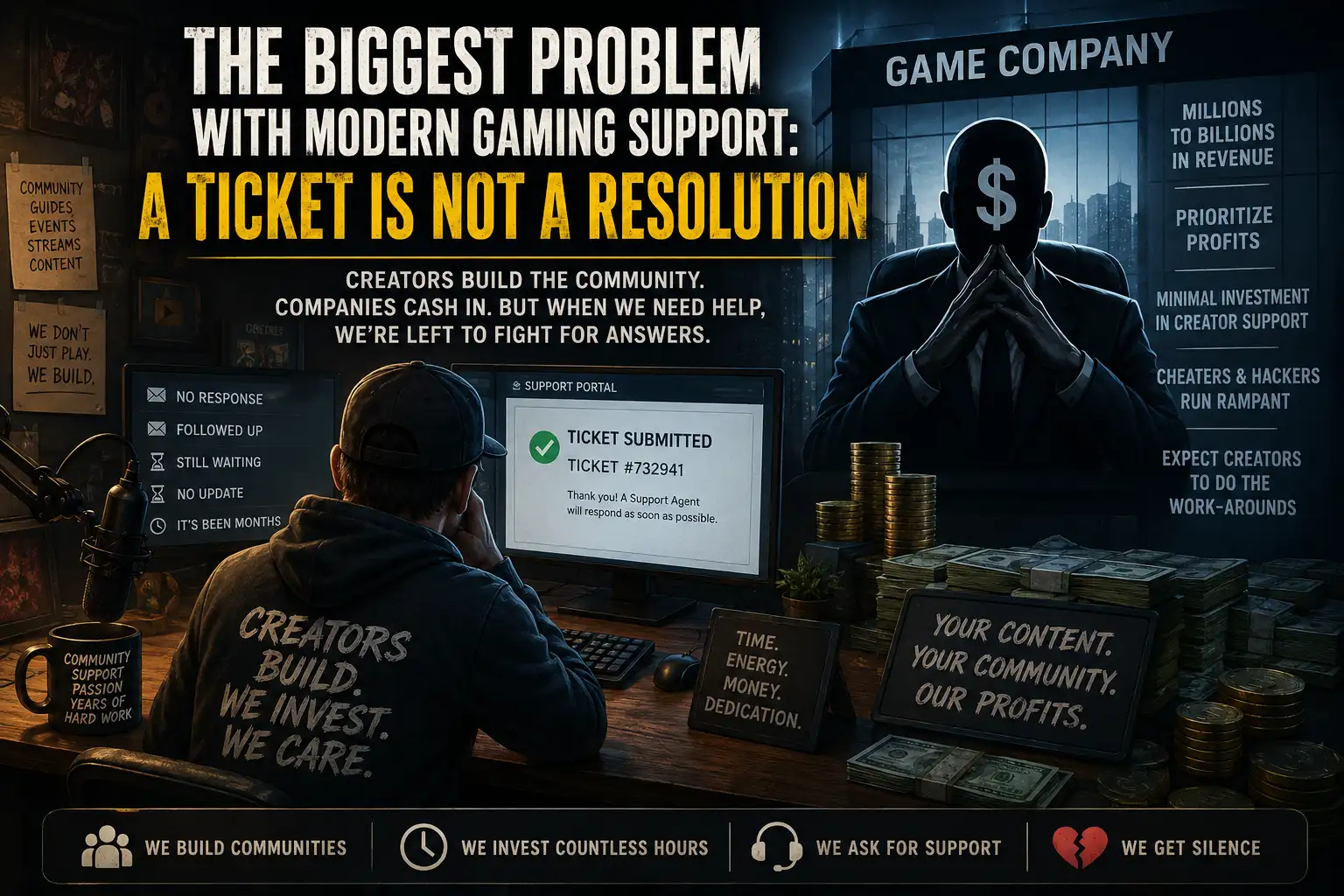
The Biggest Problem With Modern Gaming Support: A Ticket Is Not A Resolution
By all appearances, the gaming industry has invested millions into creating support systems. There are websites, ticket portals, Discord servers, community managers, automated responses, and countless ways for players and creators to submit an issue.
But there is one question that matters above all else:
What happens after you submit the ticket?
My experience has exposed what I believe is one of the biggest failures in modern gaming support: a company can have every piece of support infrastructure visible to the public while still failing to deliver an actual path to resolution.
For months, I have been attempting to resolve an issue affecting my ability to create content. I have followed the official channels. I have submitted support requests. I have waited. I have followed up.
The problem is not that nobody has spoken to me.
The community teams and representatives communicating with players are often doing everything they can within the limits of their authority. This is not an attack on the individuals who are trying to help.
The problem is what happens when an issue reaches the point where a community response is no longer enough.
A community representative cannot investigate internal systems.
A community representative cannot access every internal tool.
A community representative cannot change how automated systems classify, flag, or impact a creator account.
That requires the appropriate internal teams to investigate and take action.
That is where the process breaks down.
When communication stops, the problem does not stop.
Creators are left to their own devices, forced to choose their own routes to find answers, protect their channels, and preserve the communities they have spent years building.
Some search for alternative contacts.
Some turn to public communities and Discord servers.
Some repeatedly explain the same issue to different people, hoping someone, somewhere, has the authority to help.
None of those actions should replace a functioning support escalation process.
A creator should not have to become their own investigator, support manager, and advocate simply because an official case has reached a point where communication disappears.
Silence does not create confidence.
It creates uncertainty, frustration, and eventually forces creators to question whether the platform values the time, energy, and commitment they continue to invest.
The result is a situation where a creator can spend months waiting while new issues continue to appear, with no explanation of what caused the original problem, no clear guidance on how to avoid future problems, and no confidence that the next stream, video title, description, or even a single word will not create another unexpected issue.
That is an impossible environment for a creator to operate in.
The Creator Economy Built The Modern Gaming Industry
The frustration becomes even greater when creators look at the scale of the industry itself.
Gaming is a multi-billion-dollar industry.
Many companies generate enormous profits from communities built around their games.
Players spend money.
Creators spend thousands of hours producing videos, streaming, creating guides, answering questions, organizing events, building websites, managing communities, reporting issues, and keeping excitement around a game alive.
In many ways, companies continue to compound their success on the backs of the communities and creators providing the attention, engagement, education, promotion, and social ecosystems that keep games relevant for years.
Yet when those same creators encounter serious problems, many are left asking:
Where is the investment in the people who are helping keep these communities alive?
Creators should not be expected to spend their time creating work-arounds for broken systems, chasing answers through unofficial channels, or carrying responsibilities that require internal access and company resources.
When Players Become The Anti-Cheat Department
The frustration extends into the ongoing battle against cheating and hacking.
Players and creators report offenders.
They collect evidence.
They document suspicious behavior.
They warn their communities.
They educate new players.
Those actions help, but they should support effective anti-cheat systems, investigations, enforcement, and communication—not replace them.
When cheating problems continue for years, communities naturally begin asking difficult questions about priorities.
Are enough resources being invested into protecting fair competition?
Are enough resources being invested into the creators and communities helping keep the game alive?
Are the people generating attention and longevity for a game receiving the same level of commitment from the companies benefiting from that dedication?
Those questions do not exist because communities want to attack the games they love.
They exist because trust begins to break when the burden of maintaining a healthy ecosystem shifts from the organizations with the resources to solve problems onto the players and creators who simply want to enjoy the game.
When Getting Support Starts Costing Money
The contradiction becomes even more obvious when official support systems fail and creators are pushed toward unofficial channels.
There is already a ticket.
There is already a case.
There is already a place where the information belongs.
Yet creators can find themselves trying to compress months of technical information and account history into Discord messages because that is the only place where they can get someone's attention.
Discord is an incredible community tool.
It is not a replacement for a professional escalation and resolution system.
A serious account issue should not depend on a creator breaking months of information into multiple public messages because a chat platform has character limits.
The situation becomes even more absurd when the ability to fully explain a problem is restricted by those limitations and a paid premium service is offered as the solution.
A creator who has already invested countless hours, personal money, and effort into supporting a game should not be placed in a position where paying for a larger message limit becomes the practical path to communicate a problem.
Support should not have a price tag attached to the ability to explain the issue.
When creators are forced to chase unofficial contacts, work around communication limits, spend additional money, and essentially build their own support pathway, the support system itself has failed.
What Would You Actually Lose?
Some will ask a different question:
"If the game disappeared from your life tomorrow, what would you actually lose?"
The answer is not a salary.
It is not a six-figure sponsorship.
It is not a massive partnership.
The financial reality is that many independent creators invest far more time, money, and effort into a gaming ecosystem than they receive back financially.
The real investment is harder to measure.
The community you built.
The friendships you made.
The viewers who show up every stream.
The reputation you created.
The websites, tools, events, giveaways, and infrastructure you built because you believed the community deserved something better.
That is what makes these failures hurt.
Creators are not simply asking for a bug to be fixed.
They are trying to protect years of investment in something they helped create.
But there is another side of that equation.
Time has value.
Every hour spent chasing tickets, rewriting explanations, moving conversations across platforms, documenting issues, and waiting for answers is an hour not spent creating content, improving communities, developing new ideas, or simply enjoying the game that started the journey.
Eventually, every creator must ask:
Am I staying because I love this community, or am I staying because I feel obligated to keep fighting the same battles?
That answer matters more than the amount of money involved.
The Real Test Of Support
The gaming industry often celebrates creators.
It celebrates the streams, videos, guides, events, and communities that keep games alive long after release.
But support is not measured when everything is working.
Support is measured when something breaks.
Anyone can create a support button.
Anyone can create a Discord server.
Anyone can create a ticket system.
The real test is whether those systems lead to accountability, investigation, communication, and resolution.
Because a ticket number is not support.
A response is not a resolution.
A community acknowledgement is not the same as an internal investigation and a meaningful solution.
A system that leaves creators afraid to publish a video, title a stream, write a description, or engage with their audience because they do not know what might trigger the next unexplained problem is not protecting creators.
It is creating fear and uncertainty.
The Relationship Has To Work Both Ways
At the end of the day, every relationship between a creator and a platform is an exchange.
The platform receives the creator's time.
The creator's energy.
The creator's passion.
The creator's audience.
The creator's creativity.
Years of dedication.
In return, the creator receives enjoyment, community, opportunity, and the tools needed to continue growing.
But every relationship requires value in both directions.
Loyalty is powerful.
Community is powerful.
History is powerful.
But loyalty alone cannot carry a relationship when creators are expected to continuously adapt around broken systems, perform the work of investigators, moderators, and support staff, fight against bad actors, and carry responsibilities that should be properly supported by companies earning millions and billions from the very communities that made their success possible.
Because in the end, the biggest failure of modern gaming support is not that a ticket was created and ignored.
The biggest failure is when the creator becomes the support system.