
Gaming companies love to talk about their creator communities.
They talk about partnerships, growth, creativity, and the value that creators bring to their games. They encourage creators to build their own brands, expand their audiences, and become more than just a channel focused on one title.
Pixonic has made similar promises through its Creator Program, including the message that creators are free to grow their channels and create content beyond War Robots.
But a statement on paper means absolutely nothing when the systems behind it create the opposite reality.
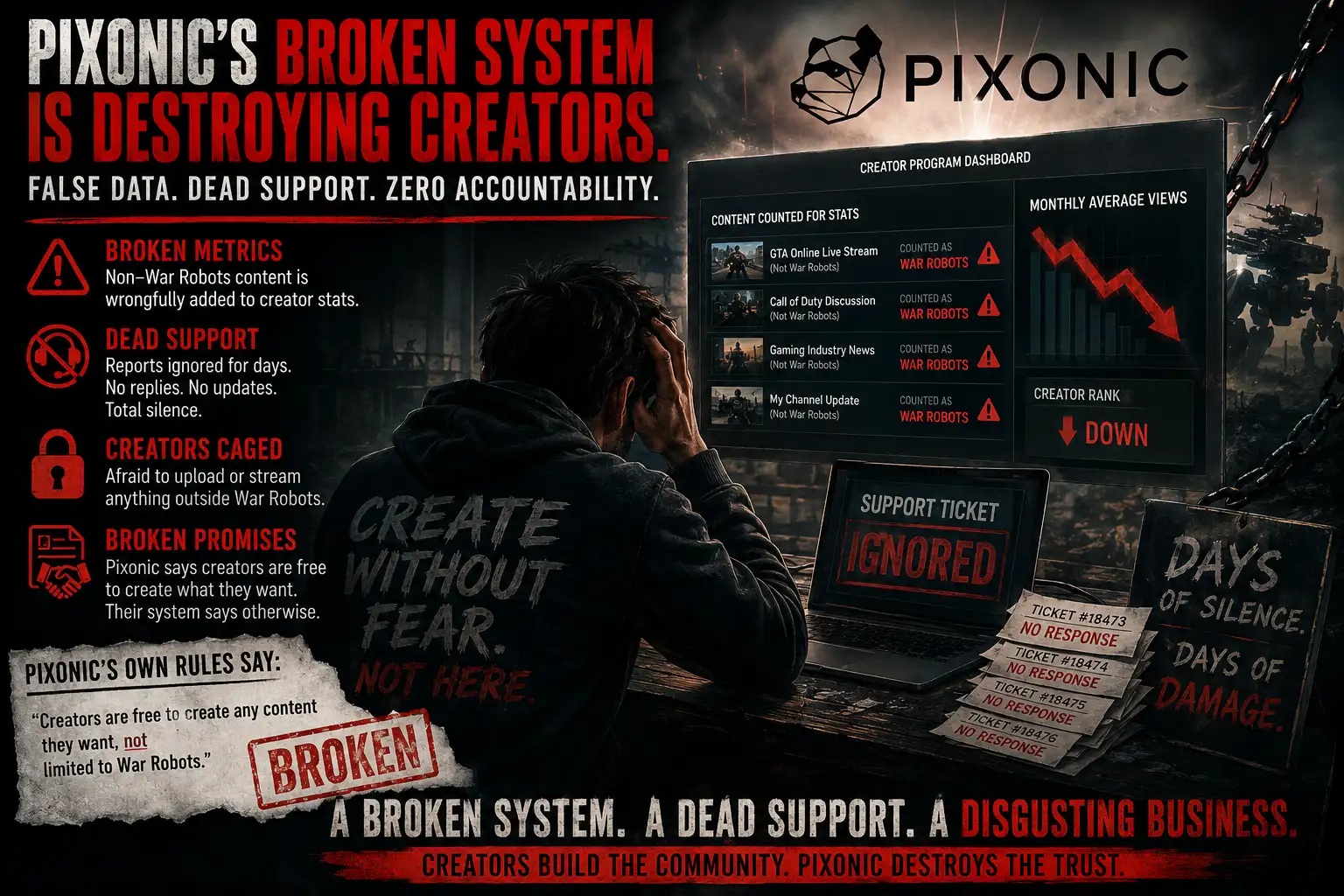
Right now, there is a serious problem with Pixonic's creator statistics system: content that should not be associated with War Robots can be incorrectly pulled into War Robots creator metrics.
That failure creates a situation where creators are no longer simply making videos based on what they enjoy or what their audiences want.
They are forced to think about protecting themselves from Pixonic's own broken system.
When A Company Makes Creators Fear Their Own Upload Button
Think about what this means in practice.
A creator should be able to upload a GTA stream, a Call of Duty discussion, a gaming documentary, a technology video, or any other topic without giving Pixonic a second thought.
That is what creative freedom actually looks like.
Instead, creators are placed in a situation where they have to ask questions that should never even exist:
"Did I accidentally use the word WAR in my description?"
"Does a phrase in my title look too similar to something Pixonic might recognize?"
"Could this unrelated video somehow end up attached to my War Robots Creator statistics?"
Those questions are ridiculous.
A creator should never have to review a completely unrelated video looking for innocent words that could cause an automated system to incorrectly classify their work.
The fact that this concern even exists shows how badly a creator metric system can affect the people who depend on it.
Pixonic says creators can create anything they want.
But if creators have to censor their own titles, descriptions, or metadata because they fear an unrelated video may be incorrectly added to their War Robots statistics, then that freedom only exists in a written policy — not in reality.
The Worst Part Is Not The Broken Data. It Is The Silence.
Technology breaks.
Systems have bugs.
Automation fails.
The real measure of a company is not whether a problem happens. The real measure is what the company does after the problem is reported.
And that is where this situation becomes far more troubling.
This issue has not existed for a few hours.
It has continued for days.
During those days, creators have raised concerns, explained that unrelated content appears to be affecting War Robots metrics, and asked for someone to investigate.
The response has been silence.
No meaningful communication.
No public acknowledgement.
No clear explanation.
No timeline for a fix.
No confidence that the people responsible for the system are even looking into the problem.
That transforms a technical failure into a support failure.
A broken system can be fixed.
A company choosing not to communicate with the people affected by that system is an entirely different problem.
A Creator Program Without Support Is Not A Partnership
A Creator Program is a relationship.
The company receives exposure, community engagement, streams, tutorials, discussions, videos, and years of content that keeps the game visible.
Creators spend thousands of hours building audiences, producing content, helping new players, answering questions, and keeping communities alive.
But a relationship cannot only work one direction.
A company cannot celebrate creators when they are generating attention and engagement, then disappear when those same creators need help.
That is not a partnership.
That is a company taking the benefits of a creator community without accepting the responsibility that comes with managing one.
The Real Damage Is Bigger Than A Number
Many people might look at a broken statistic and say, "It is only a number."
It is not.
Those numbers determine rankings, rewards, status, and opportunities inside a Creator Program.
More importantly, they influence behavior.
A broken system does not just display incorrect information.
It changes what creators feel safe creating.
It can delay videos.
It can cancel streams.
It can discourage experimentation.
It can push creators into staying inside one game's ecosystem because the risk of the system making another mistake is too high.
The irony is almost unbelievable.
A program can publicly say, "You are free to create whatever content you want."
Yet the reality becomes:
"Be careful what you upload, because our system might incorrectly decide it belongs to us."
Those two things cannot coexist.
Pixonic Needs To Decide What Kind Of Creator Program It Wants
If Pixonic wants a Creator Program that genuinely supports creators, then it needs systems that respect creators' independence.
That means:
A metric system that accurately identifies War Robots content.
Complete transparency showing exactly which videos are counted and why.
A simple process for disputing incorrect statistics.
Human support that actually responds when a creator's status is affected.
Communication when there is an active problem.
The solution is not complicated.
Creators are not asking for special treatment.
They are asking for correct data, accountability, and the ability to create content without fearing that a company's broken tracking system will punish them for it.
The Bottom Line
The biggest issue is not that Pixonic's system appears to be broken.
Every company experiences technical failures.
The bigger issue is what happens after the failure.
A company that truly values its creators does not leave them guessing.
It does not leave them afraid to upload.
It does not create an environment where someone has to examine every title, every description, and every word of unrelated content just to avoid being incorrectly connected to a game they are not even discussing.
A Creator Program should help creators grow.
It should not become a digital leash that controls where creators feel safe to go.
Until Pixonic fixes its creator metrics and provides real support, the message being sent to creators is impossible to ignore:
You are free to create anything you want — as long as our broken system does not decide it belongs to us.