
A Creator Program is built on one simple foundation:
Trust.
Creators trust that the company measuring their performance is using accurate data. They trust that the rules are applied fairly. They trust that if something goes wrong, there is a real support system capable of correcting the problem.
Without that trust, a Creator Program is nothing more than a scoreboard controlled by a company that nobody can challenge.
Pixonic now has a serious problem because that trust has been damaged.
Their Own Dashboard Shows the Problem
This is no longer a hypothetical discussion about what might happen.
This is no longer a creator making assumptions about how the system works.
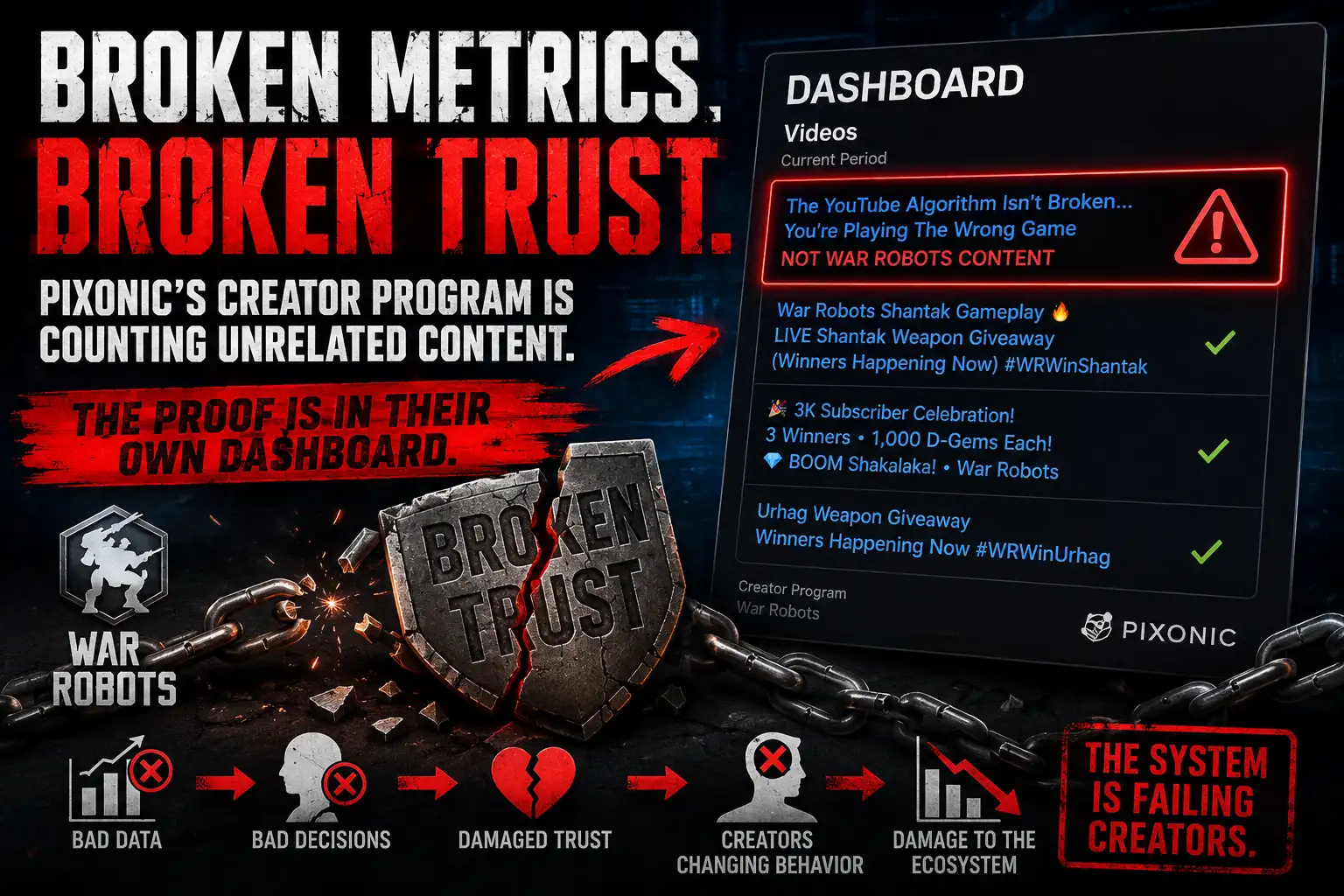
The Creator Program dashboard itself shows a video titled:
"The YouTube Algorithm Isn't Broken... You're Playing The Wrong Game"
listed among the videos counted for War Robots Creator Program statistics.
That title is not a War Robots video.
It is not a War Robots gameplay stream.
It is not a War Robots giveaway.
It is a general discussion about YouTube and content creation.
Yet it appears inside a system that is supposed to evaluate War Robots creator performance.
That raises a question Pixonic needs to answer:
If a completely unrelated video can enter War Robots Creator Program statistics, what other content can be incorrectly classified?
Pixonic Says Creators Are Free. Their System Says Otherwise.
Pixonic's Creator Program has communicated that creators are free to expand their channels and create content outside of War Robots.
On paper, that sounds like creator freedom.
But a statement means nothing if the system behind it creates the opposite result.
Creators should not have to stop before every upload and ask:
Does my title contain a word that Pixonic's system might incorrectly identify?
Does my description contain the word "war" in another context?
Could a video about another game be incorrectly added to my War Robots statistics?
That is not creative freedom.
That is a system forcing creators to self-censor because they cannot trust how their content will be classified.
A Creator Program cannot honestly say:
"Create anything you want."
while creators are forced to think:
"Be careful what you upload, because our system might claim it."
Those two statements cannot coexist.
Bad Data Creates Real Damage
Many companies treat data problems as a minor technical issue.
They are not.
The chain of damage is simple:
Bad Data → Bad Decisions → Damaged Trust → Creators Changing Behavior → Damage to the Entire Ecosystem
When a creator no longer trusts the system judging them, the system has already failed.
Creators delay uploads.
Creators avoid topics.
Creators avoid experimenting.
Creators avoid growing their brand because they fear a company's broken automation will incorrectly judge their work.
The damage extends far beyond a number on a dashboard.
The Bigger Failure: A Dead Support System
Technology can fail.
Every company has bugs.
The real test of a company is how it responds when those failures affect the people who support its ecosystem.
This issue has been reported.
Evidence has been presented.
The problem has continued for days.
Yet there has been no meaningful correction, no clear communication, and no visible path toward resolution.
That transforms a technical failure into a business failure.
A company cannot build a Creator Program, use automated systems to evaluate creators, and then disappear when those systems are challenged.
A Billion-Dollar Company Should Understand the Risk
War Robots did not become successful through advertising alone.
It grew because players created communities, creators produced content, and passionate people spent years bringing attention to the game.
Creators are not disposable marketing tools.
They are partners in the ecosystem.
When a company benefits from creators but fails to provide reliable systems and responsive support when those systems cause harm, it sends a dangerous message:
"We value your work, but we are unavailable when our mistakes affect you."
The Question Pixonic Must Answer
The issue is no longer about one video.
The issue is much bigger:
How many other creators have incorrect statistics and simply do not know it?
How many creators are avoiding making videos outside of War Robots because they do not trust the system?
How many creators have accepted inaccurate data because there is no effective support path to challenge it?
The Bottom Line
Pixonic has a creator system that appears capable of classifying unrelated content as War Robots content.
Their own dashboard provides evidence that this can happen.
Their own Creator Program says creators are free to create outside of War Robots.
Those two realities are in direct conflict.
A Creator Program without accurate data is broken.
A Creator Program without effective support is abandoned.
And a Creator Program that causes creators to fear creating outside of its ecosystem is not supporting creators at all.
Pixonic needs to fix the data.
Pixonic needs to fix the support.
Most importantly, Pixonic needs to restore the trust that its own system has damaged.