
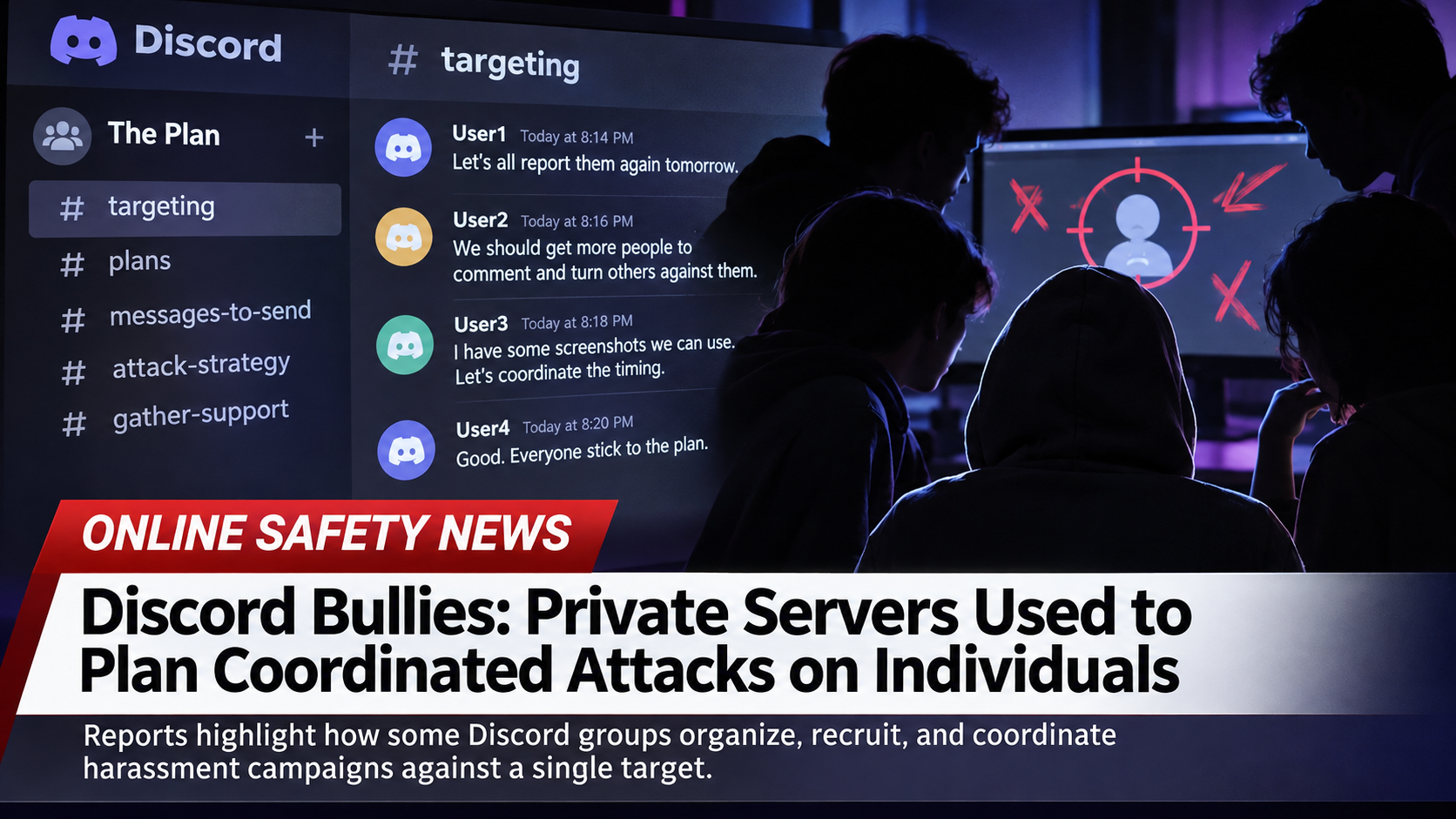
When a Community Becomes a Mob
Discord was built to bring people together. Gamers, content creators, developers, and communities use the platform to communicate, collaborate, and build relationships.
But what happens when a Discord server stops being a place for friendship and becomes a gathering place for people who want to target someone?
What happens when individuals aren't simply expressing disagreement but are discussing how to turn others against a particular person?
There is a difference between having an opinion about someone and organizing a group to go after them.
That distinction matters.
Online bullying is no longer limited to one person making insulting comments. In some cases, harassment becomes coordinated, with multiple individuals participating in campaigns designed to embarrass, discredit, isolate, or intimidate their target.
And private online communities can make that coordination easier.
Behind Closed Doors: The Digital Planning Room
Discord offers private servers, restricted channels, group messages, and voice conversations. These features are useful for legitimate communities, but they can also be misused.
Imagine a group of individuals gathering in a private Discord channel to discuss someone they dislike.
Instead of moving on with their lives, they begin sharing that person's social media posts, discussing their activities, monitoring their content, and encouraging others to participate in confrontations.
One person starts the conversation. Another contributes an accusation. Someone else suggests where to post comments or how to provoke a response.
Eventually, the discussion is no longer about disagreement.
It becomes a coordinated effort to make one person's online life miserable.
Not every private conversation about another person constitutes harassment. The problem arises when discussion turns into organized intimidation, repeated unwanted contact, threats, or deliberate attempts to mobilize others against a target.
The Gang Mentality: Strength in Numbers, Weakness in Accountability
One of the most troubling aspects of coordinated online bullying is how individuals can behave differently when surrounded by a supportive group.
Someone who might never confront another person independently may become aggressive when several others encourage the behavior.
Within these groups, hostility can become a form of social approval.
The louder someone attacks the target, the more attention they may receive from fellow participants.
The result can be an escalating cycle of insults, accusations, ridicule, and harassment.
Ten people repeating the same accusation do not automatically make that accusation true.
Popularity is not evidence. Group agreement is not proof. And having a private Discord channel does not give anyone the authority to conduct a campaign against another human being.
When Disagreement Becomes a Coordinated Attack
Disagreement is a normal part of online communities.
People are free to criticize creators, question decisions, leave communities, and express dissatisfaction.
But coordinated harassment crosses a different line.
Warning signs can include:
- Organizing groups to flood someone's livestream, comments, or social media accounts.
- Encouraging multiple people to confront or repeatedly message the same individual.
- Sharing someone's personal information to expose them to unwanted attention.
- Coordinating false reports or knowingly spreading fabricated allegations.
- Monitoring someone's activities for the purpose of provoking or intimidating them.
- Recruiting additional participants to isolate or punish a person over a personal disagreement.
The defining issue is not whether people dislike someone.
The issue is whether they are organizing actions intended to harass that person.
Criticism challenges ideas and conduct. Harassment targets people through abusive behavior.
The Cowardice of the Private Audience
There is a particular contradiction in groups that publicly promote friendship, respect, positivity, or community unity while privately encouraging hostility toward an individual.
A community cannot credibly claim to stand for unity while tolerating organized harassment within its own membership.
A server administrator who witnesses credible evidence of coordinated abuse faces a choice: address the conduct or allow it to continue.
That does not mean administrators are automatically responsible for every message written by every member.
It means community leadership should take credible harassment complaints seriously rather than dismissing them because the accused individuals are friends, moderators, or influential members.
A community's values are measured by what its leadership permits, not simply by what its welcome message promises.
The Target Doesn't Have to Participate
One of the biggest misconceptions about online harassment is that the targeted individual must respond to every accusation, insult, or provocation.
They do not.
A person has every right to build a website, operate a business, create videos, establish an independent community, or simply exist online without seeking approval from a hostile group.
Nobody owns another person's right to participate in an online community.
Nobody gets exclusive control over an idea such as unity, friendship, collaboration, or community support.
And nobody should have to abandon a legitimate project because a group of individuals dislikes their independence.
You do not need permission from a Discord clique to succeed outside its circle.
Discord Is a Platform, Not a Shield
Private channels do not make harassment acceptable.
A message being hidden from public view does not automatically make its contents harmless.
Discord has policies addressing harassment, threats, and other abusive conduct. Those policies apply to conduct on the platform, including behavior in private communities.
However, allegations of coordinated harassment should be supported by evidence. Screenshots, message histories, timestamps, and direct communications can help establish what actually occurred.
A disagreement, an unpopular opinion, or a private conversation criticizing someone should not automatically be treated as proof of an organized harassment campaign.
The difference lies in the conduct, the coordination, and the evidence.
Community Unity Shouldn't Require an Enemy
Perhaps the greatest irony of coordinated bullying is that the people participating may believe they are defending their community.
But what exactly are they defending when their collective energy is directed toward attacking one individual?
Real communities do not need a common enemy to remain united.
They grow through shared interests, mutual respect, collaboration, and opportunities for their members.
A healthy community welcomes independent thinking.
An unhealthy community may treat independence as betrayal.
And when members are expected to join attacks against outsiders to prove their loyalty, the problem is no longer a disagreement between individuals.
It is a problem with the community's culture.
A Message to Discord Server Owners and Moderators
If your server exists to support gaming, streaming, creativity, or friendship, protect that purpose.
Do not allow private channels to become organizing centers for targeted harassment.
Do not confuse loyalty with unquestioning obedience.
Do not permit personal grudges to become community-wide campaigns.
And do not allow a handful of aggressive personalities to define the reputation of everyone else.
Moderation is not about protecting friends from accountability.
It is about applying reasonable standards consistently, regardless of who is involved.
The Bottom Line: A Private Server Doesn't Make a Public Attack Acceptable
Discord can be an outstanding tool for building communities. Millions of people use online communication platforms for legitimate and productive purposes.
But any communication platform can be misused when people decide that organizing against an individual is more important than the community they originally came together to build.
If a group needs a private planning room, a collection of participants, and a coordinated strategy just to go after one person, perhaps the group should reconsider what it has become.
There is nothing wrong with disagreement.
There is nothing wrong with criticism.
There is nothing wrong with walking away from someone you no longer support.
But organizing people to harass, intimidate, or silence another individual is not community building.
It's bullying with an audience.
A Question for Our Readers
Have you witnessed a Discord server or private online group being used to organize harassment against someone?
Have you seen a gaming community turn against a creator, streamer, or independent community member simply because they refused to follow the crowd?
NewsSpoiler wants to hear about it.
Share your experiences, discuss what responsible community leadership should look like, and help bring attention to the difference between legitimate criticism and coordinated harassment.
Speak up about abusive conduct. Preserve evidence. Report credible threats and harassment through appropriate channels.
Do not publish private information, retaliate, or organize another campaign against the people involved.
Because community unity should mean bringing people together — not gathering a crowd to tear someone down.
NewsSpoiler.com — Independent Perspectives. Uncomfortable Questions. Conversations Worth Having.