
People love to talk about content quality.
Make better videos.
Make better thumbnails.
Write better titles.
Improve your editing.
Improve your storytelling.
And while all of that matters, there is a problem that many creators eventually run into that nobody wants to discuss:
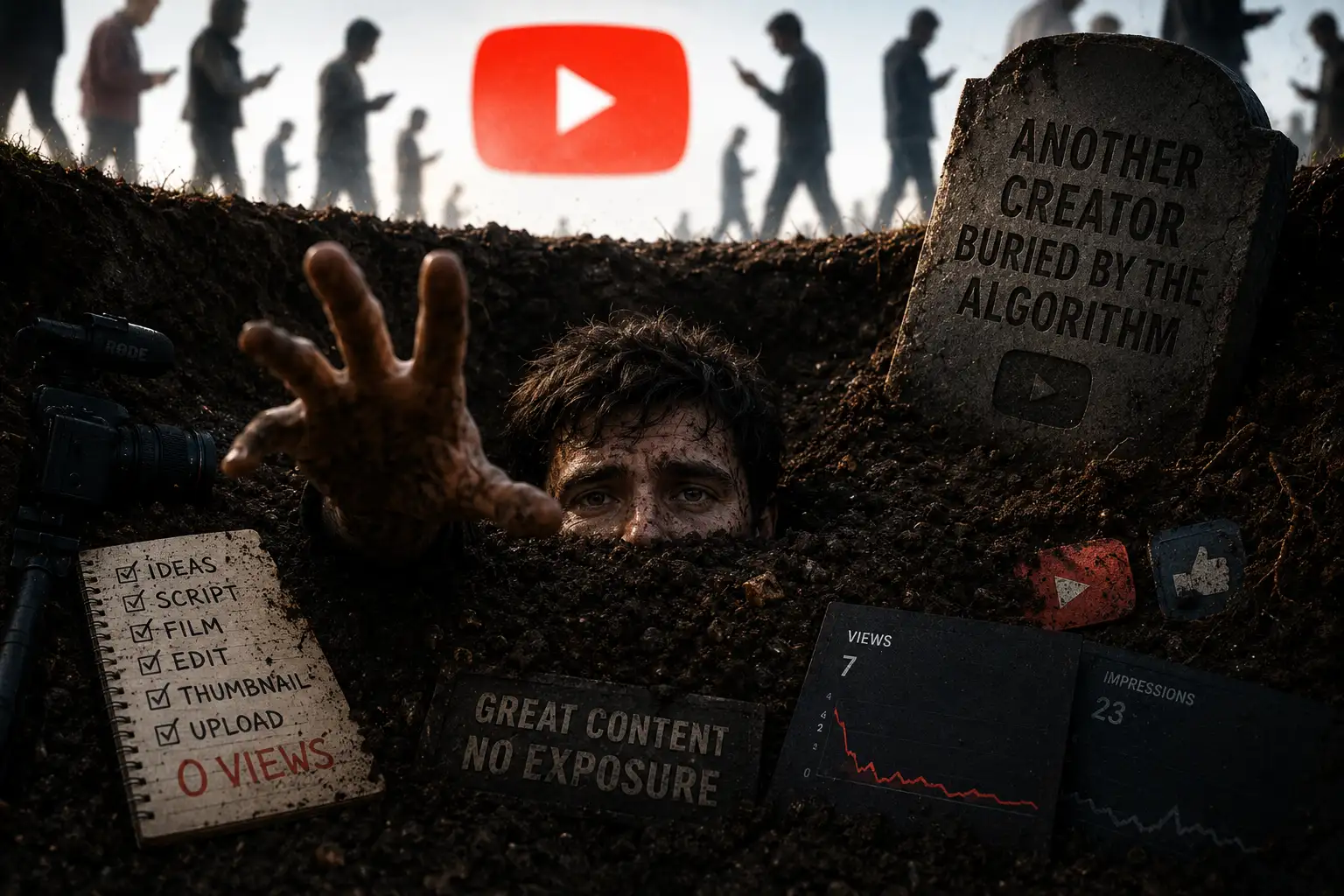
You cannot improve your way out of a system that never gives your content a chance to be seen.
After years of creating content, watching analytics, testing formats, studying audience behavior, and observing platform trends, one thing becomes increasingly clear:
Discovery is becoming more important than quality.
Not because quality stopped mattering.
Because quality only matters after someone actually sees the content.
The Audience Never Got To Vote
One of the biggest misconceptions in modern content creation is that a video's performance is entirely determined by audience interest.
In reality, audiences can only react to content they are shown.
If a video reaches ten people, the audience never had a meaningful opportunity to decide whether it was good.
If a video reaches one hundred thousand people, that is an entirely different situation.
Yet many creators are judged by outcomes without acknowledging the difference in opportunity.
A video that nobody sees is often labeled a failure.
But how can something fail if it never had an audience?
The Shift From Search To Prediction
Years ago, platforms functioned more like libraries.
People searched for what they wanted.
Today, platforms increasingly function like prediction engines.
Instead of asking users what they want, algorithms attempt to predict what users will want before they know it themselves.
That sounds efficient.
Sometimes it is.
But it also creates a massive bottleneck.
A creator is no longer simply competing against other creators.
They are competing against an algorithm's confidence level.
The system must first believe a video deserves exposure before viewers ever have the chance to make that decision themselves.
The Dangerous Feedback Loop
This creates a feedback loop that benefits what is already visible.
Popular content receives more visibility.
More visibility generates more engagement.
More engagement generates more visibility.
Meanwhile, new creators, smaller creators, niche creators, and experimental creators often find themselves fighting uphill before the race even begins.
The result is a system that can accidentally reward predictability while making discovery of unique content increasingly difficult.
That is not a criticism of technology.
It is a consequence of scale.
When billions of videos exist, systems naturally favor certainty.
The problem is that innovation rarely looks certain in the beginning.
The Myth That Every Outcome Is Earned
There is another uncomfortable truth creators eventually learn.
Not every successful video succeeds because it is better.
Not every unsuccessful video fails because it is worse.
Exposure matters.
Timing matters.
Topic selection matters.
Audience availability matters.
And yes, algorithmic decisions matter.
Anyone who has managed content libraries for years has seen it happen.
A video can sit unnoticed for months and suddenly explode after receiving exposure.
The content did not magically become better overnight.
The audience finally found it.
The Real Cost
The biggest casualty of discovery problems is not views.
It is originality.
Creators begin changing their behavior.
They stop experimenting.
They stop taking risks.
They stop creating things they are passionate about.
Instead, they start creating things they believe the system wants.
Over time, this can make platforms feel larger while becoming less diverse.
Everyone begins chasing the same signals because visibility becomes more valuable than creativity.
Discovery Is The New Gatekeeper
The internet was supposed to remove gatekeepers.
In many ways, it did.
Anyone can publish.
Anyone can upload.
Anyone can create.
But being allowed to publish and being discovered are two very different things.
The modern challenge is not access.
It is visibility.
For many creators, the question is no longer:
"Can I make something worth watching?"
The question is:
"Will anyone ever get the chance to see it?"
And that may be the most important creator issue nobody wants to talk about.