
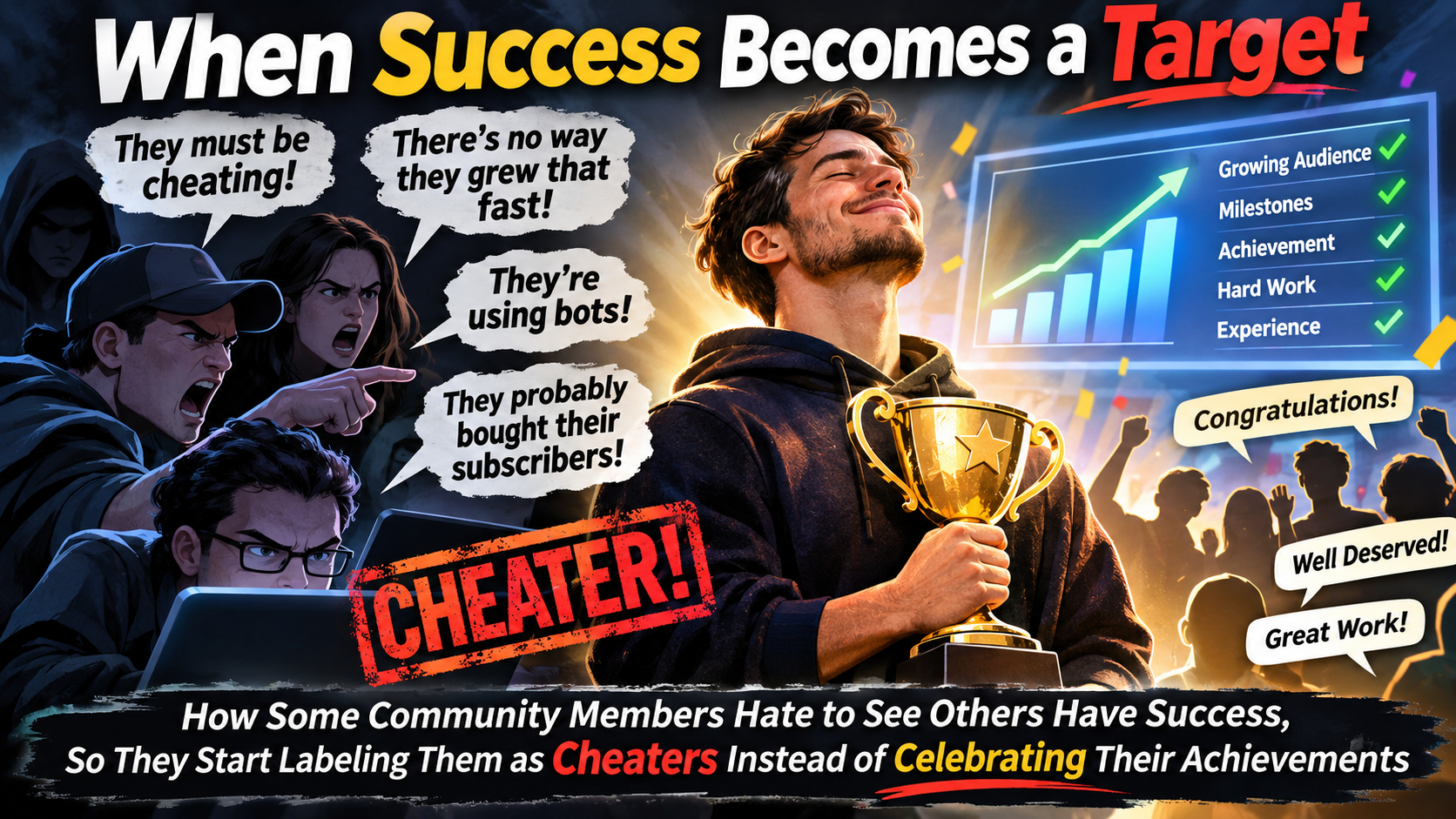
When Someone Else's Success Becomes a Problem
There is an ugly pattern that continues to surface in gaming communities, creator circles, and online social groups.
Someone starts making progress. Their audience grows. Their numbers climb. Their reputation expands. They accomplish something that others have struggled to achieve.
And instead of congratulations, the accusations begin.
"They must be cheating."
"They're buying subscribers."
"They're using bots."
"There's no way they're growing that fast legitimately."
Suddenly, someone's success becomes the subject of suspicion, speculation, and public criticism.
The most troubling part? These accusations are sometimes made without a single piece of credible evidence.
Apparently, for some community members, it is easier to accuse someone of cheating than to accept that another person might be succeeding through determination, experience, and hard work.
Success Doesn't Require Anyone Else's Permission
One of the biggest misconceptions in online communities is that everyone must follow the same path to achieve success.
They don't.
Some creators have years of experience building websites, developing platforms, understanding audiences, producing content, and promoting their work.
Others are just getting started.
Some have established networks, technical knowledge, marketing experience, and infrastructure that newer creators haven't developed yet.
These differences matter.
When an experienced creator grows faster than someone who has only recently entered the industry, that doesn't automatically make their achievements suspicious.
It may simply mean they have spent years developing capabilities that others have yet to acquire.
You cannot judge someone's success by comparing it to the limits of your own experience.
Just because you don't know how someone accomplished something doesn't mean they cheated to get there.
The Dangerous Habit of Labeling People Without Evidence
Calling someone a cheater is not a harmless observation.
It is an accusation that challenges their honesty, credibility, and reputation.
When community members publicly accuse others of buying subscribers, manipulating statistics, using bots, or exploiting systems without evidence, they risk spreading misinformation.
And when those accusations are repeated by other community members, speculation can begin to look like an established fact.
That is how reputations become targets.
There is an important distinction between asking legitimate questions about unusual activity and publicly declaring someone dishonest.
Questions invite explanations.
Accusations demand evidence.
Suspicion is not proof. Personal disbelief is not evidence. And jealousy is not an investigation.
If someone genuinely believes cheating has occurred, they should present verifiable evidence through appropriate channels.
Otherwise, they should stop presenting their assumptions as facts.
Why Can't People Just Celebrate Someone Else's Success?
Consider what a healthier community would look like.
A creator reaches 10,000 subscribers. Others congratulate them.
Someone builds a successful website. Fellow community members recognize the accomplishment.
A player achieves something extraordinary. Other players appreciate the achievement.
A small creator begins growing rapidly. Instead of accusations, experienced members ask what strategies contributed to that growth.
That is how communities become stronger.
Success should create opportunities for learning, collaboration, and inspiration.
Unfortunately, some individuals appear to treat another person's achievement as though it somehow diminishes their own.
It doesn't.
Someone else gaining 20,000 subscribers doesn't take a single subscriber away from you.
Someone building a successful platform doesn't prevent you from building your own.
Someone reaching a milestone before you doesn't mean your opportunity has disappeared.
There is room for more than one person to succeed.
Communities Cannot Preach Unity While Attacking Achievement
This contradiction deserves particular attention.
Many online communities proudly promote words such as unity, respect, support, teamwork, and positivity.
But those words mean very little when community members turn against someone simply because that person is succeeding.
You cannot reasonably claim to support creators while attempting to discredit their accomplishments without evidence.
You cannot promote community growth while discouraging the people who are actually growing.
And you cannot claim to stand for fairness while treating suspicion as sufficient grounds for public accusations.
A community's values are demonstrated by how its members behave, not by the slogans displayed in its descriptions.
If your idea of community support ends the moment someone becomes more successful than you, perhaps you need to reconsider what support actually means.
Experience Is Not Cheating
One factor frequently overlooked in these discussions is experience.
Someone who has spent decades developing technical skills, studying online systems, building businesses, and understanding digital audiences does not start from the same position as a beginner.
Their knowledge compounds.
Their infrastructure expands.
Their previous work creates opportunities for future growth.
A creator who operates an interconnected network of websites, communities, and promotional channels may have substantially more ways to attract an audience than someone relying exclusively on a single social media account.
That is not automatically artificial growth.
That is infrastructure.
That is strategy.
That is the accumulated value of years of work.
The fact that someone else has built something you don't understand does not make their success fraudulent.
Rather than accusing experienced individuals of cheating, communities could benefit from understanding what that experience makes possible.
The Real Damage Comes From the Accusations
False or unsupported allegations can have consequences beyond a heated conversation.
They can damage professional relationships, discourage collaboration, mislead audiences, and create unnecessary conflict.
When accusations spread through group chats, Discord servers, livestreams, and social media discussions, people who have never examined the evidence may repeat them.
This can turn an ordinary achievement into a public controversy.
Community leaders and moderators have a responsibility to distinguish legitimate reports of misconduct from unsupported personal attacks.
Criticism should remain possible. Genuine cheating should be investigated. Verified wrongdoing should not be excused.
But none of that justifies treating every successful person as a suspect.
Your Energy Could Be Going Toward Your Own Success
There is another question worth asking.
How much time do people spend monitoring someone else's subscriber count, criticizing their achievements, or discussing why they supposedly don't deserve their success?
Now imagine putting that same time into creating content, learning new skills, improving a website, building a community, or developing a business.
Success generally requires action.
It requires consistency, experimentation, problem-solving, and the willingness to continue when things don't work the first time.
Watching someone else succeed is not the same as doing the work yourself.
And attempting to diminish their accomplishments does nothing to improve your own.
You don't build yourself up by trying to tear somebody else down.
A Message to Community Members: Learn to Celebrate Success
The next time someone in your community reaches a milestone, consider congratulating them.
If their growth surprises you, ask how they accomplished it.
If they have skills you don't possess, consider learning from them.
If you believe something improper occurred, investigate responsibly and distinguish facts from assumptions.
But don't automatically reach for accusations simply because their achievements exceed your expectations.
A strong community doesn't require everyone to achieve the same results.
It recognizes effort, respects individual accomplishments, and encourages people to continue building.
The success of one member can attract attention, create opportunities, and strengthen the entire community.
That is something worth supporting.
Final Thought: Their Success Is Not Your Failure
Some people spend years building toward something others only notice when it finally becomes successful.
They don't see the countless hours of preparation, the failed experiments, the technical problems, the financial investment, or the persistence required to make progress.
They only see the results.
And sometimes, rather than acknowledging what they don't know, they decide the results must be dishonest.
That mindset benefits nobody.
Someone else's success is not evidence of cheating. Your inability to explain their achievements does not invalidate them. And their progress does not represent your failure.
Communities have a choice.
They can become places where accomplishments are recognized, experience is respected, and success is celebrated.
Or they can become environments where every achievement is met with suspicion and every successful member becomes another target.
The people building something deserve to be judged by their actions and the evidence, not by the resentment or assumptions of spectators.
Because at the end of the day, celebrating another person's success costs you nothing.
But trying to destroy it without evidence says far more about your conduct than it does about their achievements.
NewsSpoiler.com | Independent Commentary | Gaming, Creators & Online Communities